Category Archives: Life in the church

Sermon at Eliana’s Funeral

IMG_0086On Sunday afternoon, we held the service to commend Eliana to God’s care. It was a hard and beautiful time. The church was packed beyond capacity; so many family and friends came to help us sing Eliana across the river: family from all over, friends, neighbors,  members from Faith Lutheran Church where I am the pastor, members from Acacia Park Lutheran Church where Chris is pastor, pastoral colleagues from across the Chicago area, colleagues and partners in our community work. It was a glorious gathering. Todd Carrico, our music director did a fabulous job of leading the song, and did the assembly ever sing! They sang for us when the words were stuck in our throats or held back by tears. 

I don’t usually publish my sermons as part of this blog. Sermons are contextual and best heard in the assembly as they are preached. This one is no exception. However, in some ways, this sermon is a continuation of what I have written in the past few posts I’ve shared here, thoughts about promises and resurrection and what all that could mean as we grieve Eliana’s death, a life too short and in which there was too much pain. 

The sermon was based on the lessons Chris and Liz chose for the service: Isaiah 43:1-3a, 4-7, 18-19, Psalm 139:1-17, Romans 8:26-27, and John 4:1-15. Often in the sermon, I use what in the printed word seems to be an ambiguous “you.” In most cases, I’m addressing Eliana’s parents, Chris and Liz Honig.

Eliana Frances Honig. Eliana. God hears. What a beautiful name for a beautiful little girl. Eliana’s world was pretty small and pretty limited. Nearly her entire life was spent in the confines of a small room on the Neo-Natal Intensive Care Unit of Lurie Children’s Hospital in downtown Chicago. Yet, she was Eliana. There is both joy and a deep sense of sadness today. Only in her death do you get to introduce her to the world. When you penned her obituary, you told us about a beautiful, brave little girl who was a fighter, who sparred with her nurses and had her own unique way of curling up her feet and touching her bandaged hand to her cheek, who in spite of her near constant pain tried to soothe herself, and was responsive to the gentle sound of your voice and touch, even when there were so few places you could touch her.  I think she must have been the most well-read 8 week old on the planet.

What you have described is Eliana, a girl with her own personality in spite of her EB, a unique human being who was not defined by her disease. God created Eliana. God created her in God’s image. From the very beginning God knew her and God loved her. While her skin disorder made her life difficult and painful, she was formed wonderfully, and you, her parents, were able to see how extraordinarily she was knit together, how remarkable and complex she was. She was, in spite of her disease, in spite of her short life, a precious human life with consciousness and will and the ability to connect with those few people who were able to come to know her.

And she was loved. Oh, was she loved. She was loved by mama and papa, Grampa Frank and and Gramma Luann, Grampa Jim and Gramma Sheryl, Aunt Shannon, Uncle Tim and Aunt Stacey, nurses Kate and Ursula and Sara and Stephanie, Dr. Henna, Dr. Mancini, Dr. Chamlin. Oh, that child was loved. And not because she was any of those amazing things that appear in her obituary. She was loved because of her life. Your love for Eliana allowed you to see those amazing things in her. The mutual love of child to parent and back again brought joy to you and to everyone who got to know Eliana.

That joy is muted today because the sad truth is we are not intended to bury our babies. I have no words to make sense of why we have to do that. For all of my faith and all of my theology, I have never been able to put together a cogent explanation for the kind of suffering that Eliana experienced, and the suffering of parents who lose their children.

At first glance, the gospel lesson has little to say to those who are grieving the death of a child. Jesus is enjoying a little verbal sparring with a woman from the wrong side of the tracks. They happen to be at the old well of Jacob in the middle of the day. Neither Jesus nor the Samaritan woman should be talking to each other. Yet the conversation goes on and in response to the woman’s questions and yearnings, Jesus talks about water and thirst and the possibility of never being thirsty again and about how one’s deep thirst can be slaked by a water that brings eternal life.

On April 7, on the morning before she went to surgery to have a feeding tube inserted, Eliana was baptized into Christ’s death and resurrection. Though it wasn’t an abundance of water, it was water with the Word that brought to your precious daughter the gushing springs of life. It wasn’t exactly the baptism that you had imagined. It was not at church, and beautiful Eliana traded a lacy white baptismal dress for Aqua-phor soaked dressings that wrapped her wounds. Still, in the application of water of from a tiny plastic vial along with the words of the gospel, it was living water; it was water that gave her springs of life with God.

When we mention this promise of eternal life, though, I hope we won’t immediately and automatically fall into the pious platitudes that offer little help when our grief is so raw. “Well, she’s in a better place,” some are quick to say.  I say that being held in her parents arms would be a fine place. There is truth in the promise of eternal life. We don’t have to speak of Eliana as if she has disappeared, disintegrated into nothing. She lives, having passed through the gateway of death into life in God’s nearer presence. God has welcomed her with the loving arms of one who says, “Fear not, precious little girl. I have called you, Eliana, and you are mine.” The pain that was so much a part of her life her on this side of the river is over. She has been made whole. Her baptismal promises she has received in all their fullness.

Those promises, true though they may be, seem small consolation in the face of Eliana’s death. Her death came way too soon and it leaves us feeling empty and cheated. I’m not ready to hear words that tie it all together in a nice clean bow so that now we are expected to make sense of it all and move on.

So many people were praying for a miracle. Frankly, I would have settled for less than a miracle. I would have settled for a little luck and a little time.  Those gifts were not given. And I can’t for the life of me imagine why. If asking God for healing is something we are allowed to do, then why are some prayers answered and others not? Another theological conundrum for which I have no answer.

Is that why you chose the passage from Romans? Because words for prayers have run dry after the one thing you so desperately prayed for has been denied?

The Spirit will hold you up. The Spirit will gather your sighs and your cries, your bone-deep sobs and your anger and the sadness and take them to God and God will hold them in God’s heart, loving you in the midst of what is inexplicable. The promise that the Spirit will hold you is nearly identical to the strong and gentle words of the prophet: “when you pass through the waters, I will be with you; and through the rivers, they shall not overwhelm you; when you walk through fire you shall not be burned, and the flame shall not consume you.”

Somehow God was with Eliana through her ordeal and she has had her homecoming. Somehow God is with you in the midst of facing her loss. And here’s what gives those promises their teeth, what makes them more than nice, empty words.  When God chose to come among us in Christ, God risked becoming vulnerable to all that this broken and fallen word might have to offer. In the last days of his life, Jesus experienced the worst that a broken and fallen world could throw at him: abuse, and beating and mockery and finally a cruel, torturous death. There is no place we can go where God has not already been; there is no horror we can experience that God has not already endured. In Eliana’s cries of pain, God was not distant but by her side. In your grief and sorrow, God has not abandoned you, but is in fact carrying you. When you pass through such unspeakable loss, God says, I will be with you, I will carry you.

Look around you Chris and Liz. Look around you at the community that has carried you and promises to carry you into the future. When you can’t believe, they will believe for you; when you can’t pray, they will pray for you. When you don’t feel like taking even one step, they will be here to walk with you. The loving arms of God hold you fast through the people of Acacia Park Lutheran Church, Faith Lutheran Church, your family, your friends and all the others gathered here today. We are holding you today.

In a few moments, you will be invited to this table to receive the fruit of Jesus’ death and resurrection. We will sing. With saints and angels we will sing. We sing because that’s what we do when there is nothing else that we can do. For a brief moment, the curtain that separates us from those who have already crossed over is opened and we join the saints and angels in their song. Eliana is singing that song, and we sing with her. She is enjoying that feast of victory at the banquet table of the Lamb. When we receive our morsel of bread and taste of wine, we join her at table, she eating the feast of victory, and we a meal in which God promises to sustain us for the journey that for us is not yet over. In the bread and wine comes the promise one more time: when you pass through the waters, I will be with you.

Because Resurrection Is More Than a Metaphor

resurrection.jpgYesterday I posted this on my Facebook page: it seems to me that the challenge of preaching on Easter is to preach resurrection as something that God really did and still does without turning it into a metaphor for stuff that was going to happen anyway, with or without Christ’s resurrection.

Too often, I think I’ve missed the point in my Easter preaching. In 25 years of Easter preaching, I think I’ve preached a few of those Easter sermons where I talk about our own experience of resurrection.  Someone experiences a reconciliation in a relationship; it feels like a resurrection. Someone is told that they’re cancer-free; it feels like a resurrection. One year, we had come out of a pretty serous congregational conflict; Easter that year felt like resurrection, and I’m betting that’s what I preached. In those cases, I was using resurrection as a metaphor. In a sense, they were resurrections.  A metaphorical sense. I’m not denying God’s presence in those experiences, and I’m not even going to deny that God might have had something to do with them, though I’m less certain about that. Regardless, they aren’t the point of Christ’s resurrection. Those things would have happened whether Christ rose from the dead or not. And if Christ’s resurrection is the game-changer that the New Testament tells us it is, then it has be be more than a metaphor for the places in our lives where we experience rebirth.

In that great chapter that interprets the resurrection (1 Corinthians 15), Paul begins by simply stating that the resurrection happened, that it’s an historical fact. He doesn’t begin by explaining it, but by proclaiming it. He then goes on to say that Christ’s resurrection from the dead means that there will be a general resurrection from the dead; Christ is the first in a long line of those who will rise from the dead. But even that isn’t what Paul is getting at, I don’t think. It’s an aside; not unimportant, but not the point.

What lies closer to the center of what Paul is getting at is embedded in these words:  Then comes the end, when he hands over the kingdom to God the Father, after he has destroyed every ruler and every authority and power. For he must reign until he has put all his enemies under his feet. The last enemy to be destroyed is death. (1 Corinthians 15:24-27)

God’s work is on a trajectory. The kingdom is coming. The work is happening. God is working to foil the powers of evil and sin, to bind the powers, to lay low the authorities. Christ’s resurrection was the decisive turning point in the work of bringing all things to their fullness, to that restoration that God promises, the endgame to which all things are moving.

To do that God has made a people. That’s not our usual language to take about the fruit of Jesus’ death and resurrection. We’re much more likely to talk about personal salvation, of the implications of Christ’s resurrection for me personally. But I don’t think Christ’s work has ever been about personal salvation. It’s been about calling and creating a people.  It’s been about a body, a qahal, an ecclesia. It’s been about  forming a royal priesthood and a holy nation (not to be confused, fellow Americans, with a nation-state).

So, the connection of Christ’s resurrection to our own baptism is not that we have now been saved, it’s that we have now been joined to a body through whom God is working to bring redemption, healing, and reconciliation to all creation.

Here’s why I think it’s important. There’s enough bad stuff going on out there to make any reasonable person give up on resurrection and just let it be a metaphor for nice stuff that happens regardless of whether or not the tomb was empty on that first Easter morning. Truth is, I don’t guess that there is any more wrong with the world than there usually is when Eastertide rolls around. But it seems like it to me. I’ll own that. The bombings in Brussels aren’t anything new. But they are fresh and raw. This crazy circus that we call a presidential campaign has moved from the sublime to the ridiculous to the downright scary. My heart aches at the way we polarize and demonize each other and perpetuate structures of oppression. These are the front lines of the rulers and authorities and powers.

Most personally, for the last month our family has been trying to support each other and find light in our own darkness. Five weeks ago, our grandaughter, Eliana Frances was born; she’s a precious, beautiful little girl. Eliana was born with an extremely rare skin disorder, epidermolysis bullosa, and has been in the neonatal intensive care unit since her birth. EB is a very nasty disorder in which baby Eliana’s skin is deficient in the proteins that allow the layers of skin to adhere to one another. The doctors and nurses work tirelessly to manage her severe pain.

The resurrection of Jesus is not immediately going to change any of that stuff. The presidential campaign is what it’s going to be. Turning around the structures of oppression will take generations. ISIS isn’t going away and there will be more loss of life in terrorist incidents. And the resurrection of Jesus isn’t going to cure Eliana.

So, what does it mean? I think it means that in the midst of all the shit, in the damn middle of all the obvious signs of sin and brokenness and darkness and evil, God is at work. If the resurrection of Jesus was a game-changer, then I have to believe that in the same way that God was at work in Jesus’ death, so God is at work in the midst of the contrary bringing life in the midst of death. It’s a bit of a misnomer to say that death has been defeated; there’s too much of it hanging around to believe that. Paul reminds us that one day it will.

Here’s where we get at what I think is the heart of the game-changing action of God in Jesus’ resurrection. If God is at work in the middle of it all, then the body of Christ must be the incarnation of that work, a body called to live differently.  We are called, reborn, and empowered to be a people who live as if that defeat has already taken place. The powers and authorities are at work: anger, rage, oppression, vengeance, retaliation, fear. Those are the ways of death and they eat away at the human soul. They are the ways of death that God intended to put to rest in Christ’s resurrection. In it’s place a people was created who love without condition, who serve without counting the cost, who honor every human life as a brother or sister made in the image of God.

A people who have been raised from the dead. Not metaphorically. Literally.

A Modern Pentecost

imageAt least once a year when I have to preach on the great story of Pentecost, I sit at my desk wondering what that must have sounded like. The story in the Christian scriptures tells how the followers of Jesus were stuck indoors waiting for instructions about what to do next after Jesus had returned to the Father. The writer of Luke-Acts describes the sound of a rushing wind enveloping the room. Later in the day, those same Jesus-followers took it to the streets and there began telling the story of Jesus to the visitors who had made pilgrimage to Jerusalem. I try to imagine the buzz on those Jerusalem byways as people from all over the world heard the proclamation in their own languages.

I caught a glimpse of the Pentecost phenomena on Sunday afternoon at the “Know Your Muslim Neighbor” Solidarity Event on Sunday afternoon. The event was sponsored by DuPage United, our local Industrial Areas Foundation community organizing affiliate. 850 people showed up. Yeah, I know. Amazing, right?

The numbers were impressive. But it’s not the raw number that is the important thing here. It’s what the numbers stand for and what happened. That many people showed up on a Sunday afternoon when they didn’t really know what was going to happen. What is a “Solidarity Event” anyway?

I have a hunch why our Muslim neighbors showed up. There is some measure of fear in the Muslim community. And with good reason. Too much of the hate-filled rhetoric coming from public figures is directed at them. They hear the language and see they the footage on television. Two days before our event, three Muslim teenagers were shot execution-style in Fort Wayne, Indiana. More importantly, they experience it in their daily life. One woman told a story of making phone calls for the PTA at her child’s school. The mom on the other end of the line asked her where she came from – she was born in America, by the way – and then proceeded to tell her that she didn’t belong here; she should go home. A Pew research poll a few years ago indicated that nearly 60% of Americans believe that Islam and American values are at odds. Yet 60% also admit to never having met a Muslim. My experience – at the event on Sunday also demonstrated – is that Muslims are eager to make connections and to dispel the stereotypes. The best way I can think of to do that is one person at a time.

But why would the Christians and Jews show up? I’m not exactly sure. But when I have talked with a few members of my congregation, they came because they don’t like what they see. The division and rancor in the national conversation disturbs tem. They don’t know what to do but they want to do something. So they showed up. And without exception, they have reported what a meaningful experience it was.

This event was designed and planned for the primary purpose of making connections across the communities, communities diverse in religion and culture, but communities that share so much in common.  We believed that if we could get people into the same room talking to each other, we could begin to dispel the stereotypes. We also wanted to make a public statement – directed especially at public officials and the media – that we will not tolerate hate-filled, prejudice-laced rhetoric.

The program wasn’t fancy. There were some introductory remarks, and a series of three speakers, each of whom spoke for 5 minutes. But the speakers weren’t the central focus. Between each of the speeches, the participants were invited to turn to their neighbor and hold conversation on a particular question. They questions were not particularly deep; they were not controversial. They were simply doorways into a one on one, human contact that is the fundamental building block of human society. Judging by the response of the folks on Sunday afternoon, it’s something that people are craving, even though the contact happened to be with perfect strangers.

In the last few days, I keep hearing powerful testimony of what happened in the conversations. Muslims told their stories of experiencing harassment and prejudice; non-Muslims learned and sometimes were shocked to hear that in this country where we supposedly honor the value of religious freedom, our fellow citizens do not feel free to practice their religion. A clergy colleague wrote me that she and a young Muslim woman sitting next to her realized at one point that they were both crying. The tears were partly sadness at the way things are, but they were also tears of hope at what might be, hope embodied by 850 people sitting together making conversation.

When small seemingly insignificant conversations become powerful moments for people, it says something. It’s worth noticing. It’s work that is fundamental to repairing the fabric of our society. We have a fundamental need to get beyond the isolation and division. We need a vision of what e pluribus unum might look like in the 21st century. That vision will not be enacted by politicians passing legislation; it won’t be happen by activists marching in public places. It will happen as we engage the long, slow, sometimes difficult, and ultimately rewarding and healing work of relating person to person, congregation to congregation. It will happen as we build those relationships, build our power, and then begin to take action.

In both the ancient Hebrew and ancient Greek language, the words nephesh and pneuma can be translated variously: Spirit, wind, breath. Gathering in that room on Sunday afternoon, as folks used their breath to engage in conversation, it sounded like the rush of a mighty wind. And I’m convinced it was the voice of the Spirit.

Which Story Will We Tell?

groundbreaking
The stories we tell have a powerful influence in determining the life that we will lead. In our national life, we need a different story.

Every morning when I get up I get to determine which story will guide my day. Some days I am all too aware of my deficiencies.

  • I’m not very organized.
  • I live in my head.
  • It’s easy for me to procrastinate.

Some day’s it’s hard not to let that be the story.

I also recognize that for all my deficiencies, I also have gifts and I get to do my work in an amazing congregation with amazing people who invite me into the celebrations and the sorrows of their lives. I get to be part of God’s big work of bringing hope and life to a hurting world. That’s pretty cool. I want that to be the story that guides my day.


With respect to so many important matters in our national life together, we the people get to decide which story we’re going to tell.

There’s a story being told by the candidates for arguably the most powerful office in the world. They’re telling what is apparently a compelling story.

  • We should be afraid of people that aren’t like us.
  • Religions other than Christianity are dangerous.
  • By virtue of US power and exceptionalism, we have the right to impose our values and inflict violence on people around the world.
  • People who want to provide a life for their families have no right to leave war-torn places or places which offer them no opportunity for work to support their families and come to this land of opportunity.  (Even when, arguably, our own military and economic policies have contributed to the circumstances which have led to their insecurity. I digress.)
  • We have no obligation to our neighbor; I only need to care about myself and my tribe.
  • What makes us different and divides us is much more significant that what makes us similar and unites us.

While it may be a compelling story, it’s also a story that goes against everything I believe about God, about the human family, and about our life together. So, I am determined to tell a different story.

This Sunday, I’m going to be part of a gathering of Muslims and Christians that is sponsored by DuPage United, an organization of organizations committed to developing partnerships and taking action to improve our communities. Just before Christmas, a few of us came together believing that the story that is getting told is not the story we want to live. A little over a month ago, we set the ambitious goal of an event that would include 500 people, roughly equal numbers of Muslims and non-Muslims, to gather for conversation and relational work. Who would have believed that 4 days before the event, we have nearly 700 signed up, and we expect those numbers to continue to grow until we gather on Sunday afternoon? The majority of time will be spent one on one, neighbor with neighbor, getting to know one another; in doing so, we will begin to repair the torn fabric of our communities. We intend this event to be the opening of a long campaign of solidarity and partnership.

We are getting together because we want to be guided by a different story.

  • Our differences are not be be feared, but embraced.
  • We need each other and we can learn from each other.
  • Our neighbors are not strangers to be despised; they are fellow human beings to be loved and served.
  • We are all called to work together to enact God’s vision of a world redeemed and reconciled.

From what I can tell, it’s going to be a pretty good story.

I’ll come back next week and let you know how things went.

On Being Afraid to Open My Scriptures in a Coffee Shop

bibleI had a morning meeting in Hyde Park. It’s about 25 miles from where I live and takes me through the heart of downtown Chicago. At best it’s a 45 minute drive; at worst, it can take more than an hour and a half. I hate sitting in traffic. My solution? Get up when the humans are still asleep and get on the road. Early. Upon arrival, sit in a coffee shop and get some work done until it’s time for the meeting.

It took 45 minutes. Perfect. Found that coffee shop, did my journaling and then turned to one of my lenten commitments: to read through the gospels in these 40 days. I sat there in that public place at a small table next to the counter with my little pocket bible open, reading Matthew 13 and 14.

Where I live, that’s a common thing. On those days when my morning meeting schedule takes me into Panera or Starbucks or Blackberry Market or River City Roasters, I can virtually guarantee that someone will be sitting there with a bible open. Just as often there’s a group (usually it’s men) having their small group/accountability group/prayer meeting right there in that public place. In fact, I remember some of those books I had to read for evangelism class in the seminary encouraging that very tactic as an opportunity to witness to the faith. Someone will stop and ask what you are doing and you can tell them about Jesus. It’s ubiquitous. It’s expected. So, afraid to open my scriptures in a coffee shop?  Never.

On Monday evening, I sat with a group of Muslims and Christians. This came up in the conversation:  my friend and colleague said in passing that she’s “afraid to open my Koran in a public place, much less pray.” A public place like a coffee shop. Or restaurant. Or library. Afraid of harassment, or worse, of physical abuse.

And I cried inside. A simple thing that is so common for Christians is something that our Muslim neighbors are afraid to do.

This xenophobic climate being fanned by public figures is not theoretical. It’s not empty rhetoric. Words matter. These are real people. And they are our neighbors. Fellow Americans. Fellow citizens.

Silence is complicity.

Spotlight: A Cautionary Tale

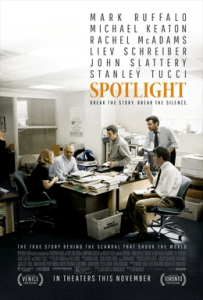
spotlight.jpgIt’s probably too late to tell you to run right out and see Spotlight.  If you can still find it in the theater, go.  It’s good.

A few months ago, a guy came out of church and almost grabbed my by the lapels. “Have you seen Spotlight?”  I didn’t even know what Spotlight was. He must have discerned the puzzled look on my face. “That movie. It’s about the priest abuse scandal in Boston. I just don’t know what to do with it. I have no words. You have to see it.” Here’s a together guy who is at the sunset of a quite successful career in the financial services industry and he’s standing at the back of the sanctuary with tears welling up in his eyes telling me I have to see some movie.

I’m not much of a movie guy, but when a movie has that kind of endorsement, I probably need to see it. He was right. It’s a powerful story, well done.

The new managing editor of the Boston Globe encourages the Globe’s investigative team (Spotlight) to pursue a report about Roman Catholic priest who had allegedly molested children and who had been moved around from place to place. As they begin investigating that incident, they uncovered other similar incidents. Before long, the team discovers that the problem involves nearly a hundred priests and that Cardinal Law knew about them. Rather than removing the offending priests from office, the hierarchy tried to rehabilitate them and return them to service, where they repeatedly molested more children.

There is plenty in the movie to be disturbed about. Most directly, the revelation that hundreds and hundreds of children were sexually abused by members of the clergy is abhorrent. That the hierarchy knew about it and by their actions (or lack thereof) perpetuated the abuse adds unspeakable outrage.

Beyond the obvious, though, one of the themes that struck a chord with me was how complicit the various civil institutions were to the abuse. Everyone knew how deeply embedded the church was in all aspects of life in Boston and so seemed to give the church the benefit of the doubt.

I was serving as a pastor in Naples, Florida at the time that the story broke. I remember a potluck conversation with a group of parishioners; somehow the  abuse story became a topic of conversation. Someone mentioned their surprise and shock that Cardinal Law had known about the abuse and tried to keep it secret. One of the guys sitting at the table had been the CEO of a large corporation headquartered in Boston; he ran in those stratospheric social circles of the Boston elite; Cardinal Law had been a friend. His take was that Cardinal Law could not have known about the abuse. “Remember what good work the church does in Boston. Beside, the Globe is just stirring things up and trying to sell papers.”

The movie reveals how consistently the various institutions that were supposed to hold other institutions accountable turned a blind eye:  law enforcement, the criminal justice system, the corporate world; even the Globe itself ignored the story for years. Everyone seemed to know, yet no one did anything. In what for me was one of the most memorable scenes in the movie, the Spotlight editor confesses that years earlier he was sent a list of twenty pedophile priests. He wrote a story that got buried in the paper and he never followed up.

While it’s easy to point the finger at the Catholic Church for the priest abuse scandal — and there is plenty of blame to go around — it’s a cautionary tale for all of us; the accusing finger ought first to be directed inward. The movie illustrates how easy it is to ignore the truth when we’re afraid of what the truth might really be. Especially when people and institutions that we love and respect are implicated, it’s easy to excuse a “few little problems here and there” because of the good work that’s getting done. We have a hundred rationalizations: there must be more to the story; it can’t be the way be as it looks; better not to rock the boat.  The human mind is a wonderful and sometimes terrible thing.

How important it becomes community and institutional leaders to build institutions of accountability and communities where hard conversations can take place. How important it is to cultivate those practices so that when the really hard stuff comes along, we’ve done it before and we know how to do it again, even when it’s really hard. And how important it becomes for societies mediating institutions (like congregations) to be deeply embedded in their communities in such a way that rather than turning the blind eye of complicity, they can hold government, market and even other religious institutions accountable.

Spotlight was a hard movie to watch, but it’s one that I hope I don’t quickly forget.

How Do You View the Heart of God?

feltbrokenheart.jpgIt sounds like a theoretical, obtuse question. But I don’t think it is. How we answer that question impacts how we view the world and our place in it. Different answers to that question getting played out in concrete situations with real people.

For example:

  • Wheaton College has moved to terminate a tenured professor of political science because she publicly expressed agreement with Pope Francis’s statement that Christians and Muslims worship the same God.
  • The Anglican Communion has suspended the Episcopal Church in America for resolution to change language that defines marriage as between a man and a woman.
  • The international refugee crisis is fostering vigorous disagreement about whether we should welcome Syrian Muslims as refugees
  • Disagreement within the Christian community over the use of handguns.

I continue to marvel over how sharply divided people of the same faith can be. I wrote about this a few months ago with reference to the Kentucky county clerk who refused to issue marriage licenses to gay couples. Now, it’s the issue of gun safety that has me thinking about it again.

A friend posted a few sentences critical of President Obama’s recent executive orders about gun safety; when I read some of the discussion that followed, I ran across this: . . .the entire point of Christianity is that the human race is overwhelmingly corrupt and evil. . .

This gets at the crux of the divide. How do you view the heart of God? And consequently, how do you view the world and your own place in the world?

I view the world as full of good. It’s not a place to be feared, but to be embraced. God’s creative dynamism fashioned a world full of beauty, full of goodness, and full of people whom God has created in God’s image. Sure, there is plenty that is wrong, and my heart often aches over it. War, violence, brutality, starvation, suffering — all of that is real. And none of that is God’s intention. God is at work bringing healing and restoration; God is working through God’s people to bring things to that fulfillment. And I want to do everything I can to push violence and suffering and death to the edges of our life together with the hope and expectation that they will eventually fall off the cliff. It’s our job as the Body of Christ to get out of the churches and into the world to be a part of God’s big work of reconciliation, redemption, and peace.

And there are brothers and sisters who see the world as a “corrupt and evil” place. There is much to fear. God’s big work in the world is to judge the people and the forces that are evil. All this evil will continue to accumulate until God finally gets fed up with it and destroys the whole thing. Then all the good people will be taken to that paradise in the sky. It’s the work of the church to deliver the profligates from their hellbent eternal destiny and the church has to take a defensive and righteous posture over against the world in order to remain free of it’s corrupting influence.

Admittedly, I’ve polarized here to illustrate a point.  Have I oversimplified it too much?  What do you think?

The Parable of the Assistant Manager in the Grocery Store


grocerystoreparable.jpgThere was once a woman wearing a hijab who was doing her weekly grocery shopping at her usual grocery store near her home. As she headed down the detergent aisle, a couple of middle-age white men made angry comments about her religion and ended with an obscenity to describe the woman and others of her religion. The woman went to the customer service counter and said, “I’m not done shopping,” she told him, “but I don’t feel safe here.”  The assistant manager told her he would protect her. For the next half-hour, he walked alongside her pretending to check inventory as she did the rest of her shopping. When asked about his actions, he said, “I was just doing my job.”  (Read the whole story by New York Times religion writer, Samuel G. Freedman.)

A few reflections:

1. In these times, we are told to be vigilant for things that are out of the ordinary. If you see someone suspicious, call the authorities. When we’re cautioned so often to look for the suspicious, does every stranger begin to look suspicious?

2. Maybe we should be more vigilant for someone who needs a helping hand or a gesture of kindness. Maybe we should be more vigilant for instances of hatred and discrimination and when we see them, call them out. We could use more expressions of our common humanity.

3.  I don’t know what it’s like to walk into a grocery store and be harassed. Worse, I never even have to think about it. I don’t have to worry about the management following me around on the assumption that I’m a criminal. I don’t have to worry about hate speech directed towards me because of my religion. I don’t have to wonder what kind of ogling I might be subject to. I never give a thought to my safety when grocery shopping. The very structures of our society are programmed to make me feel safe. Mostly I don’t even see it. That’s privilege.

4. I love the assistant manager’s words when asked why he did it. “I was just doing my job.” He didn’t ask permission or look for adulation. He was just being neighborly. Showing basic kindness and compassion. And he didn’t, apparently, think about it. Jesus once asked his disciples why they were looking for reward for following him. They were, he said, just doing what they were supposed to.  “I was just doing my job.”

In my Christian belief system, God has called me into the circle of God’s love and transformed me. God has made me part of a community that is to be good news for the world. Being good news for the world is not so much about having the right answers, but about being God’s loving presence. To be God’s loving presence is not that complicated. It may be hard, it may take patience, it requires persistence, it is undoubtedly counter cultural. But at it’s heart, it’s not that complicated. Exercise kindness; be neighborly; assume a shared common humanity in the midst of the differences.

That assistant manager? His name is Mark Egan. If God is at work bringing the peaceable kingdom — and I believe God is — Mr. Egan has given us a glimpse of what that might look like.

Today, I Stand with My Muslim Neighbors

groundbreakingToday, I stand with my Muslim neighbors. As a pastoral leader in the Christian tradition and of a Christian congregation, as a leader in my community, I speak out publicly that I stand with my Muslim neighbors and colleagues.

Over the weekend, I’ve seen and read too many stories of Muslims being persecuted, being frightened to go out for fear of harassment, and of church and civic leaders making discriminatory statements about all Muslims on the basis of the horrible actions of radicalized people.

I should note as an aside, that though the perpetrator in the Charleston Mother Emmanuel Church shootings last June was a member of an ELCA Lutheran Church (the denomination in which I serve as a pastor) never once was I called on to defend my faith over against that killing or to distance myself from the shooter. It grieves me to know that my Muslim neighbors are now called on to do that thing they should not have to do.

Over the past 10 years in our broad-based community organizing work (DuPage United) here in DuPage County, Illinois, Muslim mosques and associations and people associated with those institutions have been valued colleagues and partners in our work. I have gotten to know many of my Muslim neighbors; they are people of peace who are concerned with justice and who are loyal fellow citizens of the United States.

We have worked together on concrete issues that matter to our community: government accountability, workforce development, mental health, accountability in our local community college administration, and affordable housing, to name a few.

On several occasions, a Muslim brother or sister has spoken in our congregation, either in worship or in our adult faith formation. They have participated reverently and appropriately in our worship, demonstrating a respectful curiosity for what we believe and how we practice our faith. When they spoke to our adult group, my colleague Ahmed did not avoid the difficult questions some of our folks asked about the treatment of women in Islam, the notion of jihad, and questions about Islam as a religion of peace.

In 2005 when Hurricane Katrina devastated the Gulf Coast, we launched a project to fill a semi-truck trailer with food and other supplies needed by those displaced because of the hurricane. While we received a consistent trickle of support from local Christian congregations, it was the Muslim girls’ school in Lombard who appeared one afternoon with a rented van and a couple of minivans filled to the brim with supplies they had collected from their institutions.

In late 2011 and early 2012, MECCA, an association of Muslims, purchased land and made plans to build a mosque and community center in the southwest corner of our county. In response, the County Planning and Zoning Commission began proposing a number of restrictions that would have prevented the construction from going forward. Several Christian congregations — partners in DuPage United — appeared before county meetings on behalf of MECCA. In the end, the restrictions were not enacted, permits were granted, and construction was able to begin. As a sign of their gratitude, they asked me to be the speaker for their groundbreaking ceremonies. It would have made so much sense to ask one of their own to speak and for me to attend as an honored guest.  Yet, they asked me to speak. That was an extraordinarily generous gesture.

I could go on with story after story of my own life and ministry being enriched by the gift and blessing of being able to work together with Muslim partners. The relationships I have formed have been meaningful and mutual. I am a better person and pastor for having had the opportunity to work with them.

I am saddened, disappointed, and angry that these fellow American citizens are experiencing persecution because of misunderstanding of Islam and the fear of the other. I cannot control what others do or say. But I can make sure that my voice of support, admiration, and respect is heard in the public square.

Today — and every day — I stand with my Muslim brothers and sisters.

Perfectionism and the Topsy-Turvy Gospel

perfect familyLet me introduce you to Glen and Glenda from Glen Ellyn:  They are good people. No, I mean it. Glen supervises the regional marketing team for that company that everyone knows and has steadily and consistently been promoted. Glenda is a CPA and works for a small accounting firm doing small business taxes. Their kids are wonderful! Gary plays soccer and baseball, and is now taking trumpet lessons. Gertie has just started field hockey and loves her ballet lessons. They are both in scouts and the children’s choir at church. Glen helps coach soccer and baseball, and is the chair of the Worship Team at church. Glen and Glenda think it’s important to help the less fortunate, so they volunteer at PADS once a month and they have decided this year to help organize the fifth grade classes to do a food drive for the Glen Ellyn Food Pantry.

You would love their house. Glenda has decorated the living room spectacularly; it looks like the cover of a magazine. And not to be outdone by the neighbors, Glen has manicured his lawn to Wrigley Field specifications. It looks perfect. Every Friday afternoon he even cuts the front yard twice so that it has that crosshatched look to it. Not a weed is to be found in that lawn.

These are good people. They are model citizens. They are the kind of people, we might say, that if there were more of them, the world would be a better place.

These good people are tired. They are stressed. They complain about having no time, of being pulled in a thousand directions; they feel consumed and overwhelmed by the pressures around them. They are living, but it’s not much of a life. How can they be doing so much and feel so empty?

We are socially conditioned to be good people. In fact, I think we are socially conditioned to be perfect people.  This perfectionist strain means we have to do everything right — house, marriage, parenting, work, community involvement, church. Now, of course, no one can do that, and in our minds, we know it’s impossible, yet in our guts, we somehow try. So we refuse to make choices, thinking that if I say no to something, there is something I might miss. Because so much is possible, so much must be necessary. Trying to do everything and trying to do everything perfectly is sucking the life out of us.

Imagine Glen and Glenda taking that trip to Italy that they’ve always wanted to take. Two days in Rome, and they get on one of those touring buses and they see everything. The next morning it’s off to Tuscany where they take a quick tour of Assisi in the morning and a vineyard in the afternoon. The next morning it’s off to Florence, where they rush through the art museum in the morning and the cathedral and the shopping district in the afternoon. The next morning it’s off to Venice, where they go see the glassblowers in the morning and a gondolier ride in the afternoon and a romantic dinner along the canals in the evening. Another day split between the leaning tower of Pisa and Cinque Terre, then a day in the lakes region, a day hiking in the Italian Alps and then a day taking the train back to Rome where they fly out the next morning. When they get back to Glen Ellyn, they’re so tired, they need a vacation. They have a photograph of everything, but they have seen nothing.

Does it sometimes seem like that’s how we live?

It recalls for me a story about a rich man who came to Jesus. “Good Teacher, what must I do to be saved?”  The man was a good man. He really was. He had kept the commandments since his youth. He had worked hard. He was a exemplary citizen and a model member of his local synagogue. Infected, perhaps, with that perfectionist virus? How could he do so much and still feel so empty?

“Go. Sell what you have an give it to the poor,” Jesus said. Jesus confronted him with the impossibility his perfectionism. Called his bluff. Forced a choice: the endless and elusive striving to be a good person. Or something different. A life that’s not an achievement, but a gift.

We are not called to be good people. The gospel of Jesus calls us into the circle of God’s love, a love that flows to us in Jesus’ death and resurrection. In Christ we are made new, now, and again each morning. God makes us good people. Goodness is not an achievement. Perfection is neither a requirement nor a goal. In this new kingdom, our lives are not defined by what we achieve. We are loved, and because we are loved, we serve.

This topsy-turvy Gospel and this upside down kingdom of God call us to live differently. Receive the gift. Make some choices. Pare it down to what’s essential. Do your part. Not everything. Your part.

Wouldn’t that be life-giving? Wouldn’t that feel like freedom?