Category Archives: life in the world

With Gratitude for Those with Burning Hearts

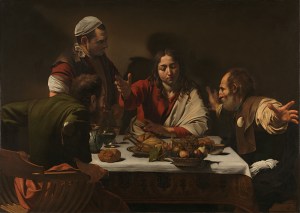
Michelangelo Merisi da Caravaggio, 1571 – 1610
The Supper at Emmaus
1601
Oil and tempera on canvas, 141 x 196.2 cm
Presented by the Hon. George Vernon, 1839
NG172
https://www.nationalgallery.org.uk/paintings/NG172

I walked into the gallery and immediately was struck by the size. Seeing a painting in a brochure doesn’t prepare you for a confrontation with a near life-sized painting. The Michelangelo Caravaggio “Supper at Emmaus”  was on loan from The National Gallery in London to The Art Institute of Chicago.

There’s the calm, peaceful countenance of Jesus at the center, his eyes serenely closed, his right hand extended in blessing. And I love the different reactions of the three sitting at table with Jesus. For the guy standing behind him, everything is reduced to a profound sense of wonder. The guy seated across from Jesus leans forward trying to believe the unbelievable, ready to reach across the table to verify with his hand what his eyes are telling him. The guy seated at the side of the table is retelling the story with his wild, broad gesticulating as if in the retelling it will make more sense.

The one detail that consistently grabs me is the dish teetering on the edge of the table. At the Art Institute, the crowd studied the painting from a carefully demarcated viewing area, stanchions separating the humans from the painting. I had this urge to reach across the divide and push that dish away from the edge.

For me that dish is the locus of tension. Is the dish going to hold or fall of the edge? One little bump on the table — which I can assure you I would have done inadvertently had I been there — and it goes crashing to the floor. Maybe it’s a visible sign of the tension still in the hearts and minds of those disciples. Was the Jesus sitting across the table real? Was the story he told them really true? Those questions and that tension are palpable in their postures and gestures. I can only imagine how acute the tension must have been when shortly after the moment captured in the painting  Jesus vanished from their sight.

I know that tension. I experience moments of extraordinary clarity, when God’s presence and God’s goodness are so real I can reach out and touch God’s wounded hands. And I experience moments when I wonder whether any of it is true,  when I feel acutely God’s  absence.  In those moments, I wonder if it will all hold together. Or will it go crashing to the floor? Is the resurrection life that Jesus promises more than just wishful thinking? 

Luke tells us that after Jesus disappeared, their hearts were burning within them, as if he became more real in his absence than in his presence.

I have my own version of Cleopas and his companions. They accompany me on the road with the risen Christ, who, by the way, is there whether we recognize him or not. Sometimes the road is only 7 miles; sometimes it feels like a lot longer. I’m grateful not to have to walk the road alone. Companions hold me up with their excitement at seeing the risen Christ, telling me how their hearts burn within them, even when whatever it is that I possess feels more like a flicker than a flame.

I met this week with a couple of nonagenarians whose faith had the quality of a fine, aged wine. They have endured the trials and can see God’s goodness and presence with the sharp-eyed vision of an eagle. They are the very incarnation of what last Sunday’s second lesson (1 Peter 1:3-9) described as an inheritance that is “imperishable, undefiled, and unfading,” faith that has been refined by trial and has come out the other side as pure and precious as gold. I also had coffee the other day with a guy who told me of his deep prayer life and how God was answering his prayers and about the opportunities for ministry that came out of those prayers. The burning quality of his faith was contagious.

I don’t very often experience my faith with that kind of sharp clarity. My experience is more like Paul’s metaphor of seeing through a glass dimly. More like a dish teetering on the edge of the table and about to fall off. Why is that, I sometimes wonder. A function of temperament? Personal defect? Not trying hard enough? I never come up with an answer.

Which makes me all the more grateful for those with burning hearts. My fellow pilgrims and their witness are often the proof of the presence of the risen Christ. I’m grateful that my faith is not just a me and Jesus thing. My fellow travelers have seen the risen Christ, and that is enough encouragement to keep walking.

Watching the Ice Melt

For the past week we’ve been been living in a temporary home just a block or so from Garrett’s Bay at the very northern tip of the Door County peninsula. The daily change of the ice and water on the bay has been a source of endless fascination for me.

When we arrived on Saturday, March 25, the bay was mostly covered with ice. It wasn’t a clear, unbroken sheet of ice; rather chunks that seemed as if they had long been broken and fused with the heating and cooling of the outside air. 

Later on in the week, a north wind blew in and the ice got scrunched up close to the shoreline as if a big snow shovel had entered the mouth of the bay and cleared the ice off most of the water. (Wish I had  picture of that, but didn’t think to take one.)

When the wind stopped blowing, the scrunched up ice loosened up again and a big patch of it floated out into the open water of Green Bay.

The warm temps over the weekend dramatically hastened the melt. You can see from these pictures just how much difference five days makes. 

Now this morning, the ice has pretty much disappeared from bay. For the past few days, temperatures have been pretty consistent through the day and night, hovering between the mid 30s and mid 40s. Still I find it astonishing that the ice the virtually disappeared in just 12 hours.

It’s raining today. Wonder if that will be enough to melt the few remaining chunks. You can be sure I’ll be watching.

We Are Going to Need Each Other

mlkspeech-1On Monday evening, I had the honor of delivering the keynote speech for the DuPage County Martin Luther King, Jr. Celebration. It was a great evening that included great music and a dramatic delivery of Dr. King’s “I Have a Dream” speech. Here is the text from which I gave my remarks on Monday.

I don’t have the words fully to express to you how honored I am to have the chance to stand in this pulpit this evening. I am humbled I am to stand in the line of the fine speakers you have had addressing God’s people on the occasion when we honor the legacy of Dr. Martin Luther King, Jr. I sat right there in the front row last year and was deeply moved by the words of Dr. Tracy Malone. I am grateful to my colleague and friend, Pastor Kevin Williams, and the people at Second Baptist Church for extending the invitation and for all the work that has gone into organizing and publicizing this event.

Pastor Williams called me on Friday afternoon to check in and see how things were with me.  “Man, something has changed,” he said. “We are going to need this gathering and each other more than ever.”  Amen to that.

When I accepted this invitation back in September, most of us thought we would be on the cusp of swearing in the first woman president of the United States. It didn’t work out that way. Instead, we are about to inaugurate a new president who campaigned on division, bigotry, and xenophobia. He won the presidency by way of the electoral college, though he lost the popular vote by nearly 3 millions votes. Some people have said that we have taken a step back in progress we had made in addressing the challenges of a racialized society. I wonder if that’s true. I have a hunch that the curtain has been pulled back revealing who we have been all along; but the ugliness is no longer hidden. It’s out there in the open for all of us to see; and it seems to legitimize action that comes of the darkest corners of our collective psyche.

I remember 8 years ago at inauguration time. There was almost this giddy sense of excitement and optimism. I invited our church staff over to our home to watch the inauguration. We ate snacks and toasted with champagne. The theme was hope, and in every place where a crowd gathered you could hear the chants, “Yes, we can.”  What a contrast to “Lock her up.”

Something has shifted. I don’t know many who are feeling that sense of unbridled optimism, even among those who voted for the president elect. Instead it’s like a pall of fear has descended on our whole country. Fear seems to be consistent among those who voted for him and those who didn’t. I’ve spent some time talking with those who voted for our president-elect. I’ve wanted to understand. Among many things I’ve discovered is that even those who are happy with the results of the election are not feeling a great sense of optimism and hope; they don’t feel like we have taken some giant step forward. It’s hard to know for sure what’s going on.

Fear is nothing new. In an age of iphones, social media, and the constant, 24/7 barrage of headlines and sound bites it’s a wonder we ever come out of our homes. The evening news is often little more than an update on what we should be afraid of today. What we eat, what we drive, what’s going on halfway around the world, what’s going on in our own city — the list of things we should be afraid of is never ending.

But the present fear goes beyond that. The campaign language of bigotry has unleashed a storm of bigoted actions. The disregard for truth has left us with an even greater suspicion of the institutions that are so vital to our democracy. We’ve even coined language for it, as if it’s perfectly acceptable and normal — they say we now live in a post-truth culture.

But it’s not normal. And it’s not the kind of country that I want to live in. I do not want to live in a country where truth doesn’t matter. I do not want to live in a country where fear and suspicion and hatred and stridency are the dominant forces that drive our public life.  Do we want communities where we are suspicious of each other? Where we choose to highlight our differences? Where there is no room for the stranger or for the person trying to make a new start, for the family trying to make a life for themselves, to escape the violence of their neighborhood or their home country? Do we want communities where we slice and dice and categorize based on color of skin or which street you live on or which symbols are in your house of worship or where your parents were born?

Dr. King had a vision for something greater and grander. On Christmas Eve, 1967, just a few months before he was assassinated he preached these words at Ebenezer Baptist Church in Atlanta, where he was co-pastor:  This Christmas season finds us a rather bewildered human race. We have neither peace within nor peace without. Everywhere paralyzing fears harrow people by day and haunt them by night. Our world is sick with war; everywhere we turn we see its ominous possibilities. And yet, my friends, the Christmas hope for peace and good will toward all men can no longer be dismissed as a kind of pious dream of some utopian. . .Let me suggest first that if we are to have peace on earth our loyalties must become ecumenical rather than sectional. Our loyalties must transcend our race, our tribe, our class, and our nation; and this means that we must develop a world perspective. No individual can live alone, and as long as we try, the more we are going to have war in this world. . .As nations and individuals, we are interdependent. . .All life is interrelated. We are all caught in an inescapable network of mutuality, tied into a single garment of destiny. Whatever affects one directly affects all indirectly. We are made to live together because of the interrelated structure of reality.

That’s what we want. An interrelated community that reflects how the creator has made us. When God created that first man, God said it is not good for the man to be alone. So, God created the woman; in that moment began the interrelatedness of the human species. We are created to be in community. Not just created in community, but created to care for and love and support one another.

In my religious tradition, Jesus is kind of a big deal. Throughout his ministry, Jesus lifted up the necessity of caring for one another. When he was preaching for a crowd of thousands and saw that they had no lunch, he fed them. When he encountered a blind man, he restored his sight, the deaf man could hear again, the lame man could walk again, the lepers he cleansed. He authorized his followers to do the same thing. He told a story about how some folks had given food to the hungry and a drink of water to the thirsty and clothing to the naked. And when they did that, Jesus told them that they had done it for him. When we serve our neighbor, we are serving God. We see God in the face of our neighbor. Caring for one another in community and relationship is holy work. That’s the beloved community of our dreams.

The challenge always is to turn our dreams into reality. This week, all our attention is on Washington, there being an inauguration and all. Some folks think there’s this big thing called government that’s going to take care of stuff. We elect the right people and the right things will happen. And when we don’t elect the right people, well, bad things happen and that’s government. It’s too big and the forces are too strong and we can’t do anything about it. After all, you can’t fight city hall.

But I refuse to believe in that kind of determinism, that we are subject to inevitable and unassailable forces. We are not victims of the vagaries of history. If there’s anything the legacy of Dr. King has show us it’s that common, ordinary people have the agency to be a force for the good in the communities where they live.

Too many people subscribe to a narrative of the civil rights movement that is simplistic and simply not true. In his book, I’ve Got the Light of Freedom, Charles Payne summarizes that popular narrative like this:

Traditionally, relationships between the races in the South were oppressive. Many Southerners were very prejudiced against Blacks. In 1954, the Supreme Court decided this was wrong. Inspired by the court, courageous Americans, Black and white, took protest to the street, in the form of sit-ins, bus boycotts, and Freedom Rides. The nonviolent protest movement, led by the brilliant and eloquent Reverend Martin Luther King, aided by a sympathetic federal government, most notably the Kennedy brothers and a born-again Lyndon Johnson, was able to make America understand racial discrimination as a moral issue. Once Americans understood that discrimination was wrong, they quickly moved to remove racial prejudice and discrimination from American life, as evidenced by the Civil Rights Acts of 1964 and 1965. Dr. King was tragically slain in 1968. Fortunately, by that time the country had been changed, changed for the better in some fundamental ways. The movement was a remarkable victory for all Americans. By the 1970s, Southern states where Blacks could not have voted ten years earlier were sending African Americans to Congress.

Simplistic. And wrong. The movement was much more than that. That’s not how it happened. The civil rights movement didn’t start in Washington with the courts or with federal government. It started in the towns and villages of Mississippi and Alabama where people whose names we don’t remember went door to door and did the long, slow, hard work of relating with people and organizing them, folks like Amzi Moore and Mrs. Haner and Mrs. McGhee and Annie Devine. Dozens of college students and a handful of high school students spread across Mississippi and went door to door getting to know people and finding out who would show up for actions and what people were worried about. When big actions were planned, actions like bus boycotts and the March from Selma to Montgomery, leaders and ordinary folk gathered to plan and to train. They role played about what would be said or done in certain situations. They trained people in how to take a beating. A younger version of U. S. Representative John Lewis was present for that training, and maybe that’s what allowed him to take the beating at the hands of the Alabama State Police that left him bleeding on the Edmund Pettis Bridge with a fractured skull. By the way, you can say many things about U. S. Representative John Lewis. But you cannot call him a man of all talk an no action. He is one of the living heroes of our democracy.

The leaders of the civil rights movement understood that when citizens want to get serious about becoming agents for the common good in their own communities it takes a lot of long, slow, persistent, consistent, and mostly unglamorous work. It requires sitting down one on one, talking to people. It requires painstaking research to discover what actions can be taken that will move us towards justice, righteousness, and that peaceable kingdom. It involves knowing the power structures in a community and institutions. It demands planning actions that will elicit a reaction. When the civil rights movement leaders planned marches and put school children in the front of those marches so that they would be the first ones to encounter Bull Connor’s police dogs, that was not an accident. It was planned to elicit a certain reaction. Those young people who went door to door building relationships and training leaders began to coalesce their power. They were organizers. It was long, slow work, but it was respectful work, work that was intentional and the kind of work that was absolutely essential to their success.

Weeks ago, when I was thinking about these remarks, and making some notes, I wrote this note to myself:  “I don’t want to make this speech into a commercial for community organizing.” A few weeks later, I came back to that note and I wrote in the margin, “But maybe I do.” 

What I have experienced in organizing is that we can turn our care for our communities and our neighborhoods and our neighbors into action that is more than symbolic. Symbolic action has its place. This gathering this evening is mostly symbolic. That doesn’t mean it isn’t important. It’s just to recognize the limitations of a symbolic gathering. Hopefully, it will be inspirational, and we will leave here with a sense of hope and a determination to go to work. At its best, this gathering will prod us to action. But this gathering makes no plan for action.

If we were to make a commitment to join together for the sake of working together, that would be something different. If we made a commitment to plan together and to work together and we began organizing ourselves to actually do that, we could expect that we would begin to enact the vision that we have for what our community should be. If we were to make specific determination about the challenges of our community and pull together the power of the people, we would discover that we can do things, we can make a difference. It doesn’t have to be all talk.

What I have experienced in community organizing is the best chance we have to enact God’s vision for what the world should be. I am a leader with DuPage United, an affiliate of the Industrial Areas Foundation, a national parent organization for organizing work that is being done across the country. We are doing real work. Here in our community, we have taken action to stand in solidarity with our Muslim brothers and sisters in the face of ramped up Islamophobia. We have pushed the DuPage County sheriff’s Department to provide Crisis Intervention Training for all of the sheriff’s deputies out on the beat. We are in the process of setting up community mental health crisis centers so we keep people who are having a mental health crisis out of the emergency room and out of jail, and most importantly, insure that they get the help they need. We can’t rely on the state to get this work done. The state of Illinois is broken. We’ve got to take things into our own hands, and we can do it. Yes, we can. 

In the next four years we are going to need each other. We are going to need to be in relationship. We are going to need to be organized. We simply must do the hard, slow, painstaking work of meeting with one another, developing a web of relationship in our community, so that I stand with you when you need me, and you stand with me when I need you. It remains to be seen whether the hateful and divisive rhetoric of the campaign will turn into policy and action. In a sense, it doesn’t matter; we’re going to need each other. You need to know that when your health insurance stops covering pre-existing conditions, your neighbors will stand next to you and fight for what’s right. When you are required to register because you are a Muslim, you need to know that there will be Christians who will stand in that line and get registered right along with you. When the school to prison pipeline keeps growing and flourishing, you need to know that you will have neighbors who will take action with you to demand that fairness and equality and justice are blind to skin color. We will need each other more than ever. I believe that’s the work that Dr. King was involved in. I think that’s the work that preserves and continues his legacy. It doesn’t matter who is president of the United States or what the Congress does or doesn’t do. We will join hands and we will work and plans and organize and fight and demand together, until justice flows down like water.

Indulge me with just a few more minutes to speak to those of you here tonight who are members of the white Christian church. If this speech was a letter, this would be the P. S. The white church has a miserable record of silence, complacency, and complicity when it comes to matters of race in this country. Too often, the white church has worked to maintain the structures of racism that have oppressed our fellow citizens of African descent, systems that have denied them the same opportunities that we white people have taken for granted.

I confess that I am late to this work. I confess my own complicity. I confess that it took the shootings at Mother Emmanuel Church to wake me up. The shooter was a member of a church in my denomination. He grew up in a white Lutheran church and attended confirmation class, probably not all that different from the confirmation classes I teach. Yet somehow his connection to church, to my church, could not erase a deep hate based only on race.

Shortly after that shooting,  I went to a colleague who pastors a church with a significant African American membership and asked if we could get members of our congregations together; I said I needed them to help us understand the problems and challenges of racism.  He schooled me; he told me “That’s not our job.” He told me, “You white people need to do your work, begin to understand racism and white privilege and how racialized our society has become.” I was taken aback. I had never heard that before. So, I got on the Facebook page for the clergy of my denomination. And I asked the question there. And I got schooled again, this time not so gently. “You white people need to do your own work. When you have done your work, come back and then we can talk.” So, that’s what I’ve been trying to do. In my congregation, all of our staff have been through anti-racism training. We have sponsored anti-racism training for our members. We are reading; we are having conversations; we are learning. We are waking up.

In the past year, Jim Wallis of Sojourners and Drew G. I. Hart have both written compelling books on racism and the church. While they disagree on certain points, they both believe that we will not make substantial progress in dismantling racism in our country until the white church shows up and starts making it a priority. That is not to say that white liberals are going to bring racial equality to the people of color. That’s a colonial attitude that has been part of the problem. I mean to say that we have our own work to do in recognizing white privilege and doing our work to begin dismantling the structures of racism.

This is my challenge to you, white church. Show up. Do your work. Have the conversations. Read TaNehisi Coates, Between the World and Me, Michelle Alexander, The New Jim Crow, Isabel Wilkerson, The Warmth of Other Suns, Nell Ervin Painter, The History of Whiteness, Debby Irving, Waking up White.

We are going to need each other. And if we in the white church are going to be our best selves and really be neighbors, then we simply must do our own work.

No matter the darkness, there is always light. No matter the fear, there is always hope. Together we can do this work.

This is a song that I learned as a child and I will never out grow it. Dr. King said that darkness cannot drive out darkness; only light can do that. Together we will shine the light into the dark places.

(And we sang:)This little light of mine.I’m going to let it shine. . .

Ev’ry where I go, I’m going to let it shine. . .

Advent and the Spirit of Joyless Urgency

urgencyI’m reading Marilynne Robinson’s relatively new collection of essays, The Givenness of Things, and came across this elegant and weighty phrase, “the spirit of the times is one of joyless urgency.”

She’s found words to describe what I see going on in my own life and around me. My to-do list is long and always growing. We crave relationship and intimacy and yet make no time for it, allowing Facebook and such to become a false and diabolical substitute. We neither make nor allow space — not for thinking, not for silence, not for people, not for God. It’s always on to the next thing. In fact, the urgency of the next thing makes it hard to focus on the now thing.

A few years ago, I convened a group where we talked about ancient spiritual practices and what they might look like in our highly technological, fast-paced world. When I talked about making space in our lives for silence, for doing nothing, for sitting and reflecting, for being with our loved ones in an unhurried, no-thought-given-to-productivity kind of way, one of the persons in the group responded that they simply could not do that. Their brain and their body would not allow it. And neither would their bank account. They had to be constantly busy and working. Alas.

Advent offers a profound antidote to urgency. We’re invited simply to wait with the prophets for the coming of the Messiah, prophets who waited for centuries, who did not see that which they were waiting for, but trusted in the promise that it would come.

Even the shortened days (at least in the northern hemisphere) of these last weeks of the calendar year invite me to sit in the quiet dark and wait and think and reflect and pray.

And when I do? I find that the image of God in which I have been created is more apparent when I slow down and when I make space. I am more generous to people, more gracious about their faults, less fearful about a broken world, more inclined to see things from the perspective of faith.

And what of the joy?

I sit in my reading and writing place on a gray morning. I’m tired from a long weekend of heavy responsibilities, sitting with a long list of things that need to get done, and little energy to get up and do any of them. This is just the kind of day to ignore the joy around me.

Yet, to see and experience those things around me that could bring joy is a decision, a choice. I think of some pretty amazing Advent worship on Sunday, of the buzz after the services about what people found meaningful. To know that people were touched by God is one of the reasons I do what I do. Surely, there is joy in that.

At one of those services, a husband and wife who had two days earlier lost their 30-something son to death by cancer were in church. I watched as they wept, as they smiled at the ways their young granddaughters engaged in the service, and as countless numbers of their fellow pilgrims shared hugs and tears with them after the service. Surely there is joy in deep human connection.

Last night as I laid on our bed reading, our 40 pound poodle mix jumped up and threw herself against me, pawing at my hand until I began to scratch her neck. As I did so, she began to relax, and laid her head down looking into my eyes as she fell asleep. A mysterious moment of connection between man and beast. Surely, there is joy in that.

The point here is not that there is no chance for moments of joy. It’s that I have not become very adept or practiced at noticing them, countless numbers of them day in and day out. Perhaps too consumed by the urgent?

So, this will by my advent discipline. To step away from urgency. And to find joy.

“Together with the Levites and the aliens. . .”


image
This evening at our Thanksgiving Eve service, we will read these words from Deuteronomy:

When you have come into the land that the Lord your God is giving you as an inheritance to possess, and you possess it, and settle in it, you shall take some of the first of all the fruit of the ground, which you harvest from the land that the Lord your God is giving you, and you shall put it in a basket and go to the place that the Lord your God will choose as a dwelling for his name. You shall go to the priest who is in office at that time, and say to him, ‘Today I declare to the Lord your God that I have come into the land that the Lord swore to our ancestors to give us.’ When the priest takes the basket from your hand and sets it down before the altar of the Lord your God, you shall make this response before the Lord your God: ‘A wandering Aramean was my ancestor; he went down into Egypt and lived there as an alien, few in number, and there he became a great nation, mighty and populous. When the Egyptians treated us harshly and afflicted us, by imposing hard labour on us, we cried to the Lord, the God of our ancestors; the Lord heard our voice and saw our affliction, our toil, and our oppression. The Lord brought us out of Egypt with a mighty hand and an outstretched arm, with a terrifying display of power, and with signs and wonders; and he brought us into this place and gave us this land, a land flowing with milk and honey. So now I bring the first of the fruit of the ground that you, O Lord, have given me.’ You shall set it down before the Lord your God and bow down before the Lord your God. Then you, together with the Levites and the aliens who reside among you, shall celebrate with all the bounty that the Lord your God has given to you and to your house. (Deuteronomy 26:1-11)

I think of my grandfather, the grandson of immigrants from Germany who came to America because they were starving in Pomerania and hoped for a better life in the New World. They settled in Kansas and farmed the land. It was a hard life, but they had enough to eat.

Grandpa was the son who went off to college and seminary to become a pastor. Ironically, his first call was to northern Saskatchewan to serve nearly 20 preaching stations of German/Russian immigrants who had fled Europe for the same reason his own grandfather had left. After a dozen or so years in the wilderness, he went home to Kansas to pastor congregations there. Yup. The son of German immigrants could call Kansas home.

I think today of the fact that contrary to the myths that I learned in elementary school about Thanksgiving, it was the indigenous folks already here who made survival possible for those first European immigrants to the North American continent. Thanks. 

Our faith reminds us that we are all pilgrims. We all are on a journey. We are all strangers and aliens. And we are invited to celebrate together the goodness of God. We are invited to remember that none of us does this alone, and none of us does this without provision from the One who has created us. We are creatures, all of us.  The Israelites, the Levites, the Philistines, the Moabites, the Mexicans, the Muslims, the members of the LGBTQ community, the descendants of slaves in the Americas, the descendants of starving Pomeranians. Creatures and fellow celebrants. 

I grew up in a small town in western Nebraska, and all I knew was people who looked just like me. The only diversity I knew was that besides Lutherans, there were Catholics, Baptists, and people who didn’t go to church. How my life has been enriched to know people who are different than that narrow slice of white, European heritage. Of all the things I am grateful for this Thanksgiving, I am most mindful in these tumultuous times of the gift and blessing of friendship and relationship with people who have taught me that life is large and who have shown me the rich mosaic of the human community. Whatever happens in the months to come, I stand with you. You are gift.

Happy Thanksgiving.

God Is in Charge?

nightbeforedawnLet me get rid of the question mark. That was just click bait.

God is in charge.

I have no doubt of that truth. I’ll stake my life on it.

But I’m not sure it means what we think it means. For the people around me — white, middle and upper middle class church people — what I hear when I listen between the lines is this: “Oh, yes, this election is disappointing, (or for some, encouraging) and there may be some things happen that I don’t like or that I will disagree with, maybe even some things that will be inconvenient for me, but it will all come out in the wash. It will be fine, because after all, God is in charge.”

That sentiment itself is privilege. Sure, it will probably be fine for me and people like me. But there’s a whole lot of people who are at much greater risk this morning than they were yesterday morning, at least if the president-elect chooses to keep his xenophic, homophobic promises for the privileged.

To all the people out there who look like me, can you imagine what it would have been like to wake up this morning Muslim? Or Mexican? or LGBQT? Or any of the other people who have been demeaned in this campaign? Imagining that things will be all right is a luxury that none these, our siblings, are afforded.

And there’s more. Believing that God is in charge has never meant that we can escape the consequences of our active participation in or complicity in evil. To target and implicate as terrorists an entire religion is evil. To act on the premise that women are objects for the sexual gratification of men is evil. To refuse to welcome to the stranger is evil. To treat LGBQT persons and their intimate relationships as if they are not as fully human and therefore not valid is evil.

Got any notion what happens when God’s people are participants in or complicit with evil?  If you need a review, read through Isaiah again or Micah or Amos, or, for that matter any of the Old Testament prophets. Oh, God is in charge all right.

I think it might be time for the church of Jesus Christ — dare I say the white church? — to put on some sackcloth and ashes. There’s enough sackcloth to go around for those who wear blue and those who wear red. Because this isn’t about party loyalty; this is about being honest about who we are as a people. And the evil to which we have become complicit. It’s time for a gut check about what we mean when we confess “Jesus is Lord.” Maybe a little sackcloth and ashes could bring the freedom that would empower us as church to do better. To live as if we truly are the body of Christ. To take the ethical implications what has too long been a privatized faith and live it as if we really believed it.

Whether we do or we don’t, God is still in charge. It just might not mean what you think it means. 

Nostalgia-itis

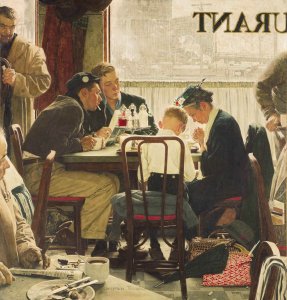
norman-rockwellOnce in a while, I long for the life I had as a child in a small town in western Nebraska. I loved that little town of Bridgeport. With a bicycle and permission from Mom, the whole town became our playground. The North Platte River was close by and we wandered for hours at a time in the river bottoms, oblivious to whose land we were trespassing on. On summer evenings the whole block was the field for a serious game of hide and seek. I remember shopping with my parents at the hardware store that was also the furniture store and the appliance store. There was one barber in town; Dad and I would walk down together to get a haircut. I loved the visits to the lumberyard, especially if it meant going back to the yard to pick out the boards Dad needed for some project; that’s where I learned to love the smell of freshly sawn lumber. The Rexall drugstore smelled like a drugstore and it’s where I bought comic books and magazines.  When I went to seminary to become a pastor, I imagined myself returning to such a place.

It hasn’t worked out that way. I’ve served my entire ministry — a few months shy of 30 years now — in the suburbs of major population centers. Deep inside, a mostly dormant longing is still lodged to return to a place like the place where I grew up. The longing becomes more acute when the frustrations and burdens of serving a large suburban parish overwhelm the joys and satisfactions of my work.

Years ago in one of those points of frustration and burden, I said to a clergy colleague and close friend (who had just retired from parish ministry, a point not irrelevant), “I’m going to resign my call and find a little church in the middle of nowhere.”

My wise friend responded, “No, you’re not. I know you better than that. That’s not who you are. You would go mad if you didn’t have the stimulation and challenge of the ministry that you’ve been called to. You have been called to this place for a reason. Stop yearning for a life that doesn’t exist except in your own mind.”

I think about that conversation a lot, especially the part about a life that doesn’t exist except in my own mind.

I think about that conversation with respect to the current campaign season. Listen to the candidates. The speeches start with a story of what things used to be like, and always the past is golden, a time when unions were strong or America was great. “Just elect me,” the storyline goes, “and we can return to that golden age.”

I think of that conversation with respect to the church. Congregations have been thrown into a state of anxiety as once prosperous and successful institutions look back on the glory years of the mid-twentieth century when they were strong congregations, pews and coffers and Sunday school rooms full. Now, struggling to keep their doors open, they hope that by calling a new pastor or getting a few new members they can return to the good old days.

Which, of course, is never going to happen. The world is different. The America of the mid-20th century which saw the US as an unrivaled global power, brought prosperity to millions of people, and saw the unprecedented expansion of the middle class doesn’t exist any longer. That we are no longer the America of the 20th century and cannot return to that time and place seems obvious, yet as a people, we talk not only as if that’s possible, but that it’s precisely what we need to do. (As an aside, access to that prosperity belonged primarily to white Americans.)

The symbiotic relationship of the church and culture that allowed churches to grow and enjoy substantial stability and institutional prosperity does not either exist anymore.

Bluntly speaking, get over it. We don’t live in the mid-20th century. That world doesn’t exist.

I wish our national leaders could speak honestly about the futility of nostalgia as as operating principle. I wish by some fiat, we could all agree that nostalgia might be a delightful way to spend an evening with family or friends, but it’s not a productive way to address the substantial challenges we face as a nation. I wish the candidates would give us their assessment of the challenges we face today and use their imaginations to articulate their version of policy to address those challenges. Of course, the polices on the right and left would look very different. But wouldn’t it be fun to debate actual solutions that take into account the nowness of our challenges and quit trying to repristinate a world that cannot exist anymore?

In the congregation I serve, mostly we have come to an awareness that 2016 is not the same as 1976 and that if we want to be part of God’s mission, we need to be different and do differently. It’s not to say there isn’t anxiety; there’s plenty of it. I still get people asking me why we have to change when what we’ve done has worked pretty well for us. Even folks who aren’t asking those nostalgic questions still long for the days when Sunday school rooms were packed, 150 kids showed up for Vacation Bible School, 60 kids showed up for the midweek kids’ programming, and the sanctuary was full for 2 services every Sunday. 

In letting go of the past, we open up space to look realistically and hopefully at the world we live in today. When we open that space, we find the energy to look — really look — at the unique challenges and opportunities in the present moment. Then we begin to think imaginatively about how we might address the challenges of the now.

In so many of the gospel lessons we’ve read this summer in our Sunday services, I’ve heard Jesus’ words in light of this lens through which we look at our mission and our challenges. When Jesus began his ministry, he set his face to Jerusalem. He went about his ministry with urgency, resolute determination, and a refusal to be distracted. When those he called wanted to go home and say good-bye first, Jesus cautioned, “No one who puts a hand to the plow and looks back is fit of the kingdom of God.” When he sent his disciples out two by two, he told them to look for welcome and then to stay as long there is work to do and then move on. When he taught his disciples to pray, he told them to ask that the kingdom come (present tense).  He told them to ask for enough bread for the day. There were no words about longing for the bread of the glory days, a sin which the Israelites perfected in their wilderness wandering.

I’m not suggesting that we disregard or dishonor the past. The saints of Faith Lutheran Church whose shoulders we stand on were faithful, energetic, and dedicated folks who established a vibrant ministry that has had an immeasurable impact on thousands of people and the community in which we serve. We can honor and give thanks for the past without attempting to recreate that past.

Like my own longing for my childhood home, there must be something deep within the human psyche that longs for the good old days. I happen to think that the good old days exist mostly in our minds, but even if they were as good as we remember, they aren’t coming back. The sooner we let them go and start really paying attending to the world of now and imagining how we might address the challenges of now, the better it will be for us, for the world, and for all of creation.

Postscript:  The notion of nostalgia as an operating principle for politicians is developed much more fully in The Fractured Republic: Renewing America’s Social Contract in the Age of Individualism, by Yuval Levin. I highly recommend the book. Written by a conservative scholar, the policy solutions Levin offers are not the ones I would support, but he is very fair and balanced in offering both critique and pathways forward for both Democrats and Republicans. He advocates for restoring the strength of mediating institutions, institutions like churches, synagogues, mosques, schools, and neighborhood organizations. This is precisely what the work of broad based community organizing does.

To My Friends

blackI believe in the power of words. I believe language gives us the ability to call worlds into being.

Yet, I feel like all the words have been used. There is nothing left to say. And I despair that we are using words to call a world into being that is full of violence, hatred, and fear.

To my LGBTQ friends: my heart aches. I have never been anything but white, male, and straight. In other words, I am usually the majority and the one with the power whenever I walk into a room. I do not know what it means to be marginalized. And I do not know what it feels like to be afraid simply because of who you are. I do not know what this massacre must feel like to your community. I want to be an ally. I am always, ever learning in my own stumbling way how to do that. For whatever that’s worth.

To my friends in the Muslim community: my heart aches. Here we go again. What happened in Orlando obviously bears no resemblance — not even a tiny resemblance — to the faith that I see you profess and practice. Yet you are being lumped in with the most radical and extreme adherents of your religion, even though you have said over and over that they do not represent your religion at all. You are understandably becoming fearful again to live in a country that wants to the world to believe freedom is our highest value and that it is the land of opportunity for everyone. Our actions too often demonstrate that we really believe freedom and opportunity are reserved primarily for white Christians. I heard my friend Hani Atassi interviewed on NPR, telling that the security fence put up around their mosque after San Bernadino had just been taken down a few weeks ago. Now it is being put back up. I have never given one second’s thought to putting up a security fence around my church. When a deranged Lutheran Christian shot 9 people last summer in a church in Charleston, he was called a disturbed young man with ties to white supremacists. There was no mention of his religion. This weekend, the perpetrator was immediately tied to Islam. It must be particularly difficult that this happened during your holy time of Ramadan, a time that I understand is intended to be full of the joy of practicing your faith in such a concrete discipline. You are my friends. I stand with you.

To my Latino friends: my heart aches. I don’t think we know whether the fact that the attack at Pulse occurred on Latino night by coincidence or design. But at some level that doesn’t matter. The majority of those killed and injured were Latino by ethnic heritage. I also don’t know what that feels like, to be targeted because of where my ancestors came from.

These three communities have been the target of hate, suspicion, and bigotry over the past several months. I don’t want to make a straight line of causation when there’s no proof — and maybe never will be — of the shooter’s motives. But as I said, I believe in the power of words. And the power of words to call worlds into being. And the words being used are calling into being a dystopic world that I want no part of. Naively, I have believed we could do better. NaiveIy, I have believed that we wanted to do better. I’m beginning to wonder.

Make No Big Plans

acornThis morning’s Chicago Tribune included an editorial cartoon by Michael P. Ramirez depicting a herd of elephants and donkeys heading off a cliff. A pair of small rodents sits on the edge of the cliff; one of them opines, “They’re giving us lemmings a bad name.”

There does seem to be a sense of doom and  inevitability. The train is headed for the end of the line and the brakes aren’t working. The engine on the airplane has gone out and we’re headed for a crash landing.

With so much wrong, societal problems that appear intractable, and institutions that people have relied on for so long falling apart, I’m hearing a sense of resignation. What is, is.  What will be will be. Deal with it.

Resignation assumes that we are victims of forces around us; we can’t do anything about them.  But I don’t believe in fatalism; I am not a victim of forces that I can’t do anything about. I don’t believe there is ever nothing we can do. We are human beings capable of action. We have agency. We can take responsibility.

So, what to do in the face of big problems? Alas, there’s the rub.  Big problems can only be solved by big plans, or so we think. When the big problems and the big plans are beyond the reach of mere mortals, hope becomes dim.

Daniel Burnham, the late 19th century and early 20th century architect who had an enormous impact on the development of downtown Chicago, famously said, “Make no little plans. They have no magic to stir men’s blood and probably will not themselves be realized.”

I say to hell with big plans.  Big plans are the nemesis of making progress on the hard things.

Jesus apparently was fine with little plans. Maybe little plans as small as a mustard seed; he used the tiny seed as an image for the kingdom of heaven.  Planted in small, unnoticed ways, it grows imperceptibly and becomes a tree large enough to provide a place for birds to build their nests.

I can speak up for my Muslim neighbors and friends.  I can seek dialogue with people who hold views that are different than mine. I can teach my kids to be kind. I can treat the people I work with dignity and respect. I can invite a local politician or the police chief or the elementary school superintendent  for coffee and find out what’s on their mind and let them know what’s on mine. I can invite a few neighbors over for dinner to discover who it is I’ve been saying hello to all these years. I can put my screens away occasionally and interact with people face to face, eye to eye, real voice to real voice. And I can find people who care about the things I care about and figure out together how to make some small plans.

What will you do? Who will you talk to? What action will you take?

When ordinary people make small plans that become effective action then big things are bound happen.

A Modern Pentecost

imageAt least once a year when I have to preach on the great story of Pentecost, I sit at my desk wondering what that must have sounded like. The story in the Christian scriptures tells how the followers of Jesus were stuck indoors waiting for instructions about what to do next after Jesus had returned to the Father. The writer of Luke-Acts describes the sound of a rushing wind enveloping the room. Later in the day, those same Jesus-followers took it to the streets and there began telling the story of Jesus to the visitors who had made pilgrimage to Jerusalem. I try to imagine the buzz on those Jerusalem byways as people from all over the world heard the proclamation in their own languages.

I caught a glimpse of the Pentecost phenomena on Sunday afternoon at the “Know Your Muslim Neighbor” Solidarity Event on Sunday afternoon. The event was sponsored by DuPage United, our local Industrial Areas Foundation community organizing affiliate. 850 people showed up. Yeah, I know. Amazing, right?

The numbers were impressive. But it’s not the raw number that is the important thing here. It’s what the numbers stand for and what happened. That many people showed up on a Sunday afternoon when they didn’t really know what was going to happen. What is a “Solidarity Event” anyway?

I have a hunch why our Muslim neighbors showed up. There is some measure of fear in the Muslim community. And with good reason. Too much of the hate-filled rhetoric coming from public figures is directed at them. They hear the language and see they the footage on television. Two days before our event, three Muslim teenagers were shot execution-style in Fort Wayne, Indiana. More importantly, they experience it in their daily life. One woman told a story of making phone calls for the PTA at her child’s school. The mom on the other end of the line asked her where she came from – she was born in America, by the way – and then proceeded to tell her that she didn’t belong here; she should go home. A Pew research poll a few years ago indicated that nearly 60% of Americans believe that Islam and American values are at odds. Yet 60% also admit to never having met a Muslim. My experience – at the event on Sunday also demonstrated – is that Muslims are eager to make connections and to dispel the stereotypes. The best way I can think of to do that is one person at a time.

But why would the Christians and Jews show up? I’m not exactly sure. But when I have talked with a few members of my congregation, they came because they don’t like what they see. The division and rancor in the national conversation disturbs tem. They don’t know what to do but they want to do something. So they showed up. And without exception, they have reported what a meaningful experience it was.

This event was designed and planned for the primary purpose of making connections across the communities, communities diverse in religion and culture, but communities that share so much in common.  We believed that if we could get people into the same room talking to each other, we could begin to dispel the stereotypes. We also wanted to make a public statement – directed especially at public officials and the media – that we will not tolerate hate-filled, prejudice-laced rhetoric.

The program wasn’t fancy. There were some introductory remarks, and a series of three speakers, each of whom spoke for 5 minutes. But the speakers weren’t the central focus. Between each of the speeches, the participants were invited to turn to their neighbor and hold conversation on a particular question. They questions were not particularly deep; they were not controversial. They were simply doorways into a one on one, human contact that is the fundamental building block of human society. Judging by the response of the folks on Sunday afternoon, it’s something that people are craving, even though the contact happened to be with perfect strangers.

In the last few days, I keep hearing powerful testimony of what happened in the conversations. Muslims told their stories of experiencing harassment and prejudice; non-Muslims learned and sometimes were shocked to hear that in this country where we supposedly honor the value of religious freedom, our fellow citizens do not feel free to practice their religion. A clergy colleague wrote me that she and a young Muslim woman sitting next to her realized at one point that they were both crying. The tears were partly sadness at the way things are, but they were also tears of hope at what might be, hope embodied by 850 people sitting together making conversation.

When small seemingly insignificant conversations become powerful moments for people, it says something. It’s worth noticing. It’s work that is fundamental to repairing the fabric of our society. We have a fundamental need to get beyond the isolation and division. We need a vision of what e pluribus unum might look like in the 21st century. That vision will not be enacted by politicians passing legislation; it won’t be happen by activists marching in public places. It will happen as we engage the long, slow, sometimes difficult, and ultimately rewarding and healing work of relating person to person, congregation to congregation. It will happen as we build those relationships, build our power, and then begin to take action.

In both the ancient Hebrew and ancient Greek language, the words nephesh and pneuma can be translated variously: Spirit, wind, breath. Gathering in that room on Sunday afternoon, as folks used their breath to engage in conversation, it sounded like the rush of a mighty wind. And I’m convinced it was the voice of the Spirit.