Author Archives: Jim Honig

Unknown's avatar

About Jim Honig

Lutheran pastor in the western suburbs of Chicago. I'm a writer, a runner, an avid outdoorsman, and a curious student of people and the human condition.

The Parable of the Assistant Manager in the Grocery Store


grocerystoreparable.jpgThere was once a woman wearing a hijab who was doing her weekly grocery shopping at her usual grocery store near her home. As she headed down the detergent aisle, a couple of middle-age white men made angry comments about her religion and ended with an obscenity to describe the woman and others of her religion. The woman went to the customer service counter and said, “I’m not done shopping,” she told him, “but I don’t feel safe here.”  The assistant manager told her he would protect her. For the next half-hour, he walked alongside her pretending to check inventory as she did the rest of her shopping. When asked about his actions, he said, “I was just doing my job.”  (Read the whole story by New York Times religion writer, Samuel G. Freedman.)

A few reflections:

1. In these times, we are told to be vigilant for things that are out of the ordinary. If you see someone suspicious, call the authorities. When we’re cautioned so often to look for the suspicious, does every stranger begin to look suspicious?

2. Maybe we should be more vigilant for someone who needs a helping hand or a gesture of kindness. Maybe we should be more vigilant for instances of hatred and discrimination and when we see them, call them out. We could use more expressions of our common humanity.

3.  I don’t know what it’s like to walk into a grocery store and be harassed. Worse, I never even have to think about it. I don’t have to worry about the management following me around on the assumption that I’m a criminal. I don’t have to worry about hate speech directed towards me because of my religion. I don’t have to wonder what kind of ogling I might be subject to. I never give a thought to my safety when grocery shopping. The very structures of our society are programmed to make me feel safe. Mostly I don’t even see it. That’s privilege.

4. I love the assistant manager’s words when asked why he did it. “I was just doing my job.” He didn’t ask permission or look for adulation. He was just being neighborly. Showing basic kindness and compassion. And he didn’t, apparently, think about it. Jesus once asked his disciples why they were looking for reward for following him. They were, he said, just doing what they were supposed to.  “I was just doing my job.”

In my Christian belief system, God has called me into the circle of God’s love and transformed me. God has made me part of a community that is to be good news for the world. Being good news for the world is not so much about having the right answers, but about being God’s loving presence. To be God’s loving presence is not that complicated. It may be hard, it may take patience, it requires persistence, it is undoubtedly counter cultural. But at it’s heart, it’s not that complicated. Exercise kindness; be neighborly; assume a shared common humanity in the midst of the differences.

That assistant manager? His name is Mark Egan. If God is at work bringing the peaceable kingdom — and I believe God is — Mr. Egan has given us a glimpse of what that might look like.


Today, I Stand with My Muslim Neighbors

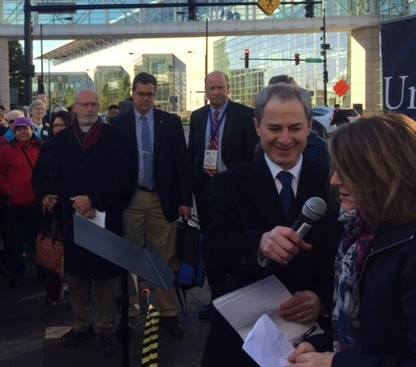
groundbreakingToday, I stand with my Muslim neighbors. As a pastoral leader in the Christian tradition and of a Christian congregation, as a leader in my community, I speak out publicly that I stand with my Muslim neighbors and colleagues.

Over the weekend, I’ve seen and read too many stories of Muslims being persecuted, being frightened to go out for fear of harassment, and of church and civic leaders making discriminatory statements about all Muslims on the basis of the horrible actions of radicalized people.

I should note as an aside, that though the perpetrator in the Charleston Mother Emmanuel Church shootings last June was a member of an ELCA Lutheran Church (the denomination in which I serve as a pastor) never once was I called on to defend my faith over against that killing or to distance myself from the shooter. It grieves me to know that my Muslim neighbors are now called on to do that thing they should not have to do.

Over the past 10 years in our broad-based community organizing work (DuPage United) here in DuPage County, Illinois, Muslim mosques and associations and people associated with those institutions have been valued colleagues and partners in our work. I have gotten to know many of my Muslim neighbors; they are people of peace who are concerned with justice and who are loyal fellow citizens of the United States.

We have worked together on concrete issues that matter to our community: government accountability, workforce development, mental health, accountability in our local community college administration, and affordable housing, to name a few.

On several occasions, a Muslim brother or sister has spoken in our congregation, either in worship or in our adult faith formation. They have participated reverently and appropriately in our worship, demonstrating a respectful curiosity for what we believe and how we practice our faith. When they spoke to our adult group, my colleague Ahmed did not avoid the difficult questions some of our folks asked about the treatment of women in Islam, the notion of jihad, and questions about Islam as a religion of peace.

In 2005 when Hurricane Katrina devastated the Gulf Coast, we launched a project to fill a semi-truck trailer with food and other supplies needed by those displaced because of the hurricane. While we received a consistent trickle of support from local Christian congregations, it was the Muslim girls’ school in Lombard who appeared one afternoon with a rented van and a couple of minivans filled to the brim with supplies they had collected from their institutions.

In late 2011 and early 2012, MECCA, an association of Muslims, purchased land and made plans to build a mosque and community center in the southwest corner of our county. In response, the County Planning and Zoning Commission began proposing a number of restrictions that would have prevented the construction from going forward. Several Christian congregations — partners in DuPage United — appeared before county meetings on behalf of MECCA. In the end, the restrictions were not enacted, permits were granted, and construction was able to begin. As a sign of their gratitude, they asked me to be the speaker for their groundbreaking ceremonies. It would have made so much sense to ask one of their own to speak and for me to attend as an honored guest.  Yet, they asked me to speak. That was an extraordinarily generous gesture.

I could go on with story after story of my own life and ministry being enriched by the gift and blessing of being able to work together with Muslim partners. The relationships I have formed have been meaningful and mutual. I am a better person and pastor for having had the opportunity to work with them.

I am saddened, disappointed, and angry that these fellow American citizens are experiencing persecution because of misunderstanding of Islam and the fear of the other. I cannot control what others do or say. But I can make sure that my voice of support, admiration, and respect is heard in the public square.

Today — and every day — I stand with my Muslim brothers and sisters.

The Fabric Is Fraying

EthansblanketThe fabric is fraying.

Maybe it always has been.

Today, I am feeling it acutely.

It’s still too early to know the details of the shooting in San Bernadino, California, but the news outlets are calling it a mass shooting.

These days in Chicago have been tense. The video of the shooting of Laquan McDonald has been public for a week, and it still haunts me. Every day something else dribbles out that ramps up the righteous outrage. Today it was the news that another video has been suppressed, a video of yet another young black man being shot as he’s moving away from police. Another case in which damages were paid, charges were not brought, and the offending police officer is still on the job, over 400 days after the incident.

Arrests were made in Belgium, men allegedly connected to the terrorist incidents in Paris a few short weeks ago.

Since 2011, some estimate that a quarter of a million Syrians have died in the civil war; that’s a bit more than 1% of the 2011 population of 23 million. Close to 12 million — that’s 50% — have been forced from their homes, and more than 4 million have fled.

The fabric is fraying.

Most disheartening to me is the way too many of our national leaders advocate the kind of action that has gotten us here — bombs, boots on the ground, no fly zones, suspicion of the stranger, close our gates, prop up the fiction of our security, change the subject.

The picture looks awful lot like the picture painted in our sanctuary on Sunday morning as the preacher read the gospel lesson from Luke.

Then there will be signs in the sun, moon, and stars; and there will be anguish in the earth month nations bewildered buy the roaring sea and waves. People will faint from fear and the expectation of things that are coming in the world because celestial powers will be shaken. Then they will see the Son of Man coming in a cloud with power and great glory. But when these things begin to take place, stand up and lift up your heads because your redemption is drawing near.

Though I don’t expect to see the Son of Man coming on the clouds, I feel the apocalyptic character of these times.

What would it mean for Christ to come in the midst of this mess?

The truth is that he does. The One who came to this mess centuries ago comes again now in the midst of our own mess. He still comes the same way, with the power of his gentle love. He walked among us, healed our diseases, calmed our fears, and rode into the Holy City as a king, though his noble steed was an ass and his eventual crown was woven of thorns. When we lift up our heads, we see his crucified body, broken so that we and this messed up world might be made whole again.

When that One who came as God among us spoke of apocalyptic times, he said — quite curiously, it seems to me — that in the midst of the turmoil, the preferred posture is not hunkering down or cowering in the corner. The preferred posture is to be standing, head lifted up. That’s a posture of confidence and action. It’s a posture of defiance in the face of evil and fear.

It’s the posture of those who know they don’t have to save the world; rather they are the ones who get to do God’s work of healing this broken world.

So, stand up.

Lift up your head.

Carry on.

Be open and vulnerable and generous.

Work with joy in your heart.

Refuse to close yourself off to other people.

Refuse fear and violence.

And live with the hopeful expectation that together, we can actually address humanity’s big challenges. Standing together with our heads lifted up.

I wrote this because I need to read it.

When the Newtown, Connecticut Police Chief Stepped to the Podium. . .

donotstandidlyby. . .the tears began running down my face. It wasn’t so much what he said. It was seeing in flesh and blood a man who had seen far more of the consequences of senseless violence than anyone should ever have to see; it was seeing in the lines on his face the toll that such a tragedy had taken. And it was the deep sadness that the senseless loss of life from gun violence goes on because we have not decided yet that enough is enough.

On Monday, I was at McCormick Place, the huge convention center complex in downtown Chicago, for a rally and press conference sponsored by Metro IAF, the midwest/east coast version of the community organizing affiliate that our congregation works with. For a couple of years now, Metro IAF has been working on a broad strategy directed at gun safety, Do Not Stand Idly By.

The rally was timed to coincide with the 2015 conference and exhibition of the International Association of Chiefs of Police. About 200 citizens mostly from Chicago and surrounding suburbs stood at the edge of the street stood across the street from the hall where the conference was being held. Inside the exhibition hall, major firearm manufacturers were displaying their wares, competing against one another for more sales to the government entities around the world that purchase these essential tools for law enforcement.

The IAF’s strategy is to leverage the buying power of government agencies at every level to force gun manufacturers to begin manufacturing their guns with smart technology that would allow only the owner of the gun to fire the gun. The technology is already available. One approach uses fingerprint recognition technology, similar to the security apparatus on the current generation of iPhones. Another approach requires a bracelet to be worn on the shooting hand before the gun will fire. (In addition to the website linked above, you can read more about the strategy in this Washington Post article.)

We heard personal stories that illustrate why the need for action is so urgent. DiAne Boese of Oak Park told of how as 4 year old child, she was a gunshot victim. She was playing in her yard with the child from next door who had found a gun at home and thought it was a toy. He pointed it at her head and pulled the trigger. The gun was loaded and went off, sending a bullet through her head. She spent most of her childhood enduring a series of surgeries and treatments attempting to repair that damage from that tragic accident.

A pastor from Bridgeport, Connecticut told of a promising 15 year old member of his congregation who got caught in the cross-fire of a gang-related shooting. “I have buried too many young people who have died before they had a chance to live,” he said.

Every day 150 Americans are shot and 83 (including eight children) are killed by firearms. Every year an average of 30,000 Americans die from firearms. A 2009 study at the Yale School of Medicine showed that over 7,000 children are hospitalized or killed due to gun violence every year. An additional 3,000 children die from gun injuries before making it to the hospital, bringing the total number of injured or killed adolescents to 10,000 each year. Why are we ready to accept such carnage? Why do we think it’s acceptable?

Attending the rally were police chiefs from Palatine, Illinois, Bridgeport, Connecticut, and Newtown, a few of the dozens of chiefs of police around the country who are endorsing this effort. When Chief Kehoe from Newtown spoke, his heartfelt plea was to take action. He is supporting this approach that provides a way forward that ought to find support across the political spectrum. It is neither pro- nor anti-gun. It’s a reasonable approach to gun safety and reducing the number of tragic shooting deaths. “With people like you involved and working, we can do this,” Kehoe said.

Decades ago, as a society we decided that too many people were dying in automobile accidents; we forced auto manufacturers to install seatbelts. Then we made laws that made it a ticketable offense not to wear a seatbelt. When that wasn’t enough, we forced auto manufacturers to install lifesaving air bags. Auto deaths have been reduced dramatically.  When we decided too many children were dying accidentally in baby cribs (a tiny fraction of the number of children killed by guns), we forced the manufacturers of baby furniture to change their design to reduce the chance that a baby would get stuck and die in the crib. The list goes on and on and on of instances in which the federal government has forced manufacturers of a wide spectrum of consumer goods to make changes that make those products safer.

I’m not so naive as to draw a straight line of causation between easy access to guns and the epidemic of gun violence in this country. That epidemic has a tangled and complicated web of causation. Still, it’s reasonable to hold that easy access to guns is part of the equation and something that we can easily do something about, if only we muster the communal will to do so. And it’s about time.

Perfectionism and the Topsy-Turvy Gospel

perfect familyLet me introduce you to Glen and Glenda from Glen Ellyn:  They are good people. No, I mean it. Glen supervises the regional marketing team for that company that everyone knows and has steadily and consistently been promoted. Glenda is a CPA and works for a small accounting firm doing small business taxes. Their kids are wonderful! Gary plays soccer and baseball, and is now taking trumpet lessons. Gertie has just started field hockey and loves her ballet lessons. They are both in scouts and the children’s choir at church. Glen helps coach soccer and baseball, and is the chair of the Worship Team at church. Glen and Glenda think it’s important to help the less fortunate, so they volunteer at PADS once a month and they have decided this year to help organize the fifth grade classes to do a food drive for the Glen Ellyn Food Pantry.

You would love their house. Glenda has decorated the living room spectacularly; it looks like the cover of a magazine. And not to be outdone by the neighbors, Glen has manicured his lawn to Wrigley Field specifications. It looks perfect. Every Friday afternoon he even cuts the front yard twice so that it has that crosshatched look to it. Not a weed is to be found in that lawn.

These are good people. They are model citizens. They are the kind of people, we might say, that if there were more of them, the world would be a better place.

These good people are tired. They are stressed. They complain about having no time, of being pulled in a thousand directions; they feel consumed and overwhelmed by the pressures around them. They are living, but it’s not much of a life. How can they be doing so much and feel so empty?

We are socially conditioned to be good people. In fact, I think we are socially conditioned to be perfect people.  This perfectionist strain means we have to do everything right — house, marriage, parenting, work, community involvement, church. Now, of course, no one can do that, and in our minds, we know it’s impossible, yet in our guts, we somehow try. So we refuse to make choices, thinking that if I say no to something, there is something I might miss. Because so much is possible, so much must be necessary. Trying to do everything and trying to do everything perfectly is sucking the life out of us.

Imagine Glen and Glenda taking that trip to Italy that they’ve always wanted to take. Two days in Rome, and they get on one of those touring buses and they see everything. The next morning it’s off to Tuscany where they take a quick tour of Assisi in the morning and a vineyard in the afternoon. The next morning it’s off to Florence, where they rush through the art museum in the morning and the cathedral and the shopping district in the afternoon. The next morning it’s off to Venice, where they go see the glassblowers in the morning and a gondolier ride in the afternoon and a romantic dinner along the canals in the evening. Another day split between the leaning tower of Pisa and Cinque Terre, then a day in the lakes region, a day hiking in the Italian Alps and then a day taking the train back to Rome where they fly out the next morning. When they get back to Glen Ellyn, they’re so tired, they need a vacation. They have a photograph of everything, but they have seen nothing.

Does it sometimes seem like that’s how we live?

It recalls for me a story about a rich man who came to Jesus. “Good Teacher, what must I do to be saved?”  The man was a good man. He really was. He had kept the commandments since his youth. He had worked hard. He was a exemplary citizen and a model member of his local synagogue. Infected, perhaps, with that perfectionist virus? How could he do so much and still feel so empty?

“Go. Sell what you have an give it to the poor,” Jesus said. Jesus confronted him with the impossibility his perfectionism. Called his bluff. Forced a choice: the endless and elusive striving to be a good person. Or something different. A life that’s not an achievement, but a gift.

We are not called to be good people. The gospel of Jesus calls us into the circle of God’s love, a love that flows to us in Jesus’ death and resurrection. In Christ we are made new, now, and again each morning. God makes us good people. Goodness is not an achievement. Perfection is neither a requirement nor a goal. In this new kingdom, our lives are not defined by what we achieve. We are loved, and because we are loved, we serve.

This topsy-turvy Gospel and this upside down kingdom of God call us to live differently. Receive the gift. Make some choices. Pare it down to what’s essential. Do your part. Not everything. Your part.

Wouldn’t that be life-giving? Wouldn’t that feel like freedom?

On Living in Fear. Or Not.

lockdowndrill.jpgLast week, I made the last of my confirmation visits to our seventh grade students, the ones entering our two-year confirmation process. Most of the visit is about just getting to know the students, what they are interested in, what school is like for them, what they did over the summer. When I asked about school and about how the year had started for him, the student I was visiting stopped me and suddenly became much more animated. He began to recount what had happened that very day. He told about a drill they had to go through to help prepare them for what might happen if a shooter came into their school.

They were told over the intercom that the school was on lockdown and that they should initiate the protocol for an emergency involving an armed intruder to the school. During the first week of school, they had been told what to do; they knew the drill, literally. So, the entire class of students huddled in a corner of the room away from the door and windows and the teacher locked the classroom door.

They didn’t know whether or not it was a drill. They didn’t know that it wasn’t, and the student said they thought it probably was, but they weren’t told whether it was or not. He talked about the wave of fear that overcame the huddled group of students when someone came to their classroom door, unlocked it and stepped in. It was someone the student hadn’t seen before, and his first thought was that this was real and someone had just entered their classroom to harm them.

As it turned out, it was a new custodian who apparently hadn’t gotten the word about the drill and was just going about his work of emptying trash cans. ‘

This all happened last Thursday, ironically, the same day that the mass shooting happened at Umpqua Community College in Roseburg, Oregon. Of course, the students didn’t know any of that, and I suppose it doesn’t matter. Only one of those strange, haunting coincidences.

As I sat there listening to this seventh grade student — a bright, well-adjusted, very gifted and articulate student who is growing up in a stable family with two parents who love him and provide for him — my heart sank.

I get the idea of safety drills. No one ever knows what is going to happen and practicing what to do if the bad stuff happens makes some sense. I grew up on the plains of western Nebraska, an area where tornadoes were not uncommon; we went through tornado drills and fire drills. We always knew when they were drills and when they weren’t. We’d do our thing of getting out of the school for a fire drill, or getting down under our desks for the tornado drill, and then it would be over and we’d get back to our business.

But I never worried about someone coming into my school intent on shooting us. Now, our children worry about that. And in the case of the drill fail at a local middle school last Thursday, we had a group of students who for a split second thought that their nightmares were coming true.

I think it’s bad enough that so many lives are ending too quickly and too violently because of gun violence in this country. I think it’s horrifying that we witness so many mass shootings.

But think about this. Aside from the massive, senseless loss of life, we are raising a generation of children who are learning to be afraid. We are teaching them to be afraid of someone coming into their school to shoot them, that we have to worry about terrorism every time we get on an airplane, and that people who look different are to be distrusted because they could be terrorists. The pervasive culture of fear, especially for our children, is among  the most tragic consequences of all.

For now, let me state the obvious, and something which requires a choice for each of us: we don’t have to live in fear.  Parents, we don’t have to live in fear. Let your kids know we don’t have to live in fear. There is a big, beautiful, awe-inspiring world out there, full of wonder and mystery, full of abundance and beauty. The bogeyman under the bed wins if we let him. We can choose to embrace what is good and beautiful about life, about community, about the people around us, the ones we know and the ones we don’t. We can live with curiosity and gratitude. Joy is possible. We can live hopefully, knowing that together we can curb the impulses to fear and the violence and hatred that engenders it. Choosing to see the good and dwell on it is the antidote to living in fear.

I get my 35 middle school students for 90 minutes a week, and I’m determined that this is going to be a drumbeat with them. While there are scary things out there — there always have been — we don’t have to live in fear. I’m not about to let the madness draw my attention away from that.

On Leaders Who Disappoint and How Real Change Happens

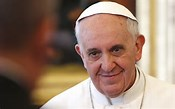
francis.jpgIn his speech before Congress Pope Francis managed to rise above the fray.  With no histrionics, he spoke directly and simply, yet profoundly. The speech surprised me; he managed to address the divisive issues that have become occasions for the two parties to shout across the aisle at each other. He spoke in such a way that all of us in this divided house could listen.

Not forty-eight hours later came the report that Pope Francis met with Kim Davis, the Rowan County, Kentucky county clerk who has refused to issue marriage licenses to anyone as a way to make a stand for her opposition to gay marriage. Since the news came out, there have been as many interpretations of that visit as there are positions to take. And regardless of the Pope’s awareness and degree of complicity, that meeting has enormous symbolism. I’m not ready to make a personal judgment; however, for the symbolic impact of that visit, I am disappointed.

It’s disappointing to me because Kim Davis is the icon for a brand of Christianity that is disdainful to me. It’s a brand of Christianity that makes our faith more about the rules than about relationship, and especially rules about sex. I wish we could just get off of that. Every time I turn around, someone else is reinforcing the ridiculous notion that the Christianity is mostly about rules, and we’re concerned about the sex rules more than any others. It’s maddening.

While I’m disappointed that the meeting happened, I’m not losing much sleep over it. While I was impressed with the pope’s speech before Congress, I never went over the moon about it. He represents a change of tone from the Vatican, but perhaps not much else. A friend, who is a good Roman Catholic and an astute observer of all things Catholic, often reminds me that nothing of substance has changed.

Leaders inspire us. Leaders disappoint us. Sometimes leaders just downright make us mad. Just ask the members of my congregation.

The whole back and forth saga of the pope’s visit to America — and I have to imagine that it feels the same for both conservatives and progressives — is a reminder that while leaders have influence, real change is not going to happen from the top down. Bernie Sanders (another leader who inspires me and who I’m sure will disappoint me and enrage me) reminded students at the University of Chicago this week that real change, deep change never happens from the top down. It always happens from the bottom up, beginning at the margins and moving towards the center.

Earlier this week, I facilitated a bible study with a group of about 20 women. Part of our study was about the gospel lesson for this coming Sunday (Mark 10:2-16, if you want to read it), a difficult text where Jesus pits scripture against scripture. On the one hand he holds up the inviolability of the marriage covenant; on the other, he cites the Mosaic law which allows for divorce in certain occasions, a legal move which was only available to the man.

The study led us into conversation about marriage, about the difficulty and hard work of relationships, especially relationships like marriage. And it led us into the tall grass of a conversation about same sex marriage.

I fully celebrate that our gay and lesbian brothers and sisters can now be legally married. The sealing of their covenantal love is just as holy and just as wonderful a relationship and covenant as heterosexual marriage. I also know that not everyone in the congregation I serve shares that opinion.

The conversation we had yesterday would not have happened a dozen years ago in this place. Partially, it’s a sign of the rapid change that has happened in the larger society.

But I’d like to think that the priority we’ve placed on having deep and meaningful conversation in our congregation has contributed to the change. Over the past dozen years, we have created space for lots of conversations about lots of things. Forty or fifty people meet every week for bible study. We host conversations about the intersection of faith and life. We talk a lot these days about the rapid changes in our society and their impact on the church. Every council and team meeting includes time for conversation and prayer. At any given moment in time several groups, including our staff, are reading and discussing a book together. We have hosted authors to lead us in conversation about things that matter. When space is created for people to listen to one another, space is also created for the Spirit to soften our hearts.

It’s not the kind of change that happens rapidly; it’s not always even visible. But it’s the kind of work that forms and shapes us as the body of Christ, forming us as individuals, and more importantly, forming us as a corporate body, so that our thoughts, words, and deeds are in greater alignment with the work God is doing in the world, so that we are participating with God in bringing about the kingdom.

Lament at the Closing of a Church

churchclosing.jpgFor an unremarkable Tuesday morning, too many cars populated the aging parking lot, weeds abundant in the cracks in the asphalt. In the lobby of the church, a woman sat with a clipboard balanced on her walker taking the names of those who entered through the front door. Next to her was the first indication that something was a little off. Still the middle of September, boxes of Christmas decorations, including strings of lights and a random collection of extension cords, sat on the floor in the open area. In the church office, another white-haired woman sat behind a desk. Next to the door was a hand-written sign written with a felt-tipped marker. “Donations.”  The short hallway leading to the sanctuary was littered with rolls of colored paper, a portable steamer, and a few boxes with unidentified contents. A variety of textiles — banners, altar paraments, vestments —  draped the sanctuary pews. On a shelf behind the altar and on the communion railing were rows and rows of glass vessels of all shapes and sizes. Scattered around the altar were candles and candelabras and a potpourri of gadgets used for the church’s worship.

The congregation is closing at the end of this month. What lay around the building was a collection of physical stuff that had accumulated over the years that this proud congregation had been serving its neighborhood.

So, this is what it looks like when a congregation closes. Or at least what it looks like when one congregation closes, one of the over 4000 that close in the US every year.

I had traveled to the south suburbs of Chicago to see if there were things that could be put to use in my congregation. It didn’t feel good to be there. It felt a little like picking through the clothing of someone who had just died. While there, I was dealing with my own feelings about the closing of a congregation. What had happened? What was the tipping point? What does this say about the church? Is this where we all are headed?

Later on in the day, I started thinking about those women. What must it have been like to see things that had meant so much to you carted off and loaded in the backs of cars you had never seen before, taken by people who were strangers and who were taking them to undisclosed locations? What did it feel like to see banners that had been visual reminders of faith and that once hung in your sanctuary, folded up and carted off? What was going through their minds when someone carried out in a cardboard box eucharistic vessels from which they had received the sacrament hundreds of times. To those of us picking through the spoils they were just things that we hoped might find a use; to those who were watching, it must have felt like a part of their lives were being carried away. Maybe it was a little like the women who sat in a different garden in a different time and place.

I was chatting with another pastor, sharing with him my discomfort at picking through the piles. He shared the same discomfort and then added, “It’s a positive that this congregation has decided to become a legacy congregation.” I suppose in a sense that’s true. Their stuff will live on in another ministry. It’s at least a way to put a positive spin on it. When they sell the building, the proceeds will likely go to a judicatory fund that is supporting new initiatives. On some level that is all good.

But I’m leery of jumping to the positives too quickly. To jump too quickly to the saccharine platitudes covers over the reality that something is dying. It’s not something anyone has to feel guilty about. It may not even be something that anyone has to take responsibility for. Yet it’s real. There is loss. There is sadness. There is grief. I can imagine that it must hurt. To acknowledge that is important. To lament is a holy thing.

Something will rise from the ashes; that’s God’s way. Accompanied in the wilderness by a God of resurrection and life, that’s our hope. Hope is made more real when we can acknowledge that we don’t need to explain away or cover over the grief and sadness.

To you, members of Prince of Peace Church, I don’t know with any precision what you are feeling in the midst of all this. But I acknowledge my own sadness and that I could feel something of your grief in my bones. And for the moment, I sit with you at the waters of Babylon.

What If It’s Not about the Rules?

bibleIt’s like that car crash that we can’t not look at. We all want it to go away, yet we keep looking.

That county clerk in Rowan County in northeastern Kentucky has now become the poster child for what some are calling a courageous stand for religious freedom. Her supporters are cheering for her version of Christianity, citing biblical support for her defiance, claiming that she is a righteous woman who is properly obeying God in the face of a law that would require her to sin were she to follow it. Her cause has been picked up by at least two Republican presidential candidates, Mike Huckabee and Ted Cruz; they appear ready to canonize her as an icon for what they would like this country to be.

Here I sit. An adherent of the same religion, at least in name. A leader in the church. I see her defiance very differently, not as something that brings honor to her faith, but distorts and diminishes the heart of Christianity. She willfully is disregarding the oath that she took when elected as County Recorder. I don’t have so much an issue with that fact that she disagrees with the Supreme Court decision legalizing same-sex marriage. That is her constitutional right. But if her conscience dictates that she can’t do what her job and her oath of office require, then she should resign. Instead she has chosen to grandstand and drag the whole country into this fake debate about religious freedom and a drama that is mostly irrelevant.

It is so striking to me how adherents of the same nominal Christian faith can come to such polar opposite conclusions about her actions, and more fundamentally, about the issue that prompted her grandstanding. Mike Huckabee is an ordained Baptist pastor and was the pastor of a large, successful Baptist church before going into politics. Ted Cruz grew up in the church; his father was the pastor of a large, successful fundamentalist-leaning church. Cruz is graduate of Princeton first, and then Harvard Law School. These are not stupid people.

While I don’t carry the educational credentials of Cruz, I am a leader in the church and called on almost daily to articulate the Christian faith. I come to vastly different conclusions about Davis’s actions, about gay marriage, and I suppose about nearly every other aspect of Christian teaching and Christian life. How can that be?

Earlier this summer, I read The Righteous Mind, a fascinating book by Jonathan Haidt. Haidt is a moral psychologist and the book sets out to describe how persons shape their moral universe. The common understanding is that people find their fundamental moral principles — often in their faith and their own sacred texts — and then arrive at actions and beliefs that are reasoned from their fundamental moral principles. So, for instance, if we are adherents of Christianity, we look at what the bible has to say about moral issues, the voice of the bible leads us to our moral principles, and then we determine our actions based on those principles.

But Haidt suggests that this isn’t the way it works. Using a wide array of theories, research and experimentation, he describes how people intuit moral positions and then go in search of a moral framework to support their position. So, for instance, if I have an intuitive disdain for homosexuality, that decision is made “in my gut” as Haidt describes it, and then I go in search of support for my position. Did you get that? Let me say it another way: we go looking for divine support for positions that we have taken intuitively.

I’m no expert on psychology, and so I can’t evaluate Haidt’s thesis as an expert. But he does make a compelling case. It strikes me as a cogent argument for, among other perplexing questions, why adherents of the same religion come to such different moral conclusions.

But it also shakes religious foundations to the very core. What could it mean if we do not, in fact, base our moral principles on our sacred scriptures, but on our intuitions that have been shaped by our upbringing, our culture, and even our personality? What then, could Christianity possibly be about, if not a moral code for righteous living?

As far as I can tell, Christianity has never been a moral code. it’s always been about a relationship and a calling. It’s about a recognition of our brokenness, a transformation that comes through Jesus and results in a dying to self and a rising to a new relationship with God, and then a calling to be in the world in such a way that you love God and love your neighbor. Morality? That’s something different.

That fundamental core of Christianity is so easy to forget. We want to be the good people. To be the good people requires knowing the rules. Knowing the rules means you have to make the rules. Then you can tell everyone else what the rules are. And if you don’t like the rules, then you make a different set of rules. And then we get to the kind of saga that is getting played out on our television screens and Facebook feeds, such a distortion of Christianity that I can’t even recognize it.

Here’s to believing it’s not about the rules.

Relationship. Relationship. Relationship.

picnic2Here’s what happened on Sunday afternoon at church. Nine people who didn’t even know each others’ names at 12:00 noon, 90 minutes later were hugging one another, shedding a few tears, and demonstrating a general reluctance for the meeting to be over.

It was the first gathering of folks who want to become members of our congregation. We did it differently than we’ve ever done it before; not surprisingly, the outcome was different than it ever has been before.

Thirty years ago, my pastoral training told me that I have the responsibility to impart a certain body of information to those who want to join our church. They need knowledge of the very basics of the Christian faith: who Jesus is, what he did, what we believe about God and the Spirit, what faith is, how we are saved, what the church is, the sacraments, stewardship, and on and on. I’ve had this sense that if people are going to join a confessional church , then they ought to have an idea of what they are confessing.

As if that weren’t enough, I’ve thought it would help them to assimilate into the congregation if they were given information about our church: our worship and why we do what we do, our various ministries, Sunday School and Adult Faith Formation, the stuff we do in the community. We’ve brought in staff members to describe their ministries, and folks who are already members to tell them a little about what they love about Faith.

In the back of my mind, it’s always felt a little like we were going through the motions, that people showed up, but they weren’t transformed in any meaningful way. It was like we had set up this relatively benign obstacle course that they had to complete in order to join the club; they did it; and they were in.

We did something different on Sunday. We had lunch together and enjoyed some casual conversation as we ate. Then we did bible study. Here’s the catch: not informational, knowledge-based bible study. Instead, we used Eric Law’s Kaleidoscope Bible Study method. The passage is read three different times; each time, the group is given a different question to reflect on while the passage is read and then there are three rounds of sharing. We also used Law’s process of mutual invitation:  after each person shares, they invite  someone else at the table to share.

It would not be appropriate for me to relate the conversation that happened in that room, but I can say that it got very real very quickly. People told stories of loss, of the difficulties of life, of the challenges of parenting, and of the struggle to believe. Matters of faith became intertwined with the realities of life and the Christian faith bloomed into something intensely relevant. What’s more, an almost miraculous personal bond developed among people who walked into that room not knowing each other’s names. In 28 years of ministry, I can’t ever remember that happening with a group of new members.

I’m pretty sure I haven’t discovered the holy grail of assimilating people into the faith. It was one meeting. We have a long ways to go.

But that experience was one more in a long line of experiences that is reinforcing for me just how critically important relationships are to the work of the church. I did not get into this work leading with my heart; I got into this work with my head. I love theology and books and bible study. I began pastoral ministry with the central notion that it was my job to impart a body of knowledge that would help people be Christians. “Faith comes by hearing. . .” and all that. It was never that relationships were unimportant; they just weren’t primary.

It’s been a long, long transition — one that I am still learning, and still trying to live into — to come to the place of putting my head in the background and leading with my heart, to know that all church work is about relationship and that while the cognitive aspects of the faith are not unimportant, they mean almost nothing apart from relationship. After all, a relationship with God is very, very different than knowledge about God.