Author Archives: Jim Honig

Unknown's avatar

About Jim Honig

Lutheran pastor in the western suburbs of Chicago. I'm a writer, a runner, an avid outdoorsman, and a curious student of people and the human condition.

Because Resurrection Is More Than a Metaphor

resurrection.jpgYesterday I posted this on my Facebook page: it seems to me that the challenge of preaching on Easter is to preach resurrection as something that God really did and still does without turning it into a metaphor for stuff that was going to happen anyway, with or without Christ’s resurrection.

Too often, I think I’ve missed the point in my Easter preaching. In 25 years of Easter preaching, I think I’ve preached a few of those Easter sermons where I talk about our own experience of resurrection.  Someone experiences a reconciliation in a relationship; it feels like a resurrection. Someone is told that they’re cancer-free; it feels like a resurrection. One year, we had come out of a pretty serous congregational conflict; Easter that year felt like resurrection, and I’m betting that’s what I preached. In those cases, I was using resurrection as a metaphor. In a sense, they were resurrections.  A metaphorical sense. I’m not denying God’s presence in those experiences, and I’m not even going to deny that God might have had something to do with them, though I’m less certain about that. Regardless, they aren’t the point of Christ’s resurrection. Those things would have happened whether Christ rose from the dead or not. And if Christ’s resurrection is the game-changer that the New Testament tells us it is, then it has be be more than a metaphor for the places in our lives where we experience rebirth.

In that great chapter that interprets the resurrection (1 Corinthians 15), Paul begins by simply stating that the resurrection happened, that it’s an historical fact. He doesn’t begin by explaining it, but by proclaiming it. He then goes on to say that Christ’s resurrection from the dead means that there will be a general resurrection from the dead; Christ is the first in a long line of those who will rise from the dead. But even that isn’t what Paul is getting at, I don’t think. It’s an aside; not unimportant, but not the point.

What lies closer to the center of what Paul is getting at is embedded in these words:  Then comes the end, when he hands over the kingdom to God the Father, after he has destroyed every ruler and every authority and power. For he must reign until he has put all his enemies under his feet. The last enemy to be destroyed is death. (1 Corinthians 15:24-27)

God’s work is on a trajectory. The kingdom is coming. The work is happening. God is working to foil the powers of evil and sin, to bind the powers, to lay low the authorities. Christ’s resurrection was the decisive turning point in the work of bringing all things to their fullness, to that restoration that God promises, the endgame to which all things are moving.

To do that God has made a people. That’s not our usual language to take about the fruit of Jesus’ death and resurrection. We’re much more likely to talk about personal salvation, of the implications of Christ’s resurrection for me personally. But I don’t think Christ’s work has ever been about personal salvation. It’s been about calling and creating a people.  It’s been about a body, a qahal, an ecclesia. It’s been about  forming a royal priesthood and a holy nation (not to be confused, fellow Americans, with a nation-state).

So, the connection of Christ’s resurrection to our own baptism is not that we have now been saved, it’s that we have now been joined to a body through whom God is working to bring redemption, healing, and reconciliation to all creation.

Here’s why I think it’s important. There’s enough bad stuff going on out there to make any reasonable person give up on resurrection and just let it be a metaphor for nice stuff that happens regardless of whether or not the tomb was empty on that first Easter morning. Truth is, I don’t guess that there is any more wrong with the world than there usually is when Eastertide rolls around. But it seems like it to me. I’ll own that. The bombings in Brussels aren’t anything new. But they are fresh and raw. This crazy circus that we call a presidential campaign has moved from the sublime to the ridiculous to the downright scary. My heart aches at the way we polarize and demonize each other and perpetuate structures of oppression. These are the front lines of the rulers and authorities and powers.

Most personally, for the last month our family has been trying to support each other and find light in our own darkness. Five weeks ago, our grandaughter, Eliana Frances was born; she’s a precious, beautiful little girl. Eliana was born with an extremely rare skin disorder, epidermolysis bullosa, and has been in the neonatal intensive care unit since her birth. EB is a very nasty disorder in which baby Eliana’s skin is deficient in the proteins that allow the layers of skin to adhere to one another. The doctors and nurses work tirelessly to manage her severe pain.

The resurrection of Jesus is not immediately going to change any of that stuff. The presidential campaign is what it’s going to be. Turning around the structures of oppression will take generations. ISIS isn’t going away and there will be more loss of life in terrorist incidents. And the resurrection of Jesus isn’t going to cure Eliana.

So, what does it mean? I think it means that in the midst of all the shit, in the damn middle of all the obvious signs of sin and brokenness and darkness and evil, God is at work. If the resurrection of Jesus was a game-changer, then I have to believe that in the same way that God was at work in Jesus’ death, so God is at work in the midst of the contrary bringing life in the midst of death. It’s a bit of a misnomer to say that death has been defeated; there’s too much of it hanging around to believe that. Paul reminds us that one day it will.

Here’s where we get at what I think is the heart of the game-changing action of God in Jesus’ resurrection. If God is at work in the middle of it all, then the body of Christ must be the incarnation of that work, a body called to live differently.  We are called, reborn, and empowered to be a people who live as if that defeat has already taken place. The powers and authorities are at work: anger, rage, oppression, vengeance, retaliation, fear. Those are the ways of death and they eat away at the human soul. They are the ways of death that God intended to put to rest in Christ’s resurrection. In it’s place a people was created who love without condition, who serve without counting the cost, who honor every human life as a brother or sister made in the image of God.

A people who have been raised from the dead. Not metaphorically. Literally.

A Modern Pentecost

imageAt least once a year when I have to preach on the great story of Pentecost, I sit at my desk wondering what that must have sounded like. The story in the Christian scriptures tells how the followers of Jesus were stuck indoors waiting for instructions about what to do next after Jesus had returned to the Father. The writer of Luke-Acts describes the sound of a rushing wind enveloping the room. Later in the day, those same Jesus-followers took it to the streets and there began telling the story of Jesus to the visitors who had made pilgrimage to Jerusalem. I try to imagine the buzz on those Jerusalem byways as people from all over the world heard the proclamation in their own languages.

I caught a glimpse of the Pentecost phenomena on Sunday afternoon at the “Know Your Muslim Neighbor” Solidarity Event on Sunday afternoon. The event was sponsored by DuPage United, our local Industrial Areas Foundation community organizing affiliate. 850 people showed up. Yeah, I know. Amazing, right?

The numbers were impressive. But it’s not the raw number that is the important thing here. It’s what the numbers stand for and what happened. That many people showed up on a Sunday afternoon when they didn’t really know what was going to happen. What is a “Solidarity Event” anyway?

I have a hunch why our Muslim neighbors showed up. There is some measure of fear in the Muslim community. And with good reason. Too much of the hate-filled rhetoric coming from public figures is directed at them. They hear the language and see they the footage on television. Two days before our event, three Muslim teenagers were shot execution-style in Fort Wayne, Indiana. More importantly, they experience it in their daily life. One woman told a story of making phone calls for the PTA at her child’s school. The mom on the other end of the line asked her where she came from – she was born in America, by the way – and then proceeded to tell her that she didn’t belong here; she should go home. A Pew research poll a few years ago indicated that nearly 60% of Americans believe that Islam and American values are at odds. Yet 60% also admit to never having met a Muslim. My experience – at the event on Sunday also demonstrated – is that Muslims are eager to make connections and to dispel the stereotypes. The best way I can think of to do that is one person at a time.

But why would the Christians and Jews show up? I’m not exactly sure. But when I have talked with a few members of my congregation, they came because they don’t like what they see. The division and rancor in the national conversation disturbs tem. They don’t know what to do but they want to do something. So they showed up. And without exception, they have reported what a meaningful experience it was.

This event was designed and planned for the primary purpose of making connections across the communities, communities diverse in religion and culture, but communities that share so much in common.  We believed that if we could get people into the same room talking to each other, we could begin to dispel the stereotypes. We also wanted to make a public statement – directed especially at public officials and the media – that we will not tolerate hate-filled, prejudice-laced rhetoric.

The program wasn’t fancy. There were some introductory remarks, and a series of three speakers, each of whom spoke for 5 minutes. But the speakers weren’t the central focus. Between each of the speeches, the participants were invited to turn to their neighbor and hold conversation on a particular question. They questions were not particularly deep; they were not controversial. They were simply doorways into a one on one, human contact that is the fundamental building block of human society. Judging by the response of the folks on Sunday afternoon, it’s something that people are craving, even though the contact happened to be with perfect strangers.

In the last few days, I keep hearing powerful testimony of what happened in the conversations. Muslims told their stories of experiencing harassment and prejudice; non-Muslims learned and sometimes were shocked to hear that in this country where we supposedly honor the value of religious freedom, our fellow citizens do not feel free to practice their religion. A clergy colleague wrote me that she and a young Muslim woman sitting next to her realized at one point that they were both crying. The tears were partly sadness at the way things are, but they were also tears of hope at what might be, hope embodied by 850 people sitting together making conversation.

When small seemingly insignificant conversations become powerful moments for people, it says something. It’s worth noticing. It’s work that is fundamental to repairing the fabric of our society. We have a fundamental need to get beyond the isolation and division. We need a vision of what e pluribus unum might look like in the 21st century. That vision will not be enacted by politicians passing legislation; it won’t be happen by activists marching in public places. It will happen as we engage the long, slow, sometimes difficult, and ultimately rewarding and healing work of relating person to person, congregation to congregation. It will happen as we build those relationships, build our power, and then begin to take action.

In both the ancient Hebrew and ancient Greek language, the words nephesh and pneuma can be translated variously: Spirit, wind, breath. Gathering in that room on Sunday afternoon, as folks used their breath to engage in conversation, it sounded like the rush of a mighty wind. And I’m convinced it was the voice of the Spirit.

Which Story Will We Tell?

groundbreaking
The stories we tell have a powerful influence in determining the life that we will lead. In our national life, we need a different story.

Every morning when I get up I get to determine which story will guide my day. Some days I am all too aware of my deficiencies.

  • I’m not very organized.
  • I live in my head.
  • It’s easy for me to procrastinate.

Some day’s it’s hard not to let that be the story.

I also recognize that for all my deficiencies, I also have gifts and I get to do my work in an amazing congregation with amazing people who invite me into the celebrations and the sorrows of their lives. I get to be part of God’s big work of bringing hope and life to a hurting world. That’s pretty cool. I want that to be the story that guides my day.


With respect to so many important matters in our national life together, we the people get to decide which story we’re going to tell.

There’s a story being told by the candidates for arguably the most powerful office in the world. They’re telling what is apparently a compelling story.

  • We should be afraid of people that aren’t like us.
  • Religions other than Christianity are dangerous.
  • By virtue of US power and exceptionalism, we have the right to impose our values and inflict violence on people around the world.
  • People who want to provide a life for their families have no right to leave war-torn places or places which offer them no opportunity for work to support their families and come to this land of opportunity.  (Even when, arguably, our own military and economic policies have contributed to the circumstances which have led to their insecurity. I digress.)
  • We have no obligation to our neighbor; I only need to care about myself and my tribe.
  • What makes us different and divides us is much more significant that what makes us similar and unites us.

While it may be a compelling story, it’s also a story that goes against everything I believe about God, about the human family, and about our life together. So, I am determined to tell a different story.

This Sunday, I’m going to be part of a gathering of Muslims and Christians that is sponsored by DuPage United, an organization of organizations committed to developing partnerships and taking action to improve our communities. Just before Christmas, a few of us came together believing that the story that is getting told is not the story we want to live. A little over a month ago, we set the ambitious goal of an event that would include 500 people, roughly equal numbers of Muslims and non-Muslims, to gather for conversation and relational work. Who would have believed that 4 days before the event, we have nearly 700 signed up, and we expect those numbers to continue to grow until we gather on Sunday afternoon? The majority of time will be spent one on one, neighbor with neighbor, getting to know one another; in doing so, we will begin to repair the torn fabric of our communities. We intend this event to be the opening of a long campaign of solidarity and partnership.

We are getting together because we want to be guided by a different story.

  • Our differences are not be be feared, but embraced.
  • We need each other and we can learn from each other.
  • Our neighbors are not strangers to be despised; they are fellow human beings to be loved and served.
  • We are all called to work together to enact God’s vision of a world redeemed and reconciled.

From what I can tell, it’s going to be a pretty good story.

I’ll come back next week and let you know how things went.

On Being Afraid to Open My Scriptures in a Coffee Shop

bibleI had a morning meeting in Hyde Park. It’s about 25 miles from where I live and takes me through the heart of downtown Chicago. At best it’s a 45 minute drive; at worst, it can take more than an hour and a half. I hate sitting in traffic. My solution? Get up when the humans are still asleep and get on the road. Early. Upon arrival, sit in a coffee shop and get some work done until it’s time for the meeting.

It took 45 minutes. Perfect. Found that coffee shop, did my journaling and then turned to one of my lenten commitments: to read through the gospels in these 40 days. I sat there in that public place at a small table next to the counter with my little pocket bible open, reading Matthew 13 and 14.

Where I live, that’s a common thing. On those days when my morning meeting schedule takes me into Panera or Starbucks or Blackberry Market or River City Roasters, I can virtually guarantee that someone will be sitting there with a bible open. Just as often there’s a group (usually it’s men) having their small group/accountability group/prayer meeting right there in that public place. In fact, I remember some of those books I had to read for evangelism class in the seminary encouraging that very tactic as an opportunity to witness to the faith. Someone will stop and ask what you are doing and you can tell them about Jesus. It’s ubiquitous. It’s expected. So, afraid to open my scriptures in a coffee shop?  Never.

On Monday evening, I sat with a group of Muslims and Christians. This came up in the conversation:  my friend and colleague said in passing that she’s “afraid to open my Koran in a public place, much less pray.” A public place like a coffee shop. Or restaurant. Or library. Afraid of harassment, or worse, of physical abuse.

And I cried inside. A simple thing that is so common for Christians is something that our Muslim neighbors are afraid to do.

This xenophobic climate being fanned by public figures is not theoretical. It’s not empty rhetoric. Words matter. These are real people. And they are our neighbors. Fellow Americans. Fellow citizens.

Silence is complicity.

Ash Wednesday — Beginning the Journey

mountaintopWe stood in the trailhead parking lot about 20 miles and a few thousand feet above Aspen, Colorado. It was already getting close to noon, a few hours later than we had hoped to get started. The skies were gray and a fine, misty rain was falling. We had to make a decision. Head out on the trail or go back to town, find a room for the night and formulate Plan B.

I was nervous anyway, the kind of anxiety I always have when we’re ready to head out on the backpacking trail for a few days. Have I remembered everything? Will the gear hold out? What will the weather be like? Will the map be accurate and will we be able to find the right trail at the right time?

My anxiety was heightened because just a year earlier, we had tried to hike the same 25 mile loop, a loop that crossed four 12,000-foot-plus passes. But I couldn’t do it. I hadn’t trained well enough and got a mild case of altitude sickness. A year earlier, Plan B had been a shorter, less strenuous, and less spectacular route.

But my sons, Chris and Tim, had heard so much about this loop, about it’s beauty and spectacular views that they were determined. I had trained, worked hard to get ready, and wondered if it was going to be enough.

Here we were. About to begin. In the rain.

Though we talked for a few minutes about our options, there was no question. There was no Plan B. We were going to do this.

We set out, Chris and Tim with all the confidence of headstrong adolescents who delighted in physical challenges. Me with all the doubts of a middle-aged realist who couldn’t shake the memory of the previous year’s fail.

That first afternoon was only a few miles, a couple of hours, and a relatively mild climb, though I remember thinking that it was plenty steep. It would only be mild in retrospect and in comparison with the climbs that lay before us.

For some reason that trip came to mind last night as I was winding down at the end of Fat Tuesday and anticipating this morning’s beginning of the lenten journey. Last night felt like standing in that parking lot about to take the first step of a journey that was known only by looking at a route on a map. The journey itself would play out in time, step by step.

I have thought about this year’s Lenten journey and sketched out some lenten discipline for the next 40 days. I’m going to read through the gospels in these 40 days. I’m going to fast once a week, starting today (though I guess according to today’s gospel lesson, I’m not supposed to tell you that). I’m going to abstain from alcohol.

But right now, this journey is represented by intentions only. Like that 4-day hike represented by some dotted-line skritches on a map, this journey will get played out in time, step by step.

There are some big things on my calendar — a grand experiment at church, a preaching series to launch a Year of Discernment, a big solidarity event with some mosques in the area. I’m looking forward to those things.

Even more, I’m looking forward to deepening some spiritual practices that often get rusty in the rush of daily activity. Each year, Lent for me is a time to press the reset button, to wipe the dust off the practices in my daily life of faith that I intend always to be there but somehow get forgotten.

The gift for me this morning, on this Ash Wednesday morning, as I think about the steps of my journey to the Pascha, is that I have caught a glimpse of the truth that is always there, but is too often hidden to my view — the steadfast love of the One who in my baptism has called me his own.

That hike in the Maroon Bells Wilderness area was probably the most spectacular, most beautiful backpacking hike I have ever taken. It was stunning. The second day, we paused along Snowmass Lake, an alpine lake accessible only by trail, the sheer cliff across the lake reflecting in the lakes’s glassy surface. We could have sat at West Maroon Bells Pass forever, scanning the 360-degree panorama of mountain peaks. Every meadow we passed through brought extraordinary fields of blooming wildflowers.

It was also the most difficult. I developed a routine in order to get up steep final approaches to those four passes. Ten slow, small steps; stop to catch my breath. Ten slow, small steps; stop to catch my breath. Ten slow, small steps; stop to catch my breath.

And that will be my plan for the next 40 days.

Spotlight: A Cautionary Tale

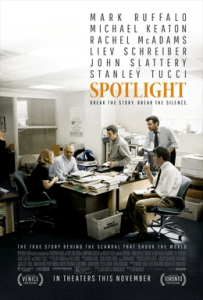
spotlight.jpgIt’s probably too late to tell you to run right out and see Spotlight.  If you can still find it in the theater, go.  It’s good.

A few months ago, a guy came out of church and almost grabbed my by the lapels. “Have you seen Spotlight?”  I didn’t even know what Spotlight was. He must have discerned the puzzled look on my face. “That movie. It’s about the priest abuse scandal in Boston. I just don’t know what to do with it. I have no words. You have to see it.” Here’s a together guy who is at the sunset of a quite successful career in the financial services industry and he’s standing at the back of the sanctuary with tears welling up in his eyes telling me I have to see some movie.

I’m not much of a movie guy, but when a movie has that kind of endorsement, I probably need to see it. He was right. It’s a powerful story, well done.

The new managing editor of the Boston Globe encourages the Globe’s investigative team (Spotlight) to pursue a report about Roman Catholic priest who had allegedly molested children and who had been moved around from place to place. As they begin investigating that incident, they uncovered other similar incidents. Before long, the team discovers that the problem involves nearly a hundred priests and that Cardinal Law knew about them. Rather than removing the offending priests from office, the hierarchy tried to rehabilitate them and return them to service, where they repeatedly molested more children.

There is plenty in the movie to be disturbed about. Most directly, the revelation that hundreds and hundreds of children were sexually abused by members of the clergy is abhorrent. That the hierarchy knew about it and by their actions (or lack thereof) perpetuated the abuse adds unspeakable outrage.

Beyond the obvious, though, one of the themes that struck a chord with me was how complicit the various civil institutions were to the abuse. Everyone knew how deeply embedded the church was in all aspects of life in Boston and so seemed to give the church the benefit of the doubt.

I was serving as a pastor in Naples, Florida at the time that the story broke. I remember a potluck conversation with a group of parishioners; somehow the  abuse story became a topic of conversation. Someone mentioned their surprise and shock that Cardinal Law had known about the abuse and tried to keep it secret. One of the guys sitting at the table had been the CEO of a large corporation headquartered in Boston; he ran in those stratospheric social circles of the Boston elite; Cardinal Law had been a friend. His take was that Cardinal Law could not have known about the abuse. “Remember what good work the church does in Boston. Beside, the Globe is just stirring things up and trying to sell papers.”

The movie reveals how consistently the various institutions that were supposed to hold other institutions accountable turned a blind eye:  law enforcement, the criminal justice system, the corporate world; even the Globe itself ignored the story for years. Everyone seemed to know, yet no one did anything. In what for me was one of the most memorable scenes in the movie, the Spotlight editor confesses that years earlier he was sent a list of twenty pedophile priests. He wrote a story that got buried in the paper and he never followed up.

While it’s easy to point the finger at the Catholic Church for the priest abuse scandal — and there is plenty of blame to go around — it’s a cautionary tale for all of us; the accusing finger ought first to be directed inward. The movie illustrates how easy it is to ignore the truth when we’re afraid of what the truth might really be. Especially when people and institutions that we love and respect are implicated, it’s easy to excuse a “few little problems here and there” because of the good work that’s getting done. We have a hundred rationalizations: there must be more to the story; it can’t be the way be as it looks; better not to rock the boat.  The human mind is a wonderful and sometimes terrible thing.

How important it becomes community and institutional leaders to build institutions of accountability and communities where hard conversations can take place. How important it is to cultivate those practices so that when the really hard stuff comes along, we’ve done it before and we know how to do it again, even when it’s really hard. And how important it becomes for societies mediating institutions (like congregations) to be deeply embedded in their communities in such a way that rather than turning the blind eye of complicity, they can hold government, market and even other religious institutions accountable.

Spotlight was a hard movie to watch, but it’s one that I hope I don’t quickly forget.

Before You Lump All Muslims in with ISIS. . .

blackflags.jpg. . .perhaps it would be helpful to learn a little more about Islam. For that I would recommend Karen Armstrong’s well-known and respected work, Islam: A Short History. 

It would also be helpful to learn something about ISIS, but I’ll get to that.

Years after reading Armstrong’s helpful introduction to Islam, one thing continues to stick with me, even haunt me. Armstrong argues that the Islamic world of the Middle East has been thrust into the modern world in a very short time and in an extraordinarily exploitative fashion. Western Europe took centuries to enter into modernity and the gradual transition happened organically; it was not imposed from the outside. In the drive to impose western institutions in the Middle East and Africa, European and American powers have created a tinderbox of economic and social upheaval that began in the late 19th century and continues to the present.

When the Arab Spring broke out in 2011 in Tunisia, initially I was hopeful because the protests represented a bottom up movement by ordinary people, many of them of the millennial generation. In the end, those protests have had mixed and uncertain results; in Syria and Libya, they’ve led to civil war.

As we’ve watched the Syrian Civil War played out in near daily nightly news images, we’ve also been party to ISIS. Images of the beheading of westerners and the immolation of a Jordanian pilot and the brazen terrorist attacks in France, have established ISIS as the latest thing to fear and the impetus for testosterone laced diatribes from presidential candidates.

But just who is ISIS and how did ISIS happen?  For a gripping account of the answer to both those questions, I’d highly recommend Black Flags: the Rise of ISIS by Pulitzer Prize winning journalist, Joby Warrick.

Warrick begins the story even before the US invasion of Iraq in 2003, chronicling the rise of an number of relatively insignificant persons who would later rise to prominence in Islamist terrorist networks. When the US invaded Iraq, the chaos left in the aftermath of that invasion gave cover to radical islamists and sharply polarized the country between the former Sunni majority ruling class and the new Shi’ite ruling class with ties to Iran. The US invasion of Iraq was sold as a way to stabilize the region and get rid of a bad guy (Saddam Hussein). Instead the US dramatically destabilized the region and provided opportunity for the radical Islamists to gain foothold.

One of the most shocking threads of the story is how often high level members of the US administration, all the way up to the Vice-President and President, ignored the intelligence of our own CIA agents on the ground and the counsel of our allies in the region. Time and time again, those quarters cautioned against intervention. The Bush administration’s deafness to caution and its hellbent determination to invade Iraq helped to create the quagmire that opened space for the terrorist network that has become ISIS.

Warrick also makes it clear that ISIS is not Islam. Even the most fundamentalist Islamic clerics have denounced the tactics and brutality of ISIS as antithetical to Islam. The leaders of ISIS are disenfranchised thugs using a thin veneer of Islam to provide cover for their brutality and raw power grab. (By the way, that makes even more despicable the stereotyping of American Muslims and Syrian refugees as people to fear simply because they are Muslim.) Mainstream Christians have no trouble denying that radical Christian sects have anything to do with authentic Christianity. We ought to be able to give our Muslim neighbors the same benefit of the doubt.

The majority of Americans have bought the propaganda of the American war machine, accepting the premise that when the country goes to war, it’s always righteous and the only way to express patriotism is to support both the policy and the troops. The American public has been sold a bill of goods, has accepted a bundle of lies, and wrapped its acceptance in a cloak of patriotism.

But that’s not patriotism; that’s raw nationalism. If we care about our country, we’ll point out the cost of war. We’ll point out that armed intervention coupled with an arrogant refusal to listen and heed counsel insures that everyone loses. The only ones who win when the US goes to war (as it has nearly continuously since the mid-1950s) are the politicians who get to pad their egos and the military industrial complex that reaps obscene profits.

And who pays? Warrrick writes that the Iraq War cost the American taxpayers one trillion dollars  in direct costs and another trillion in indirect costs. The greater cost is the 4500 American soldiers who died, the 20,000 or so who were wounded, and the deaths of as many as 25,000 Iraqi civilians.

The US still acts like the world’s colonial master and still demonstrates shameful hubris with respect to countries in the Middle East and Africa. We don’t live that part of the world; our cultural and political institutions and culture are vastly different from those of the Middle East. Still we think that we can impose our own version of order and democracy, paying little attention the leaders of sovereign countries, even when those countries are our friends and allies. The United States of America was founded on the notion of self-determination. Is that notion only good for us? Others around the world are not smart enough or civilized enough to exercise that same right? Our does our own self-interest trump that right?

Read Black Flags. And prepare to be angry. It’s not a nice story.

How Do You View the Heart of God?

feltbrokenheart.jpgIt sounds like a theoretical, obtuse question. But I don’t think it is. How we answer that question impacts how we view the world and our place in it. Different answers to that question getting played out in concrete situations with real people.

For example:

  • Wheaton College has moved to terminate a tenured professor of political science because she publicly expressed agreement with Pope Francis’s statement that Christians and Muslims worship the same God.
  • The Anglican Communion has suspended the Episcopal Church in America for resolution to change language that defines marriage as between a man and a woman.
  • The international refugee crisis is fostering vigorous disagreement about whether we should welcome Syrian Muslims as refugees
  • Disagreement within the Christian community over the use of handguns.

I continue to marvel over how sharply divided people of the same faith can be. I wrote about this a few months ago with reference to the Kentucky county clerk who refused to issue marriage licenses to gay couples. Now, it’s the issue of gun safety that has me thinking about it again.

A friend posted a few sentences critical of President Obama’s recent executive orders about gun safety; when I read some of the discussion that followed, I ran across this: . . .the entire point of Christianity is that the human race is overwhelmingly corrupt and evil. . .

This gets at the crux of the divide. How do you view the heart of God? And consequently, how do you view the world and your own place in the world?

I view the world as full of good. It’s not a place to be feared, but to be embraced. God’s creative dynamism fashioned a world full of beauty, full of goodness, and full of people whom God has created in God’s image. Sure, there is plenty that is wrong, and my heart often aches over it. War, violence, brutality, starvation, suffering — all of that is real. And none of that is God’s intention. God is at work bringing healing and restoration; God is working through God’s people to bring things to that fulfillment. And I want to do everything I can to push violence and suffering and death to the edges of our life together with the hope and expectation that they will eventually fall off the cliff. It’s our job as the Body of Christ to get out of the churches and into the world to be a part of God’s big work of reconciliation, redemption, and peace.

And there are brothers and sisters who see the world as a “corrupt and evil” place. There is much to fear. God’s big work in the world is to judge the people and the forces that are evil. All this evil will continue to accumulate until God finally gets fed up with it and destroys the whole thing. Then all the good people will be taken to that paradise in the sky. It’s the work of the church to deliver the profligates from their hellbent eternal destiny and the church has to take a defensive and righteous posture over against the world in order to remain free of it’s corrupting influence.

Admittedly, I’ve polarized here to illustrate a point.  Have I oversimplified it too much?  What do you think?

Why I Write This Blog

The turn of the calendar sometimes gets me thinking a little bit sentimentally. Last week, I went back and looked at my early blog posts; my first post was January 1, four years ago.

I was a blogging machine that first week, posting four times in 9 days. I didn’t continue at that pace.

I began writing this blog with the hope of building a following that would be useful for the novel that I was getting ready to publish. Everything I read told me to write a blog to that you’d have a following of folks who would be knocking down your door to to read what you wrote. It didn’t quite turn out that way.

I don’t say that with bitterness or regret. The blog has become for me a thing in itself, something that has brought me a great deal of satisfaction and if a few people read it along the way, even better.

Which brings me to the point of what I want to say today. What this platform has become for me is a way to contribute the the conversation that goes on between matters of faith and what’s going on out there in the big, wonderful world. Matters of faith are important to me — no, they are central to me. I also carry this insatiable curiosity about what’s going on in the world, a deep desire for things to work better than they do.  I write because I think I have something to share with the rest of the world that might be useful, something that might be pertinent to the larger conversation. I have no illusions that I have firm or definitive answers to any of the things I write about. But I do have opinions, and sometimes those opinions might be useful beyond my own head.

There is a lot out there in the world that is not right. For most of us, I think, the default position is that there’s nothing we can do. I don’t buy that. I think that when a lot of us care about those intractable problems and we do even little things collectively, we can get something done. I’ve seen it happen over and over in organizing work; some of that I’ve written on these pages. I think of the honeybees, the thousands  of them all going out finding even more thousands of flowers and each collecting their little bits of pollen and returning to they hive. Those communities of bees get done what they need to do to survive and thrive.

Part of what’s necessary for the human community to survive and thrive in the midst of the challenges of the 21st century is to have conversation about those challenges. Conversation is not the whole thing, but it’s a necessary thing. We are a species of language, information, and reflection. Our ability to reflect on our situation is one of the most powerful and magical things about being human. Our reflection and conversation will, I believe, lead to a measure of healing, reconciliation, or making things better.

I want to be part of that larger conversation from the perspective of my Christian faith, and of my position as a leader in the Christian Church. I come to the conversation from my vocation as a Lutheran pastor. I come also fully aware that some lousy versions of Christianity have contributed to the mess the world is in right now. The Christianity that I know and attempt to practice is a faith that is inclusive, inviting, and gracious, a way of being that finds it’s transformative source in the death and resurrection of Jesus and attempts to live consistently and authentically according to the teachings of Jesus.  God has intentions for the world; God is at work moving things towards fullness and completion. My vocation is to be an agent of that reconciliation and healing.
If you’ve read this blog for very long, you know that it’s not about one thing. I suppose that violates a cardinal rule of blogging. I haven’t carved out a niche. I write about the things I’m interested in and I’m interested in a lot of different things. But if you look back at the nearly 120 pieces I have posted, what it looks like is that I’m mostly interested in the intersection of faith and life — in particlular, how the Christian faith gets lived out in the world — and what faith has to say about the gnarly messes that we come into contact every day. Reflecting and writing on that intersection calls on my training in theology, my twenty-seven years of experience as a parish pastor in Lutheran congregations, and my continuing interest in theology. It also calls on that curiosity about this big, wonderful world that I’ve already mentioned.

I write, certainly, because I want people to read what I write. And for those of you who are still with me, thanks. But I’ve also discovered that I write for myself. It’s good for me. I want to be a writer when I grow up, and the more I write, the more I practice, the better I get. This is my version of going in to the piano practice room and doing my scales. And, there’s even something b beyond that. When I write, it helps me to organize and clarify what I really think about something. I’m am prone to fogginess of thought, and laziness when it comes to the hard work of actually naming with clarity what I think. Writing forces clarity.

As we enter this new year, I’m looking forward to continuing this conversation. Thanks for being a part of it. And if it’s like many of the conversations I get to be a part of, it will take us to places that are beyond what I could have imagined.

In a Moment in Time

redwoodsIn a moment in time, early on this Christmas Eve, I crawled out of bed to greet this new day. In a moment in time, in the morning darkness of my kitchen, I ground beans, boiled water, and made a cup of coffee with an ancient Melitta pour over coffee cone. In a moment in time, I sit in a quiet room watching out the window as the sun peeks over the horizon. Moments of time stacked one upon another in a progression compose an individual life.

In a moment in time Mary and Joseph came to the difficult conclusion that there was no other place to bed down for the night. In moment in time the labor pains could no longer be ignored.  In a moment in time Mary gave birth, not in her mother’s home surrounded by matriarchs and a midwife, but in a cattle stall surrounded by beasts. In a moment in time, a moment marked not by the idyllic tranquility of O Little Town of Bethlehem, but by the terror of giving birth in such a place and the wonder of giving birth in such a place.

In a moment in time the Eternal put on the limiting cloak of chronos.  The Infinite became finite. In a moment in time God entered our world in an utterly dependent baby. In doing so, that moment in time would become the pivot point of all human history. In that moment in time, God took on all that it meant to be human, our tears, our sprains, our sniffles, our disappointments, our dashed dreams, and eventually our death.

The splinters of that crude manger would one day become the splinters of a cruel cross.  The One who entered time would endure death for our sakes. All of this in a moment in time.

God entered our times and our places and our flesh so that we could know God. In the baby of the manger and the crucified man on the cross, we discover God’s true disposition towards us, indeed towards all creation. God entered our world in a moment of time so that we could live in the confidence of divine grace and mercy.

God entered our time so that there are no moments of time in which we are abandoned to our own self destructive ways, to the evil of our lashing out at on another, to the ways of death we seem so determined to follow. We live trusting that even now, God is bringing all things to fullness in Christ.

Regardless of what any particular moments of time may bring, of this we can be sure:  they are embraced and redeemed by a loving and gracious God who at Christmas became one of us. In a moment in time.

Merry Christmas.