Author Archives: Jim Honig

Unknown's avatar

About Jim Honig

Lutheran pastor in the western suburbs of Chicago. I'm a writer, a runner, an avid outdoorsman, and a curious student of people and the human condition.

My Favorite Books of 2017

I still remember the first chapter book that I learned to read: Miss Suzy. I was so proud to  read all by myself this book that my parents had been reading to me forever. Later on, I spent summers wearing out the path between our home and the Bridgeport Public Library. One summer, it was to see if I could read all the Hardy Boys series in one summer. The next summer it was Nancy Drew. My parents bought the Pictorial Encyclopedia of the Civil War, and I read that one summer; we also had the Worldbook Encyclopedia in our home. I didn’t read it cover to cover, but I got my licks in.

Reading continues to be important to me as an adult — as a pastor, as a curious resident of this amazing world, and as a responsible citizen of this nation and the global community. Reading also goes hand in glove with my vocation as a writer. The aspiration to be a good writer requires reading good writing.

2017 has been a year of transition, leaving one call in the western suburbs of Chicago and taking a position as pastor of a church Door County, Wisconsin. Transitions require a tremendous amount of my physical, intellectual, and emotional resources. For me, that means I haven’t done as much writing this year as I had hoped.

Reading, however, has remained constant. And I have read some books this past year that I thought were pretty great. Below is a list of the ones that really stood out for me.

Over the next couple of weeks, I’ll post a short review of each, a new review posted every few days. They’re not listed in any order that would suggest that I liked one better than the other. They are from different genres and I liked them for different reasons. They appear here roughly in the order in which I read them, simply a random list of my favorites from the past year.  If there’s anything that looks intriguing, come back and take a look at the review.

The Age of Anger: A History of the Present, by Pankaj Mishra

Lincoln in the Bardo, by George Saunders

Hope in the Dark, by Rebecca Solnit

The Day the Revolution Began, by N. T. Wright

Do I Make Myself Clear?, by Harold Evans

Tears We Cannot Stop, by Michael Eric Dyson

The Daughters, by Adrienne Celt

Original Blessing, by Danielle Shroyer

White Rage, by Carol Anderson

How to Think: A Survival Guide for a World at Odds, by Alan Jacobs

Faith Formation in a Secular Age, by Andrew Root

Evicted: Poverty and Profit in the American City, by Matthew Desmond

Sapiens, by Yuval Noah Harari

The Incarnation from 10,000 Feet

This is an edited version of the sermon I preached at Shepherd of the Bay Lutheran Church in Northern Door County, Wisconsin on Christmas Day, 2017. It’s based on the gospel lesson for the day, John 1:1-14.

As a new resident of Door County, I want to tell you that I have fallen in love with this place. I love it here. But I can love more than one place, right. I also love downtown Chicago. I love the vibe, the buildings; I love Grant Park, the Lakefront. I love standing at Waterpower Place and looking up at the Hancock building, and the shops and stores along Michigan Avenue. I also love coming into Chicago on an airplane, when you can see the entire scope of the city, it’s vastness and also it’s lakeshore location. Two different views. One smack dab in the middle of the details of it all. The other the whole big city in one look.

That’s sort of the way it is with the two versions of the Christmas story. Last night, we heard Luke’s version of it — with the warmth and the very human angle of two young parents and their firstborn son, born in a cave with barnyard animals as the only witnesses. That’s the view up close.

This morning we get the view at 10,000 feet. Today, we hear the story of Christ’s entrance into this world on the grand cosmic scale. In the beginning was the Word, and the Word was with God, and the Word was God. John takes us back to the very beginning of time, to the creation of the universe, a grand action at which the pre-Incarnate Christ was a full participant.  John goes way out on a limb and asserts that of all the things that have been created, none of it was created without his direct participation.

And then we get to this: And the Word became flesh and dwelt among us. Not just came alive, John says, but became flesh. The stuff of this human life, skin and bones and muscles and arteries and a brain and hair and toenails and lungs. This one, the Creator of the universe, the One whom the Greek Church calls Pantokrator, ruler of everything, became human with all that being human involves. That same Greek Church is fond of saying God became like us so that we might become like God. 

Let me try a different take on this. You know what it’s like when you go to the zoo, right? You walk around on sidewalks to look at the animals as an observer. There are fences between you and the animals. And in some cases, there are big panes of glass between you and the animals. You watch them, but in most cases you cannot interact with them. And for the most part, you cannot smell them or touch them, or even hear them. While you may be near them, you do not interact with them. You are an observer.

God could have done that. And who would have blamed God. There is something messy about human life, our wrenching agonies and our chaotic ecstasies, our drama and our dysfunction, our brokenness and seeming inability to learn from our mistakes. Who could have blamed God for coming among us, not as a participant, but as an observer? At arm’s length. Ready to tell us something, but not to get God’s hands dirty. Ready with some hopeful future, but the story told from a distance, where God would not have to smell us or look into our heartbroken eyes or feel the pain of our diseases and sharp poke of our demons.

But that’s not how God came. He came and dwelt among us. That word could be translated, set up his tent among us. Slept on the same hard ground that we sleep on, cooked on the same campfire that we cook on, walked to the same latrines that we walk to, subject to the same burned fingers at the campfire and the same blisters from the hike that went a few miles too long.

And this one came to set up his tent among us as the Light.

I don’t know about you, but I need that Light. I feel the weight of the darkness. I feel the burden of the struggling who every time they think they are about to get a leg up, someone kicks it out from under them. I feel the pain of the way we castigate those whose skin is a different color or who come from a different place and speak a different language or who worship God differently than we do. I hear the stories of broken relationships and diseased bodies and empty checking accounts. Sometimes the darkness is overwhelming.

But there is light. And his name is Jesus. He came full of grace and truth. He came to show us that the darkness will not win.

There’s a song that has become important to me. It comes out of the struggle of Black South Africans in their struggle against apartheid. The text was written by Archbishop Desmond Tutu. The black South Africans went through dark days. But they could always sing of the light. And of the victory of the One who came to shatter the darkness.It’s not a Christmas song, but I want you to sing it with me. As much as any song or hymn, it captures the essence of the good news of these opening words of John’s gospel. 

Goodness is stronger than evil, love is stronger than hate. Light is stronger than darkness, life is stronger than death. Victory is ours, victory is ours, through God who loves us.

The Word became flesh and dwelt among us full of grace and truth.

The Deep Challenge of Faith Formation

faithformation

(This review first appeared in The Englewood Review of Books.)

Andrew Root. Faith Formation in a Secular Age: Responding to the Church’s Obsession with Youthfulness. Grand Rapids, Michigan: Baker Academic, 2017.

If you’re sitting in the chair of the lead pastor at your church, and this book came across your desk, you might be tempted to pass it on to your youth pastor or the staff person in charge of the children and family programs. And if you’re sitting in either of those two offices, you might be tempted to put it on the tall stack of books that will offer you one more way to tweak your programs to reverse the slow bleed of people away from a church in decline. All three of you would be wrong.

This book is part cultural critique and part theology, combining to open a new way to think about faith formation and the future of the church.

Most anyone who works in or around the church is familiar with the notion of Moralistic, Therapeutic, Deism. It’s the concept that emerged out of the sociological work of Christian Smith and became known in church circles through the work of Kenda Creasy Dean. The individualized, consumer spirituality represented by MTD has cut loose faith formation from the fundamentals of the Christian faith. Root accepts that critique of the church and for the first part of the work offers a detailed explanation of how we got here. He argues that as a culture, we’ve become obsessed with youthfulness, not as a way to honor or form the faith of our youth, but as as a culture-wide ethos out of which flows a drive for authenticity and fulfillment. From that false and empty well comes the church’s notion that if we could only keep youthfulness in the church, we could help people become more authentic and at the same time revitalize our churches.

Root is working out Charles Taylor’s A Secular Age for the broad task of faith formation in the church. Taylor makes a distinction between 3 different kinds of secularism, and Root seeks to unpack the implications of those distinctions for the work of faith formation. In Secular 2 (Taylor’s language), there is a competition between religious space and non-religious space; the church is constantly battling to maintain its hold on religious space. Faith formation becomes a battle to keep the youth participating in congregations, thereby maintaining our hold on that particular religious space. In Secular 3 (again, Taylor’s language), the facade of religion is held onto, even when we as a broad culture have given up on the idea that there can be any connection to the transcendent. Faith is simply the grasp of a set of cognitive truths that inform how we live ontologically in this world.

As an answer to the above, Root spends the second part of the book exploring Paul and how Paul’s understanding of faith helps us to seek connection with the divine in a culture that has lost any hope for transcendent experience. Basing much of this part of the work on the new Finnish interpretation of Luther and justification, especially Tuomo Mannermaa, “faith is a death experience (the cross) that leads to new life (resurrection).” What makes this faith possible is the real presence of Jesus as the minister who comes to us and even comes alongside us in our own experiences of brokenness and lostness to give us his very person as new life. Relying heavily on the great Christ hymn of Philippians 2 and the Orthodox understanding of that passage, Root explains how “the shape of Jesus’s ministering person is hypostasis (union of personhood) and kenosis (humble self-giving), leading to theosis (transformation into being a minister as Jesus is minister).”

Against a culture that eschews transcendent experience, Root argues that we experience transcendence when we stand alongside and minister to our neighbor in their own death experiences (brokenness, lostness). In doing so, “we find the real presence of Jesus, meeting our person with his own, infusing our being with Jesus’s own being as we share in the being of our neighbors humbly acting as her minister.”

The church, then is the household of ministry, and faith formation is centered in the church as the place where people receive the ministry of Jesus and then are sent into the world to minster to their neighbor. “The only thing the church offers the world is ministry! And this only thing, as we’ve seen, is everything. It is the very location of Jesus Christ; it is the energy to turn death into life and make us new beings who have our being and action in and through ministry.”

That ministry, he concludes, is lived out in three distinct dispositions for the church: gratitude, giftedness, and rest. Everything the church does in ministry — all of which is, ultimately, faith formation — is centered in these three distinct dispositions.

Don’t come to this book looking for lists of concrete steps to be taken to improve faith formation in the church. Don’t come looking for ways to tweak what you’re already doing to make it more appealing or more effective. You won’t find any of that.

But do come to this book ready to read slowly, to think and reflect upon the whole enterprise of faith formation from the cradle to the grave, and why the cognitive, programmatic approach that we’ve used for so long isn’t working. Come ready to be challenged and to call into question long held assumptions, and the plethora of bandaid approaches to the complex challenge of being church in this post-Christian time. No question, this is a challenging book; Root is reflecting on the difficulty of trying to connect people with God in a culture that is far more interested in the development of individual fulfillment than a life given over to divine service. I suspect that were we to take seriously Root’s diagnosis of a MTD church, we would blow up our present programs and start from scratch.

My fear is that the technical nature of the book and the short supply of practical tips will keep those who most need to read this from diving in. I hope I’m wrong and that this book will be widely read. One doesn’t have to agree with all of Root’s conclusions or even his sometimes too generalized arguments about how we got here. The rethinking of faith and the resultant reconsideration of how the church does faith formation could be transformative for our congregations. I also think this is one of those books that would be most fruitful if read in conversation with others facing the same challenges — as a staff, as a clergy or other church worker cohort. What holds great promise, in my opinion, is precisely the fact that he doesn’t offer a to-do list at the end of the book. Rather, because each context is different, each congregation with different people, different gifts, different traditions and different theological sensibilities, it becomes the responsibility of each of us to determine how we will each work to make our congregations households of ministry, and thereby deeply and substantively form the faith of our people, for the sake of God’s intentions for the world.

In the preface, Root indicates that this is the first of three books that will explore points and theories within Charles Taylor’s A Secular Age and the implications for Christian ministry. Even as I continue to reflect on this one, I can’t help but eagerly look forward to the next two.

Something to Chew on with Your Hot Dogs and Potato Salad

I was driving back home from Chicago yesterday afternoon, alternating my listening between NPR, James Taylor, and the Hamilton soundtrack. Wisconsin Public Radio reported that this year it costs six cents less than last year for the Fourth of July cookout of hot dogs and potato salad for you and 9 of your best friends.  Good to know.

The Hamilton soundtrack was a good reminder the precarious beginning of this aging republic. Few contemporaries gave those colonial revolutionaries much of a chance. The ragtag continental army was outmanned and out-resourced. No way they should have won. Yet they did.

The end of the war was not the end of the teetering on the edge of the cliff. If winning the revolution was hard, figuring out how to govern was even more difficult. It took nearly 5 years for all 13 colonies to ratify the Articles of Confederation.  That first constitution was a flawed document, and in 1787 they came back together for contentious debate that gave birth to our present constitution. I suppose we are still fighting that same battle between the power of the states and the power of the federal government.

Those men were trying to find the best governmental structure to make possible the grand democratic ideals they had written into the Declaration of Independence “that all men are created equal, that they are endowed by their Creator with certain unalienable Rights, that among these are Life, Liberty and the pursuit of Happiness.”

They are grand ideals, to be sure, ideals which we still struggle to put into practice. It’s still true that some are more equal to others. While we have made progress, there is still much work to be done.

NPR also ran a story yesterday afternoon about the current status of the Black Lives Matter movement. One of the founders talked about the difficulty of sustaining the movement when victories are so rare and when the struggles of minority communities are multiplying.

My whiteness gives me the privilege of not having to think about that. I have the luxury of not having to think about the racism, xenophobia, sexism, et. al. that has come to the surface in the campaign season and first months of the new  administration. They can be  abstractions for me.

And my little annual ritual of remembrance on this Independence Day gives me an opportunity to recommit myself not to give up and not to settle into the comfort of my privilege. There is still work to do. The American republic assumes assumes citizen engagement. We form relationships and build networks of bonds with our neighbors and other fellow citizens. We engage in our communities to discover the struggles and concerns we share, and when something is wrong, we engage to make it better. We bring to the table the power of ordinary people who care enough to take action. Then we act. There may be no more patriotic thing to do. 

It feels to me like these are politically dark times for this 241 year old republic. I’ve decided I’m not going to dwell on the things I can’t do anything about. I can’t do anything about the petulant tweets of our adolescent in chief, or about the representatives on both sides of the aisle whose loyalty is primarily to the big money that put them there and whose primary goal is to hold onto their power.

Here’s what I can do.  I can work to build a better community where I live. I can work with others to enact the ideals that we celebrate today, the virtues of an informed citizenry that works together for the common good. In the preamble to the constitution that was eventually ratified, the founding fathers had a vision that in this land we would work together to “insure domestic Tranquility, provide for the common defence, promote the general Welfare, and secure the Blessings of Liberty to ourselves and our Posterity.” Still sounds pretty good to me.  Happy Independence Day!

“I’m Going to Have to Charge You Ten Bucks for That”

A few weeks ago, I picked up one of my parishioners at his house to accompany him on a visit to his wife in a care center so he could  properly introduce her to the new pastor. He’s lived nearly 30 years as a retiree in Door County and knows his way around pretty well, I’ve discovered.

As he stepped into the passenger seat and got situated, I apologized in advance. “You’re going to hear a rattle in the exhaust system. I’m sorry for it. It will probably drive you nuts; I know it does me, but it started a few days ago, and I haven’t had a chance to get it fixed.”

We drove down his long driveway and onto the paved road. “Yup. There it is. I can hear it,” he said. “You should take it in to see Kenny. He runs the gas station in Ellison Bay. When you pull in to Kenny’s, he comes out and pumps the gas for you, washes your windshield, and even checks your oil if you ask.”

“And he does car repair?”

“Yeah, as long as it’s not too complicated.”

“Oil changes?”

“Sure. It’s a good place to get your oil changed.”

An hour later, we were on our way back home. As we approached Ellison Bay, he said, “Why don’t you stop in and see if Kenny can take a look at it?”

“Right now? Without an appointment?”

“Sure. He’s probably not doing anything else.”

We pulled in to the 1960’s style gas station with two pumps outside and the black rubber hoses on the pavement that made a “ding-ding” when you drive over them. Kenny looked up from his chair inside as if we had awoken him from a nap.

I walked inside. “I’m Jim. I’m the new pastor at Shepherd of the Bay.”

“Ah. I heard they finally got one.”

“I have a rattle in my exhaust system and my friend here thought you might be able to take a look at it.”

“Sure, I can take a look at it.  I’ll have to put it up on the lift.”

He drove the car into the service bay and put it up on one of the old-fashioned lifts that I haven’t seen since I was a kid. From the lobby area, I could  hear him as he walked around banging on the exhaust system with his leather-gloved fist, talking to himself all the way. “Nothing here. It’s gotta be a heat shield. Nothing here.” Before long his banging reproduced the annoying rattle. 

“Come on out here,” he yelled.

I pushed through the wood framed screen door from the counter area to the garage and stood under my car next to Kenny. “See this here heat shield? It’s loose. I can’t really take it off. These bolts are all rusted. Not sure what I can do.”  As he talked, he began to poke a big screwdriver in the seam between the top and bottom of the heat shield prying things back and forth. Then he stuck the screwdriver in his pocket and started banging again; the rattle was gone. “There. I think that might be better.”

I walked back inside and waited for Kenny to lower my car and back it out of the bay.

Back inside behind the cash register, he said, “I’m going to have to charge you $10 for that.”   I couldn’t tell whether he was apologizing for charging me or was afraid I was going to put up a fuss about $10.  I was happy to pay that sum and was trying to figure out a way to tell him I’d be happy to pay more. But we left it at that.

Contrast that with an experience I had at a dealer several years ago. I hadn’t had the car very long and the check engine light came on. The car didn’t seem to be running poorly, so I was tempted to ignore it. But I also worried that to do so might be foolhardy. Plus, when the check engine light is on, the cruise control is automatically deactivated. So, I took it in. They hooked it up to their diagnostic computer. Within five minutes, the technician came back and said, “The good news is that there isn’t anything wrong with your car.” Then he walked me around to the rear passenger side of the car where the access door to the gas tank was open. He took the gas cap in his hand and screwed it on, and with a little drama, tightened the gas cap.  “Your gas cap wasn’t tight. It lets too much oxygen in. Just make sure that whenever you get gas, you turn the lid on tight.”  And the bill was $125. For five minutes. No work, no repair except to tighten the gas cap. Their policy was that whenever they had to hook the car up to the diagnostic machine, the minimum charge was $125. (I since learned that there are many places that will do that for no charge.) I tried to complain that the charge was outlandish and unreasonable. To no avail. “I’m sorry sir, but this is our company policy.”  That was the last time I went to that dealer. It was clear to me that they weren’t interested in a relationship with me as a customer other than a purely economic transaction in which they could enact their policies to insure a profitable bottom line.

I don’t even know exactly why I’m writing this except to lament the loss of a time when an economic transaction often was more than that. It was also embedded in a personal, human to human relationship.

The globalization of the economy has clearly brought benefits to millions of people. It has provided access to low cost goods from around the world. It has made some Americans more aware of people of different cultures and has for them fostered a sense of the common humanity across cultural divides. It has provided developing countries with access to capital that has increased production and provided jobs.

It has not, however, been a universal benefit. To a large degree, the loss of well-paying manufacturing jobs in the US can be traced to companies moving their factories to locations around the globe where the cost of labor is much lower. And while it has provided jobs in those countries, the lack of regulation has made possible deplorable working conditions and wages that do not allow the workers to really move out of subsistence living.

But we’ve lost something more subtle, more fundamental, more valuable. We’ve lost that mediating human presence between me as a consumer and the large corporation with whom I am forced to do business. Kenny doesn’t refine the oil that he pumps as gasoline into his customers’ cars. But he is a real person who is a comforting and knowledgeable middleman between big oil and me. Kenny wasn’t afraid to tell me that he thinks my clutch is adjusted a little too close to the floor. I appreciate that. How else would I know?

I know we can’t and won’t go back to the way things used to be. In spite of the promise of politicians that they will bring back American manufacturing jobs, that isn’t going to happen. We’re way beyond that.

But I wonder if we can look for places to embed economic transactions within a relationship. When it’s possible to have some kind of human to human relationship with the person with whom I am making an economic transaction, doing business is for more than making a profit. There’s nothing wrong with making a profit. A person in business should be able to earn a living, even a comfortable living, for their work. But when there is a relationship, it is more than an economic transaction. It is an expression of community. And at least in the way I understand things, we were created to be in community.

There’s a movement to buy local, a movement which I wholeheartedly support. The thought behind it is to keep money in the local economy and provide jobs for local people. For me, it goes deeper than that. Making an economic transaction with someone with whom I have a relationship strengthens the essential fabric of community. Relationships, far more than transactions, build, maintain, and strengthen the places we live and make them into good, thriving communities. Good, thriving community is good for all of us.

With Gratitude for Those with Burning Hearts

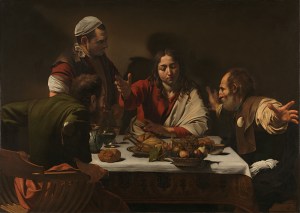
Michelangelo Merisi da Caravaggio, 1571 – 1610
The Supper at Emmaus
1601
Oil and tempera on canvas, 141 x 196.2 cm
Presented by the Hon. George Vernon, 1839
NG172
https://www.nationalgallery.org.uk/paintings/NG172

I walked into the gallery and immediately was struck by the size. Seeing a painting in a brochure doesn’t prepare you for a confrontation with a near life-sized painting. The Michelangelo Caravaggio “Supper at Emmaus”  was on loan from The National Gallery in London to The Art Institute of Chicago.

There’s the calm, peaceful countenance of Jesus at the center, his eyes serenely closed, his right hand extended in blessing. And I love the different reactions of the three sitting at table with Jesus. For the guy standing behind him, everything is reduced to a profound sense of wonder. The guy seated across from Jesus leans forward trying to believe the unbelievable, ready to reach across the table to verify with his hand what his eyes are telling him. The guy seated at the side of the table is retelling the story with his wild, broad gesticulating as if in the retelling it will make more sense.

The one detail that consistently grabs me is the dish teetering on the edge of the table. At the Art Institute, the crowd studied the painting from a carefully demarcated viewing area, stanchions separating the humans from the painting. I had this urge to reach across the divide and push that dish away from the edge.

For me that dish is the locus of tension. Is the dish going to hold or fall of the edge? One little bump on the table — which I can assure you I would have done inadvertently had I been there — and it goes crashing to the floor. Maybe it’s a visible sign of the tension still in the hearts and minds of those disciples. Was the Jesus sitting across the table real? Was the story he told them really true? Those questions and that tension are palpable in their postures and gestures. I can only imagine how acute the tension must have been when shortly after the moment captured in the painting  Jesus vanished from their sight.

I know that tension. I experience moments of extraordinary clarity, when God’s presence and God’s goodness are so real I can reach out and touch God’s wounded hands. And I experience moments when I wonder whether any of it is true,  when I feel acutely God’s  absence.  In those moments, I wonder if it will all hold together. Or will it go crashing to the floor? Is the resurrection life that Jesus promises more than just wishful thinking? 

Luke tells us that after Jesus disappeared, their hearts were burning within them, as if he became more real in his absence than in his presence.

I have my own version of Cleopas and his companions. They accompany me on the road with the risen Christ, who, by the way, is there whether we recognize him or not. Sometimes the road is only 7 miles; sometimes it feels like a lot longer. I’m grateful not to have to walk the road alone. Companions hold me up with their excitement at seeing the risen Christ, telling me how their hearts burn within them, even when whatever it is that I possess feels more like a flicker than a flame.

I met this week with a couple of nonagenarians whose faith had the quality of a fine, aged wine. They have endured the trials and can see God’s goodness and presence with the sharp-eyed vision of an eagle. They are the very incarnation of what last Sunday’s second lesson (1 Peter 1:3-9) described as an inheritance that is “imperishable, undefiled, and unfading,” faith that has been refined by trial and has come out the other side as pure and precious as gold. I also had coffee the other day with a guy who told me of his deep prayer life and how God was answering his prayers and about the opportunities for ministry that came out of those prayers. The burning quality of his faith was contagious.

I don’t very often experience my faith with that kind of sharp clarity. My experience is more like Paul’s metaphor of seeing through a glass dimly. More like a dish teetering on the edge of the table and about to fall off. Why is that, I sometimes wonder. A function of temperament? Personal defect? Not trying hard enough? I never come up with an answer.

Which makes me all the more grateful for those with burning hearts. My fellow pilgrims and their witness are often the proof of the presence of the risen Christ. I’m grateful that my faith is not just a me and Jesus thing. My fellow travelers have seen the risen Christ, and that is enough encouragement to keep walking.

Wednesday in Holy Week

With the gospel lesson for Wednesday in Holy Week, we are getting a little ahead of ourselves. The reading brings us the intrigue that takes place after what we will read tomorrow on Maundy Thursday, the account of the foot washing Jesus performed for his disciples and his teaching about their performing the same kind of loving service for one another.

Strikingly, the story begins by reporting that Jesus was “troubled in spirit”. That’s nothing new. He said the same thing in the story we read yesterday when he felt the burden of his coming hour of death. The reason for his present agony is the imminent betrayal by Judas. Announcing the approaching betrayal, Jesus wore his emotional pain on his proverbial sleeve while catching his disciples off guard.

When Judas left the room and went out, “it was night!” I suppose it’s possible that the gospel writer was indicating the time of day; but I think there’s something else going on here. Remember way back at the beginning of this gospel, when the author announced that light appeared when Jesus appeared? He even reported Jesus saying, “I am the light of the world.” In yesterday’s reading, after identifying himself as the light once again, Jesus promised his disciples they would become “children of light.” Now with the arrival of the Evil One in one of Jesus’ own disciples, “it was night.” Jesus, the light, was about to enter the darkest corners of human existence. Jesus would allow the prince of this world, the ruler of darkness, to have his moment, brief though it would be.

In fact, while the disciples were baffled that Judas would go shopping at this time of night, Jesus announced the moment for the Son of Man to be glorified and with him for God to be glorified as well. The hour has come for his death, his resurrection, and his ascension—all to the glory of God.

Our attention today is drawn to the plan and purpose of God in sending the eternal Word to become incarnate and live among us. The evangelist interprets the crucifixion of Jesus as God’s deliberate and purposeful act, not a divine resignation to the failure of humans to accept his Son. Jesus’ own motive was not a suicidal desire but a faithful commitment to ensuring that God be glorified.

Indeed, “it was a dark and stormy night.” There’s something deeply theological going on here. Jesus was entering the darkness of human evil, fallenness, and brokenness. We know what the night means — it is the evil, fallenness, and brokenness we experience in our own lives. When Jesus enters our darkness, we can be assured that we are never alone; in fact, it may be in those moments of our deepest darkness that we are closest to the crucified Christ.  In the darkness of the impending doom, Jesus is being glorified and God is being glorified in him. Night will have its moment, but God will have the day.

Tuesday in Holy Week

When I was a young associate pastor in St. Petersburg, Florida, at a large Missouri Synod church out in the western part of the city by the beaches, I got to know an older ELCA pastor who was at the historic church downtown. His name was Priit Rebane; I had the greatest respect for Priit; he was soft-spoken, theologically astute, and seemed to be full of pastoral wisdom. At one of our meetings, he told about coming out of the seminary, ready for ordination. He had learned all the theories about the virgin birth, about the resurrection and whether it happened or not, the various criticisms of scripture. A young theological hot shot, he was headed out into the parish ready to unleash all his learning on some unsuspecting parish. His mother sat him down and told him, “Priit, just tell them about Jesus.” 

In the gospel lesson for Tuesday of Holy Week, some curious Greeks come looking for Jesus. Jesus is transparent about who he is and what is coming. The questions and answers of the dialogue don’t provide much new information. We’ve seen all this elsewhere; we know the story. This encounter is less about having the right answers from Jesus than about seeing Jesus as he makes his way gently, persistently toward the cross. All the dialogue  invites us to see Jesus.

In our bones, in our souls, to the depth of our being, we understand that what’s happening this week is at the center not only of the Christian faith, but of our own lives with God and of our life together as a community of faith. We want to see Jesus.

 But what what are we looking for? It’s not enough to say that he was a good man, a good teacher, a miracle worker, an example to follow or even the victim of politics and oppression.

We are invited in today’s gospel to see the glorification of Jesus, the culmination of his whole ministry, the work that he came to do. We are invited to see Jesus lifted up as king of the universe.

Most importantly, we are invited to see the enthronement of Jesus on the cross. We are invited to see that in his death life came to us, that his crucifixion removed the barrier of sin and brokenness that stood before a loving God and a fallen humanity.

We are invited this week to see Jesus in the humble foot-washing and eucharistic meal of Maundy Thursday, in the trial, death, and burial of Good Friday, and finally, in the triumphant resurrection of Holy Saturday.

Carry those images in your mind and in your heart. They are icons of God’s love.

Monday in Holy Week

For the first time in nearly 25 years, I will not be attending formal worship services on Monday, Tuesday and Wednesday in Holy Week. I’m in a new parish and arrived just in time to step into helping to carry out plans made in advance of my arrival.

For these 25 years, I have found the readings appointed for Holy Week to be a wonderful set-up for what happens in the more popular services of the Triduum (The Great Three Days). So, here’s my encouragement to join me in taking a look at these readings. I’ll be posting some introductions and devotional reflections on the readings today, tomorrow, and Wednesday.

 Isaiah 42:1-9  In this selection from one of the servant narratives, God’s voice is heard as a kind of love song for the servant. The servant is God’s chosen delight; the Spirit holds him up. Notice the tenderness embedded in the language, like when a parent holds hands with her child. The beloved servant is called and sent to “bring forth justice to the nations.”  Here is the wonder of it: justice will result from quiet, gentle persistence, not from grand displays of force.

In the church, of course, we see Jesus as servant, the Son called by and beloved of the Father, even from the world’s creation. In the events that unfold this week, Jesus will present himself to the religious and secular authorities with a spirit of meekness; God’s justice and righteousness will result from the gentle persistence of the cross and the quiet of the empty tomb.

Hebrews 9:11-15  The letter to the Hebrews is one the most theologically dense books in the bible. In this reading the author tries to say something about Christ’s death that the gospels never say.  These few verses invite us to think particularly about the Holy Place in the Jerusalem temple, a place entered only very rarely and only by the high priest. Christ as high priest goes to the Holy of Holies once and for all. Except here’s an important distinction: the Holy Place for Christ is not the temple building, but his own body and the sacrifice his own blood, not the blood of animals. But the theological point raises more questions than it gives answers. How can death, particularly the way Christ died, in any way be considered a Holy Place, indeed, the Holy Place? Christ is the victim of injustice, an abuse of both religious authority and imperial power. The cross is an ugly sign of execution, of state-sponsored murder. All of this as Holy of Holies? That’s the strange and astonishing logic of Holy Week and, indeed, of the whole Christian tradition. It’s a place where we’re bound to be frustrated if we are intent on reason and crisp answers; instead, we are invited simply to ponder these perplexing holy mysteries of God’s love poured out for us and for all creation.

John 12:1-11  The story of Mary’s extravagant gesture of pouring expensive perfume on Jesus’ feet and then wiping them with her hair is a rich foreshadowing of what is to come so soon. Of course, just before this story, Jesus had raised Mary’s brother, Lazarus, a reading that should be fresh in our minds from just 8 days ago on the 5th Sunday in Lent. As a result Jesus’ raising Lazarus, there was an active plot to kill Jesus. But we’re getting ahead of ourselves. In thanks for what Jesus has done, Lazarus, Mary, and Martha throw him a dinner party where Mary engages in this ecstatic extravagance that fills the entire house with fragrance. Mary’s offering reflects a deeply loving and tender way of being with Jesus.

In this setting of such love and devotion, there is also ugliness. This dinner party is undertaken with Jesus’ knowledge of the plot to kill him. Judas, who is soon to betray Jesus, complains about Mary’s waste of the costly perfume, secretly desiring, of course, to keep the money for himself.

The experience of God’s love, known in the nature of Jesus’ relationship with us, does not happen in a pristine vacuum, a place and time unspoiled by the ravages of human sin and betrayal. No, the encounter between Jesus and Mary happens in the very thick of the hatred, the plots to kill encroaching, closing in. Mary’s action foreshadows the anointing associated with death.

Soon after the dinner party, Jesus will enter Jerusalem, the beginning of the end. In that holy city, he will initiate the fullness of life and love and joy. No human plot can snuff out the foundation of God’s love known in Jesus. We are invited to enter this reality during Holy Week, and especially in the coming Three Days. Contemplate the extravagance of Mary’s ecstatic act, knowing that her action is but a foreshadow of even more extravagant love that we will come to know in Jesus who is for us the very face of God.

Watching the Ice Melt

For the past week we’ve been been living in a temporary home just a block or so from Garrett’s Bay at the very northern tip of the Door County peninsula. The daily change of the ice and water on the bay has been a source of endless fascination for me.

When we arrived on Saturday, March 25, the bay was mostly covered with ice. It wasn’t a clear, unbroken sheet of ice; rather chunks that seemed as if they had long been broken and fused with the heating and cooling of the outside air. 

Later on in the week, a north wind blew in and the ice got scrunched up close to the shoreline as if a big snow shovel had entered the mouth of the bay and cleared the ice off most of the water. (Wish I had  picture of that, but didn’t think to take one.)

When the wind stopped blowing, the scrunched up ice loosened up again and a big patch of it floated out into the open water of Green Bay.

The warm temps over the weekend dramatically hastened the melt. You can see from these pictures just how much difference five days makes. 

Now this morning, the ice has pretty much disappeared from bay. For the past few days, temperatures have been pretty consistent through the day and night, hovering between the mid 30s and mid 40s. Still I find it astonishing that the ice the virtually disappeared in just 12 hours.

It’s raining today. Wonder if that will be enough to melt the few remaining chunks. You can be sure I’ll be watching.