Category Archives: Uncategorized

Weariness in the Wilderness

Confession 1.2

We’re about a week into Lent already, one of my favorite times of the church year.

This year feels different for me.

Normally, have some sense of anticipation about reengaging some of the disciplines of my spiritual life that may have gotten a little rusty or fallen into disuse. A day a week of fasting has been my practice for years and years and years. Experience has taught me to prepare mentally, physically, and emotionally for the ramped up activity and responsibilities during Lent. I know that by the time Easter arrives, I will be tired — a deeply satisfying weariness that says I have led a people through the wilderness of Lent to the promised paschal feast.

This year I enter the season weary, but it’s not a satisfying weariness. It feels more like the beginning of a long slog. It’s like that time on the backpacking trip when you need to get through the next two miles of mud in order to start ascending the hill that will take you to the lakeside campsite that is the goal of the day’s hike.

Part of it is the time of transition that our congregation’s ministry. It has meant longer days and more responsibilities. And while I’m mostly energized by that transition, hopeful for the new thing that will emerge, there are also times and days when it feels like I’m a compatriot of Sisyphus, pushing that proverbial stone up a hill. I have heard that the effort of birthing is exhausting.

That’s where I am this year. Feeling like the effort of birthing is exhausting. In the background is the hope that comes from the promises of the same God who made astonishing promises to Abraham. And in the foreground is the difficulty of seeing how those promises will be made concrete. I feel the weariness of exile when the promised return to The Land has little to hang on to.

On Sunday, the sermon was proclaimed by one of our staff members who doesn’t preach very often. She said a few things that have stuck in my gullet the past few days. First, she invited us to embrace the wilderness as a gift. Is it possible for me to see these days of weariness as the necessary gestation period for what is to be born?

The other thing she said is how willing we are to let distractions keep us from actually engaging God in the wilderness. There are so many important things to do!

I feel the weight of distractions, especially the distraction of important things that must get done.

Which leads me to believe it’s time to get off this computer and sit in the quiet of the wilderness. To listen for the voice of the One who has called me and who has promised to love me and who has promised never to leave me. Even in the weariness of the wilderness.

Faith and Literature, a Vocational Intersection, Part 2

Jim bestIn October, 2014, I was invited to Luther College in Decorah, Iowa to participate in the festivities for Homecoming Weekend, and for the inauguration of their 10th President, Dr. Paula Carlson. It was such an honor to be there. I had the privilege of preaching for the morning chapel service, and then serving on a panel for a symposium that President Carlson had called dealing with the relationship of faith and literature, a particular interest in her own research and writing.  I shared the dais with three esteemed academic scholars, Dr. Jacqueline Bussie (Concordia College), Dr. Peter Hawkins (Yale University), and Dr. Robert Schultz (Roanoke College). Each of us were to give some remarks with respect to our vocation and the intersection of faith and literature. What follows is the completion of my remarks.

Some novels help us to get at the big questions, like “Who is God?” “Is there a God?” “What is the meaning of life?” I’m thankful for those books in modern literature. I think of Walker Percy and Iris Murdoch, to name a few. I love Percy’s novel, The Second Coming. The aging protagonist of the story sets up an experiment to try to prove God’s existence. I think it’s a pretty clever premise, and Percy has my admiration for coming up with it. The whole experiment goes awry, as you might expect; the main character ends up falling in love and what plays out is a most unlikely romance where we get a glimpse into true compassion and care. Isn’t that enough of a proof of God’s existence?

There are lots of great novels out there that through story help us to work out what it means to live faithfully. I could give you hundreds of examples, but let me tell you about just one.

I have a sister two years younger than me. We had a very different relationship with our father. Dad died three years ago; as he grew older, my sister seemed to me more and more to engage in ancestor worship, describing him as a loving, doting father, whose children were always at the center of his life, and for whom he always made time. I have much more mixed, even more negative memories of my dad. Shortly after he died and as I was trying to process some of this, I read Julian Barnes’s novel, The Sense of an Ending. In that story, Tony Webster, retired and living alone, tells a story of a pivotal event when he and a close circle of friends were undergraduate students. He tells the narrative with great confidence. In the second half of the book, a letter arrives which provides documentation that he has created an entirely different narrative from what actually happened.

Reading and reflecting on Barnes’s novel gave me a window into the tentative reliability of my own memory. The moment of grace came when I realized that my own memories are mostly likely a shadow of what really happened, and enabled me to embrace the positive along with the negative memories of my father.

I want to conclude by saying a few words about my vocation as a writer.  Pastors write. That’s what we do:  newsletters, correspondence, weekly bulletin blurbs, sermons; that’s what we do. Through the years, I have become fairly adept at stringing words together coherently.

My foray into writing fiction came almost accidentally. I had come through a very painful conflict situation in my parish in which I was at the center of some parish convulsions. We came out of it and began a very positive and fruitful time of ministry at that congregation. One of the things I learned was that my whole identity had gotten too wrapped up in my role as pastor. I needed to have something to engage my time, my energy, and my creativity apart from work and even apart from my family. About that time the Naples Daily News advertised a class that was being offered at the Naples Philharmonic Center the Arts. A novelist and former film critic for the New York Daily News was offering a class in short story writing. I took a couple of classes from Hollis Alpert. More importantly, he became an informal mentor, encouraging me to keep writing, and even encouraging me to work on something larger. My first novel was a way for me to practice that craft, and also to tell some truth about the church and life in the church as a pastor, and of the complexities of human relationships.

I continue to work on my fiction writing.  I also blog. As Christians — or, really, any people of faith — we have to be actively engaged in the world. We have to let our faith speak about what’s going on around us, about life and about how we act and react. My blog is one more way that I can do that.

Thank you for the opportunity to share with you a few reflections on important things.

Faith and Literature — A Vocational Intersection

Jim bestIn October, 2014, I was invited to Luther College in Decorah, Iowa to participate in the festivities for Homecoming Weekend, and for the inauguration of their 10th President, Dr. Paula Carlson. It was such an honor to be there. I had the privilege of preaching for the morning chapel service, and then serving on a panel for a symposium that President Carlson had called dealing with the relationship of faith and literature, a particular interest in her own research and writing.  I shared the dais with three esteemed academic scholars, Dr. Jacqueline Bussie (Concordia College), Dr. Peter Hawkins (Yale University), and Dr. Robert Schultz (Roanoke College). Each of us were to give some remarks with respect to our vocation and the intersection of faith and literature. Today I offer the first section of my remarks. I’ll follow with the second installment on Thursday.

I suppose we all have a variety of ways we could frame our vocational journeys. Here’s one for me:  my vocational journey has been one of seeking the truth, seeking after The Truth, trying to understand the truth, and how we can live truly before God, with each other and in the world.

Having lobbed that opening salvo, let me step back for a minute and tell a little about myself. I grew up as the oldest child of Lutheran Church — Missouri Synod (LCMS) parents; my grandfather was an LCMS pastor. I came to this institution (Luther College) at age 18 intending to be a musician. I discovered that music was much more an avocation for me than a vocation. In other words, I didn’t want to work that hard or practice that much. I felt like I had to figure out quickly what I wanted to do with my life — a misplaced notion, to say the least. I determined pretty quickly to pursue a vocation as a pastor in the church. Because I had been raised to observe a sharp distinction between denominations, I transferred to an LCMS college, eventually attended an LCMS seminary and entered pastoral ministry. I was very much steeped in the notion that theology was a set of propositional truths. My job as a pastor was to make sure people knew the truths necessary for their salvation.

The first 15 years of pastoral ministry was a long journey of discovery towards authentically engaging the scriptures, the church, people, and what it means to be a pastor. I discovered through experience that story is fundamental, basic, and essential to human existence. We eat, sleep, poop, have sex — but mostly we tell stories. When we talk to each other, that’s what we do. Some of us tell stories exceptionally well. Those stories help reveal the truth — about life, about God, about being human, about how we relate to each other.

Wallace Stegner is one of my favorite novelists. For years, he was the chair of the Creative Writing program at Stanford University.  He used to tell his students, “We have no agenda but to tell the truth.  Of course, what I’m getting at is the deep truth about human life that is not always accessible through mere facts.”

Jesus told stories.  His parables are known far and wide both inside and outside the church.  When we try to understand Jesus’ parables, we have to know that they tell the truth slant, to use a phrase of Emily Dickinson. They evoke rather than prescribe. That’s true also of literature and the way it speaks to matters of faith and life.

An important discovery and a really life-changing vocational moment was when I came to see that the Christian faith is fundamentally relational; it is not propositional, it is relational. The mystery of the Trinity is a relational mystery, not a propositional truth. Throughout history, God has interacted with people relationally, not propositionally. God bids us to live with one another relationally. Relationships don’t rest very well on propositional truth. It just may be that the only way to even begin understanding anything true about God is to tell stories about how God is and what God does, which is exactly what the Hebrew and Christian scriptures do.

We can treat relationships clinically; when this happens do this; when that happens, do that. There’s some value to such exercises. We learn a lot and we learn differently through story. In the Wendell Berry story, Jayber Crow, Jayber, an introverted, balding bachelor-barber, has a deep affection for Mattie Keith Chatham, an attractive neighbor-girl. Mattie grows up, marries the local all-American boy,  bears, rears, and begins burying their children. When he realizes that Mattie’s philandering husband Troy will never be faithful to her, Jayber breaks off with his own girlfriend, and vows to be the husband Mattie deserves, even though his relationship with her will always be one-sided.  As Jayber’s one-sided passion for Mattie grows, so does his compassion, and he is able share in the sufferings of all his neighbors. In this story, romantic longing becomes the seed not only of a deep and broad human love but also for salvation itself.

(In the next installment, I offer more examples from a few of my own favorite authors, and reflect briefly on my vocation as a writer.)

Of Lila, Love, and Misfits

lila.jpgBrian was one of the most interesting parishioners I have ever served. A blue collar guy in a community and congregation of the wealthy, Brian often turned heads. He’d come roaring through the parking lot on Sunday morning on his big Harley, black boots, black jeans, black leather jacket, long streaming blonde hair and beard. He’d park the Harley next to the wide portico leading to the entrance to the church, and before shutting the engine off, he’d give it one last twist of the accelerator, making sure the loud roar of the engine reverberated under the cover of the roof, startling those poor souls who somehow hadn’t noticed his arrival.

Years earlier, Brian had been on the street for a while, his life a mess as a result of alcohol and drug addiction. By the time I met him, he had found sobriety and was making a good living working in his father’s manufacturing business. He was an odd evangelist, but evangelist he was, telling everyone he knew — and often those he didn’t — about how Christ had turned his life around. He’d often bring new friends with him to church, sometimes guys, sometimes his new girlfriend.

When Kristy (not her real name) started coming with Brian, her presence turned a few heads. Her dresses were quite a bit shorter, her heels quite a bit taller, and her hair quite a bit more dazzling than what we were used to. Turns out Kristy was a dancer at a gentleman’s club (an oxymoron if ever there was one), and Brian was trying to rescue her from that life and get her a “real” job. She came with him pretty faithfully. I had a few conversations with them about church and Jesus and getting on the right track. Kristy decided she wanted to be baptized; I was never very sure whether it was something she really wanted to do or something Brian was pushing for her to do. I’m guessing it was some of both.

She showed up that morning in her Sunday best — actually her Saturday night best. Short skirt, tall heels and a top with a deep v-neck. It was quite a thing to have to decide where to have Kristy stand as she bent over the font to be baptized, a choice between having the congregation look up her skirt or down her sweater. Made me long for the old days of baptismal gowns. Regardless, it was a day of great joy and celebration. We didn’t do a lot of adult baptisms.  And we didn’t do a lot of baptisms where the contrast between the life behind and the baptismal life into which Kristy was being born was so sharp.

We didn’t see Kristy much longer after her baptism. After talk of marriage, Brian and Kristy suddenly broke up. Brian didn’t want to talk about it. I’m not sure what happened. She came a few weeks by herself and then nothing. When I asked, Brian told me she had moved back north, went home, he said. I’ve always wondered what happened to her. Did that short connection with the church mean anything, have any impact at all on what came later?

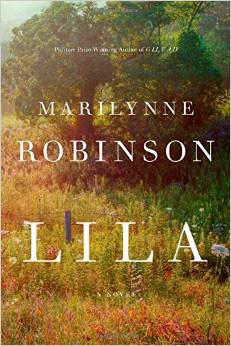
Kristy came to mind as I’ve been reflecting on Marilynne Robinson’s latest novel, Lila. Once again the story takes us back to Gilead, Iowa and to the characters we’ve already met in her previous two novels, Gilead and Home. In the first two novels, we encounter Lila as the young wife of the aging minister, John Ames. Now, we learn her story and the unlikely meeting and marriage of John and Lila.

Lila is born into a family on the very edge of survival in depression era middle America. She is taken from that family of neglect and abuse to be cared for by Doll, a loving and resourceful drifter. Doll is the only one she can trust, the only from whom she experiences love. They are virtually inseparable until Doll runs into trouble and lands in jail. Lila then has to fend for herself. While living in an abandoned shack on the edge of Gilead, she comes into contact with Rev. Ames, his church and the members of his church. What commences is an extraordinarily odd courtship and marriage. Only gradually does Lila come to know love; only gradually does she come to trust her husband and the church people around him. Constantly fearful of abandonment, she doesn’t even trust herself to stay, wondering when she will walk out the door with her baby and return to the hard life of a drifter.

Robinson captures so poignantly the cautious entry into the church by one who has learned to be suspicious of the church and church people. For those outside the church, and maybe especially for those on the edge of survival, the church can be a place to be afraid of, where those who desire to do good end up doing harm. There’s a scene when Doll temporarily leaves the loose group of itinerants, saddling them with one more mouth to feed. When they decide they can’t keep Lila, they abandon her on the steps of a church; there she is most afraid that church people will “steal” her away from Doll and that she will never again see the only one who has really cared for her, difficult though that life may be.

We get ringside seats into Lila’s struggle with the theology of exclusion so associated with the church. In particular, Lila simply can’t accept a God who would leave Doll out of heaven. Though she never got connected to the church and never was “saved,” it was Doll who saved her. We also get to see how Lila grows into the love of her husband and to some strange peace about her own part in the church. There is nothing fancy about their lives. Their love is deep, yet imperfect, hers seemingly tentative, as if that’s the only way she knows how to love. By the end, Lila seems to relax into the love of both her husband and her husband’s God.

Which brings me back to Kristy, to wondering what ever became of her. I know that wherever she is, she is still in God’s embrace. I just hope she has found a community that keeps on reminding her of that.

“Home”

home.jpgWeary or bitter or bewildered as we may be, God is faithful. He lets us wander so we will know what it means to come home.

Marilynne Robinson’s novel, Home, returns to Gilead, the fictional Iowa town that served as the setting for the novel of the same title. The return brings mostly the same characters, though the setting for most of the story shifts from the home and life of John Ames to his best friend and fellow minister, Robert Boughton. The story revisits and expands on the final episode of Gilead when Boughton’s troubled son, Jack returns home seeking forgiveness and the peace that has eluded him for his entire life. One of Boughton’s other children, Glory, has also returned home, ostensibly to care for her deteriorating father, but also because her own relational life has crashed and she needs a place to recover and restore.

Jack isn’t forthcoming with details of what has happened since he left, nor what has brought him back home. Bit by bit, piece by piece, the reader learns of Jack’s troubled life and of finally finding love and family, though home still eludes him. Glory, still sorting through her own shattered dreams of home, does her best to smooth the way for the repair of the breach between Jack and Papa Boughton.

At the heart of the wanderings and homecomings in Home is the difficult and gnarly question of forgiveness. Early on, when Glory is still trying to navigate her brother’s sudden return home and not fall through the thin ice of civility that covers the hard issues that still lie unresolved between Jack and his father, she says this, “There is a saying that to understand is to forgive, but that is an error, so Papa used to say. You must forgive in order to understand. Until you forgive, you defend yourself against the possibility of understanding.”

Papa Boughton genuinely tries to understand, a task made much more difficult by his son’s unwillingness to tell all. Still festering is a wrong from Jack’s earlier life that is still unresolved and for which Jack, ultimately is unwilling to acknowledge or for which is willing to take responsibility.

Forgiveness is not easy. It’s is not a one-dimensional. Forgiveness given can be retracted in a quick word of judgment. Intentions to forgive can be blocked by the difficulty of letting go of the transgression that cause the rift in the first place. And one can be offered forgiveness without the ability to receive it. Is reconciliation possible if the burden of transgression is so great that one cannot ever let go of it?

If home is the place where full acceptance and pure love is to be found, then I suppose none of us really ever find home. Probably, that’s simply too much to ask. Maybe home is, instead, the place where we work at it, a place where our best selves try to lay aside judgments and resentments, a paradoxical place of both warmth and struggle. Home is a place populated with skeletons of hopes and dreams unfulfilled and it is also a place were we occasionally find deep love and acceptance. It’s also the place where fathers and mothers recognize their own brokenness and failings, looking with hope not just to their sons and daughters, but to their sons’ and daughters’ sons and daughters.

What Jack came home looking for ultimately eluded him. As his sister caught a glimpse of what had almost been in his grasp, she comes to a moment of clarity and peace, realizing that at least for now, for all her wanderings, weary, bitter, and bewildered, she is home.

When Friendship Is Not the Thing

friends.jpegI suppose I’m not surprised that so much of the blogosphere and Facebook chatter about race has died down. I suspect it’s symptomatic of our short attention span. If it’s not in the news, then there’s no need to think about it anymore.

Except that there is. In the lively social media conversation a couple of months ago, there were several threads to the conversation that had to do with the notion that most white people don’t have any black friends. The implication seemed to be that white people should go out and make some friends who are black.

While I’m certainly not opposed to friendship, I think the notion is a red herring.

While my experience doesn’t need to be emblematic of anyone else’s, it’s the only experience I can speak of with any authority. In the first place, I don’t have many friends period. White or black. I am not the kind of person who cultivates a large number of social friends. I don’t go to a lot of parties. My social contacts are to a great extent the people of my congregation, and while I am friendly with them, and have a good relationship with many of them, they are not my friends.

I am also in a vocation where nurturing friendships is not particularly easy. I’m a pastor. My schedule doesn’t match the schedule of much of the world around me. I mostly work weekends, and when I do have some time on Saturday, it’s spent catching up on domestic chores that I’ve ignored all week. I don’t like to go out on Saturday night because I’m preoccupied with Sunday morning.  My day off is Friday, when most folks are working. And I often end up working two or three evenings a week. That’s why over the years, the few friendships that I have cultivated have been mostly other clergy. Our schedules mesh. It’s easy for us to find time for coffee in the middle of the morning or the afternoon or even an occasion for a late afternoon beer before heading home for dinner and another evening meeting.

Having said all that, though, I think friendship across racial lines is not necessarily what’s needed. What’s needed is public relationships across racial lines and all the other lines that tend to divide us: religious, political, socio-economic, and on and on. What we need, what I need, what the world needs is people who are willing to sit down and get to know what the Other cares about, is passionate about, lies awake at night worrying about. If racism is going to be addressed in any meaningful way in our communities, then we have to do the relational work that will make a difference in the long run.

I don’t know what it’s like to live as a black man in the western suburbs of Chicago. How could I? So, I also don’t know what’s needed or what actions on my part or on the part of the faith community I serve might be helpful. So, rather than take a stab in the dark or engage in action that is merely symbolic, I reach out.

I sit down and talk about the issues of racism and interactions with police and what it’s like to live as a person of color out here. I sit down as a pastor with members of my congregation who are African-American or Hispanic or refugee or gay or poor or any of the other boundaries that separate me from them. I reach out to my clergy colleagues across the boundaries of what makes us different. I sit down across the coffee shop table from them with an inherent curiosity and ask questions and listen. I ask them who else I should be talking to. And I encourage and challenge the members of my congregation to do the same thing.

When we do that enough times, not only are we building meaningful relationships, we discover that certain themes begin to emerge. Now we are positioned for meaningful action that just might get something done instead of the often symbolic flash in the pan action that gets some attention and then dies as if nothing at all had happened.

When enough of those conversations happen, when enough people begin to listen to one another across the lines that divide us, when we can agree on mutual action that will begin to lift some of the burdens that our brothers and sisters carry simply by virtue of the color of their skin, then we will begin to make meaningful progress towards communities where what happened to Michael Brown and Eric Garner will not be repeated over and over again.

I’m not whistling in the wind here. This is not theoretical. This is work that I do and that the community I serve does and it’s work that is bearing fruit. But it’s slow, plodding, time-consuming work. It’s work that requires a persistent, determined, and disciplined effort. And it seems like it’s not the kind of work that very many people have the appetite for in an instant gratification culture. It’s the kind of work that will draw no TV cameras, will elicit no requests for comments for a newspaper article, nor probably is it the kind of work that one can ever post to Facebook or tweet about.

But it may be the only kind of work that will really make a difference.

Thank You for Reading. No, Really. Thank You.

Screen Shot 2014-12-31 at 11.27.52 AMThank you, dear reader. Whoever you are, wherever you are, thank you for reading what I write.

If you’re short on time, that’s the punchline, and you can stop right here. That’s where this whole essay is headed. If you’re curious how I got there, read on.

One of the things that separates the human specie from the rest of the animal world is the consciousness of more than the present moment. We look back on the past, we make plans for the future, even as we experience the present moment. My dogs don’t do that. Maybe it’s what makes them seem so happy all the time. They are simply experiencing the joy of the moment.

I suppose our human sense of time is such an obvious piece of information that it hardly bears stating. I read about it recently in a book I’m reading on brain science, and I find myself on this New Year’s Eve reflecting about the past year and so, today, it is for me a valuable insight.

Comments I’ve read and heard from a variety of media sources are labeling 2014 as an awful year. Last Saturday on “Wait Wait. . .” Peter Segal suggested that 2014 should be the year about which we say, “Good-bye and good riddance.”  According to the AP, some of the top news stories of 2014 included the police shootings and the ramping up of racial tensions, the emergence of ISIS and the continuing violence in the Middle East, the loss of the Malaysian airliner (and now another plan crash in that part of the world), the NFL controversy around domestic violence, the ebola outbreak in west Africa, the extraordinarily contentious election cycle, and the tensions in The Ukraine, including the shooting down of the passenger plane last summer. Maybe it has been a year that we simply want to put in our rearview mirror.

For me, it’s been a good year. At the church I serve, a couple of losses of staff — one due to taking an assignment elsewhere, and the other a sudden death — led to a prominent sense of loss and grief. Yet, as we emerge from the grief, I find that the losses have given us a renewed sense of our ministry as a congregation. We have been given a golden opportunity to spend some time in discernment about what God is calling us to be as a congregation, and about how we do our work in the world. In the past 3 months, I’m feeling more energized and engaged in pastoral ministry than maybe I ever have.

With regard to my writing, it’s been a year of contrasts. I got the report from WordPress, the platform that hosts by blog, that I posted 28 times in 2014. That’s just over 2 times a month, far less than I had hoped for when I entered the year. Part of that is due, I suppose to the events that I described above. The losses of staff members required much more of my time and attention in the short-term than I planned for. And, of course, I don’t regret making that investment. As much as writing is necessary for me to do, my primary calling is still “pastor.” I’ve also been much more disciplined in working on my fiction which leaves less time for other writing.

As those of you who read this blog regularly already know, the subject matter for my blogging is all over the landscape, and has to do, I suppose with what I’m interested in in the moment. Blogging experts say find your niche and stick to it. But that’s not how I am. I’m not interested in one thing. I’m interested in the world and how I am in the world and how we are in the world. That inevitably leads to my reflections going all over the place. One of my most read blog posts of the year happened to be a review of a bed and breakfast I stayed at in Nebraska; someone from the bed and breakfast world read it and soon B&B proprietors from all over the place were reading it. I doubt they will be regular readers, but I’m grateful to have had the opportunity to say a kind and supportive word to them.

As I look back, it looks like what I am most interested in is how people of faith — Christians, in particular — take concrete action to work with God to accomplish God’s healing and redemptive intentions for the good world that God has created and still cares about.

What I’ve been trying to get to in this long end-of-year reflection is a word of thanks to those of you who take the time to read what I write. I’m grateful and humbled that of all the things clamoring for your attention, you would choose to invest a precious bit of that attention to some thoughts to which I have attempted to give cogent expression. I write because I need to. I need to put on paper some of the many things that rumble around in my mind; I need also to put them on paper because it forces me to clarify and remove the fuzziness of some of those thoughts. Knowing that someone else is going to read them forces me to be accountable for those thoughts. While I write for myself, I also write because I want others to read. I guess it’s an ego thing, but I like knowing that someone else is reading it. Even as I say I like that, I am sometimes amazed by it. As much as I try to tame them, I still face the demons that tell me I have nothing to say, that no one will be interested in what I’m thinking about, and that I haven’t had an original thought in years, if ever. On my better days, I can shout the demons down and live in gratitude for the miracle of language and expression and that by simply placing some characters on a page others can have some reasonable facsimile of what I am thinking and that together, the dialogue might move us all a little further along on the journey.

So, as I said before, thank you, dear reader. Whoever you are, wherever you are, thank you for reading what I write.

Changing the World

SchmaltzIf you were to look at the room and just sit back and watch, you might conclude that nothing extraordinary was taking place. A bunch of guys. Many of them wearing Bears jerseys. Monday night and the local team was on the TV.  A small deli, food out on the table, and and grocery bags of BYObeer.  Animated, even robust conversation. It looked like these guys had been doing this for years.

Except they hadn’t. In fact, for many of them, it was the first time they had seen or talked with one another. The chill of unfamiliarity that might have hung in the air at the beginning of the evening was quickly replaced by the warmth of interaction, even if they didn’t know each other.

What I’m describing is a first ever fellowship event between some of the men of the congregation I serve and the more organized men’s group — a group they call officially The Brotherhood — at the nearby synagogue, Congregation Etz Chaim.

Last night grew out of a community solidarity event that the synagogue hosted about 6 weeks ago, after they had experienced some vandalism in which the perpetrator was charged with a hate crime. That solidarity event was so meaningful for the members at Congregation Etz Chaim, that the president of the Brotherhood went to his rabbi and said, in effect, “This can’t be one-time shot. We’ve got to figure out how to nurture these relationships and make them permanent.”  So, Rabbi Bob reached out to me. “Do you have a men’s group? Our men’s group would like to invite your men’s group to get together; no agenda. Just fellowship and getting to know one another.”

I’m not sure anyone knew if this was going to work. I think a lot of us were a bit nervous. Since our men’s group is at best loosely organized, I wondered if anyone from Faith would show up (I know, I should have more confidence in my people!). I wondered if there would be the kind of mingling and conversation that the organizers of the event hoped there would be. And I think the first half-hour bore out the playful nervousness of folks, almost like the nervousness of the first middle school dance of the year. But eventually, the guys began to grab plates of food (unbelievably great food!!) and a bottle of beer. Small groups of men from both congregations began to gather around the tables while others stood one on one, talking to their counterparts. By the time the night was over, the bonds had been formed and I don’t think anyone was in a hurry to leave. It felt like they had been doing this for years. Ted, the president of The Brotherhood remarked to me as I was leaving, “We’ve got to do this again.”

What I think is most remarkable about what happened last night is that it happened at all. This is just not what we do. We stay with our own. We don’t move out of our familiar and comfortable worlds inhabited by people who are just like us; and we don’t often tend to relationships with them. Now, of course, the men in that room were in most ways more like each other than not. They were all residents of the western suburbs of Chicago, all white, and mostly educated, I suspect. But in that setting, all of them were also sharply defined by their religious affiliation, and for them to bring their religious identity into a room of strangers who were identified by an entirely different religious affiliation, and to do it for no other reason than to hang out together and to foster relationship with one another, is remarkable.

Isaiah’s vision of the kingdom of God is that the lion will lie down with the lamb. Sometimes I think it will be easier for the lion to lie down with the lamb than for 21st century American Christians to sit down with anyone who is the “other.” That’s what happened last night. A bunch of guys. Some good food. A football game on the television that was virtually ignored. And people who had walked off their turf to meet the “other” on common ground for the sake of tending to their common humanity.

You can tell me that I’m making too big a deal out of this. That it’s not going to change the world. Except that I think it is a big deal. And last night the world began to change.

Just Don’t Confuse Protest with Action

In about 40 minutes, this blog post will probably be totally irrelevant. Everyone’s focus will be on the specifics of the grand jury announcement in Ferguson, Missouri and the specifics of the aftermath. It will be great, grand, dramatic, sensational news.

Which is why I feel some inner compulsion to write it before the announcement.

My Facebook feed today has been replete with announcements of protests. Usually there’s a caveat that says “we’re gathering regardless of which way the announcement goes.” To which I say, “Well, then, what are you protesting?”

Good. Go ahead and protest. We have a long history of exercising our first amendment rights to free speech and to peaceable assembly. And in our history, many courageous people have exercised those rights at the risk of great bodily harm.

So, go ahead and protest. Just don’t equate your protest with action.

Action requires much more than protest. Does anyone remember the Occupy Wall Street Movement? Tell me what it accomplished. There was some press. The issues of economic division were highlighted. But has any progress been made towards the divide between the rich and the poor as a result of the Occupy Movement. Show me the goods.

Protest is a function of rage. When we act out of rage, the fundamental anger gets channeled into the belief that we have to do something. Get out there. Walk the streets.  Carry a sign. And in some cases, damage property, burn things, and hurt people. Rage rarely accomplishes anything in the long term. Rage is the flash in the pan. It’s gone in the same way that a firecracker explodes and results in fragments of paper on the sidewalk.  And it’s the easy way out.

Instead channel that anger into action. By contrast, action is hard work. It comes from an innate sense of curiosity. Why are things the way they are? It means finding out who the major players are. In means talking with people. Sometimes hundreds of people. And it involves time. Channeling anger into meaningful action probably won’t happen between the time of the event and the announcement of the grand jury. One has to steel oneself for the long haul, for the persistent, consistent slogging toward learning what’s behind what happened and formulating a strategy for dealing with it. And in a fast-food culture very few have the patience or the fortitude for the kind of work that it takes. But I’m convinced taking a posture of patience, channeling our anger into a deep understanding of what we’re dealing with, and then formulating an action that will be successful is the only way that real progress will be made toward righting the wrongs that populate the headlines and that so many of us experience every time we get out of bed.

So, protest if you want. And on occasion, I may join you. Just don’t confuse protest with action.

Our Work Together

1374822_10152382685842608_7720299481076555993_n-2

On Tuesday afternoon, October 21, Congregation Etz Chaim, one of the two Jewish synagogues in DuPage County, Illinois was vandalized. The perpetrator broke numerous windows and wrote anti-Semitic messages on the doors of the synagogue. He was apprehended within minutes and there was, thank God, no injury or loss of life to any persons. Still, the members of the synagogue were clearly rattled.

On Saturday evening, November 8, Congregation Etz Chaim invited the larger faith community to an event of support, “Coming Together in Solidarity.” Over 500 people attended with representatives from over 50 faith based institutions: Catholic, Protestant, Muslim, and Jewish. It was a remarkable event.  As part of our congregation’s work with DuPage United, a network of congregations and unions engaged in broad-based community organizing in DuPage County, we have developed a long-standing relationship with Congregation Etz Chaim. I also have developed a significant collegial relationship with Senior Rabbi Steven Bob and Associate Rabbi Andrea Cosnowsky. I was honored to have been invited to be one of the six speakers for the event.What follows is an approximation of my remarks.

I grew up in a small town in western Nebraska with a remarkable diversity of religious traditions. We had several varieties of Protestant churches. And we even had a Catholic church.

I went to seminary in St. Louis at a very conservative Lutheran seminary blocks away from what I believe is the oldest synagogue west of the Mississippi. I never made any attempt to visit that synagogue.  Shame on me.

While at seminary, I worked a couple of summers for a business that rented party equipment. I loaded and unloaded chairs and tables days on end. Both the owner and the manager of the business were ethnic Jews. The manager, Steve, affectionately referred to me as “Father” though I was only 23 years old and childless. I prided myself on getting into debates with him on the meaning of some of the prophecies in Isaiah. It was not a fair fight with someone who never attended synagogue and I’m not sure knew how to spell “Isaiah.” In my youthful arrogance, I was sure that I was doing the Lord’s work in “witnessing” to my vocational supervisor.

From that very, very parochial context, I stand before you this evening to say that one of greatest and most profoundly meaningful partnerships of my life and my ministry has been the partnership that I and the congregation I serve have developed with Congregation Etz Chaim.

Through over 10 years of working together under the umbrella of our broad-based community organizing in DuPage United, we have forged significant and productive relationships. I have a relationship with Rabbi Bob and Rabbi Cosnowsky. I have a relationship with a number of lay members of your congregation. Lay members of my congregation have forged relationships with lay members of your congregation. As a result, Faith Lutheran Church has a significant and productive relationship with Congregation Etz Chaim.

You might say that we have become friends. Yet, I have never gone out for a beer with either of your rabbis. I have never been in either of their homes for dinner, nor have I ever invited them to my home for dinner.

I don’t need more friends.

What I need and what the world needs is deep, meaningful public relationships. We need the kind of relationships where we work together for our common vision of what God intends for this world. We need the kind of relationships where we will set aside our sectarian, dogmatic differences for the sake of what we hold in common and what we want for the world and for the communities we live in and more importantly, what we together believe is God’s vision for the world.

That is what I have with Congregation Etz Chaim. That is what I have enjoyed and what our congregation has enjoyed. We have done God’s work together. For that I am deeply grateful.

In this time of your struggle and your insecurity, I want you to know that we stand with you and we pledge to continue to work with you. Standing with you will mostly mean standing next to you and working together. Sometimes, it may mean standing behind you to support you. There may even be times when we will stand in front of you to protect you and to deflect the weapons of the hateful. But mostly, we will stand beside you hand in hand, working with you.

And let me say that I do not make this pledge out of a sense of charity. Because I know that when the time comes when we need you, you will do exactly the same for us.