Category Archives: Uncategorized

The Deep Challenge of Faith Formation

faithformation

(This review first appeared in The Englewood Review of Books.)

Andrew Root. Faith Formation in a Secular Age: Responding to the Church’s Obsession with Youthfulness. Grand Rapids, Michigan: Baker Academic, 2017.

If you’re sitting in the chair of the lead pastor at your church, and this book came across your desk, you might be tempted to pass it on to your youth pastor or the staff person in charge of the children and family programs. And if you’re sitting in either of those two offices, you might be tempted to put it on the tall stack of books that will offer you one more way to tweak your programs to reverse the slow bleed of people away from a church in decline. All three of you would be wrong.

This book is part cultural critique and part theology, combining to open a new way to think about faith formation and the future of the church.

Most anyone who works in or around the church is familiar with the notion of Moralistic, Therapeutic, Deism. It’s the concept that emerged out of the sociological work of Christian Smith and became known in church circles through the work of Kenda Creasy Dean. The individualized, consumer spirituality represented by MTD has cut loose faith formation from the fundamentals of the Christian faith. Root accepts that critique of the church and for the first part of the work offers a detailed explanation of how we got here. He argues that as a culture, we’ve become obsessed with youthfulness, not as a way to honor or form the faith of our youth, but as as a culture-wide ethos out of which flows a drive for authenticity and fulfillment. From that false and empty well comes the church’s notion that if we could only keep youthfulness in the church, we could help people become more authentic and at the same time revitalize our churches.

Root is working out Charles Taylor’s A Secular Age for the broad task of faith formation in the church. Taylor makes a distinction between 3 different kinds of secularism, and Root seeks to unpack the implications of those distinctions for the work of faith formation. In Secular 2 (Taylor’s language), there is a competition between religious space and non-religious space; the church is constantly battling to maintain its hold on religious space. Faith formation becomes a battle to keep the youth participating in congregations, thereby maintaining our hold on that particular religious space. In Secular 3 (again, Taylor’s language), the facade of religion is held onto, even when we as a broad culture have given up on the idea that there can be any connection to the transcendent. Faith is simply the grasp of a set of cognitive truths that inform how we live ontologically in this world.

As an answer to the above, Root spends the second part of the book exploring Paul and how Paul’s understanding of faith helps us to seek connection with the divine in a culture that has lost any hope for transcendent experience. Basing much of this part of the work on the new Finnish interpretation of Luther and justification, especially Tuomo Mannermaa, “faith is a death experience (the cross) that leads to new life (resurrection).” What makes this faith possible is the real presence of Jesus as the minister who comes to us and even comes alongside us in our own experiences of brokenness and lostness to give us his very person as new life. Relying heavily on the great Christ hymn of Philippians 2 and the Orthodox understanding of that passage, Root explains how “the shape of Jesus’s ministering person is hypostasis (union of personhood) and kenosis (humble self-giving), leading to theosis (transformation into being a minister as Jesus is minister).”

Against a culture that eschews transcendent experience, Root argues that we experience transcendence when we stand alongside and minister to our neighbor in their own death experiences (brokenness, lostness). In doing so, “we find the real presence of Jesus, meeting our person with his own, infusing our being with Jesus’s own being as we share in the being of our neighbors humbly acting as her minister.”

The church, then is the household of ministry, and faith formation is centered in the church as the place where people receive the ministry of Jesus and then are sent into the world to minster to their neighbor. “The only thing the church offers the world is ministry! And this only thing, as we’ve seen, is everything. It is the very location of Jesus Christ; it is the energy to turn death into life and make us new beings who have our being and action in and through ministry.”

That ministry, he concludes, is lived out in three distinct dispositions for the church: gratitude, giftedness, and rest. Everything the church does in ministry — all of which is, ultimately, faith formation — is centered in these three distinct dispositions.

Don’t come to this book looking for lists of concrete steps to be taken to improve faith formation in the church. Don’t come looking for ways to tweak what you’re already doing to make it more appealing or more effective. You won’t find any of that.

But do come to this book ready to read slowly, to think and reflect upon the whole enterprise of faith formation from the cradle to the grave, and why the cognitive, programmatic approach that we’ve used for so long isn’t working. Come ready to be challenged and to call into question long held assumptions, and the plethora of bandaid approaches to the complex challenge of being church in this post-Christian time. No question, this is a challenging book; Root is reflecting on the difficulty of trying to connect people with God in a culture that is far more interested in the development of individual fulfillment than a life given over to divine service. I suspect that were we to take seriously Root’s diagnosis of a MTD church, we would blow up our present programs and start from scratch.

My fear is that the technical nature of the book and the short supply of practical tips will keep those who most need to read this from diving in. I hope I’m wrong and that this book will be widely read. One doesn’t have to agree with all of Root’s conclusions or even his sometimes too generalized arguments about how we got here. The rethinking of faith and the resultant reconsideration of how the church does faith formation could be transformative for our congregations. I also think this is one of those books that would be most fruitful if read in conversation with others facing the same challenges — as a staff, as a clergy or other church worker cohort. What holds great promise, in my opinion, is precisely the fact that he doesn’t offer a to-do list at the end of the book. Rather, because each context is different, each congregation with different people, different gifts, different traditions and different theological sensibilities, it becomes the responsibility of each of us to determine how we will each work to make our congregations households of ministry, and thereby deeply and substantively form the faith of our people, for the sake of God’s intentions for the world.

In the preface, Root indicates that this is the first of three books that will explore points and theories within Charles Taylor’s A Secular Age and the implications for Christian ministry. Even as I continue to reflect on this one, I can’t help but eagerly look forward to the next two.


Watching the Ice Melt

For the past week we’ve been been living in a temporary home just a block or so from Garrett’s Bay at the very northern tip of the Door County peninsula. The daily change of the ice and water on the bay has been a source of endless fascination for me.

When we arrived on Saturday, March 25, the bay was mostly covered with ice. It wasn’t a clear, unbroken sheet of ice; rather chunks that seemed as if they had long been broken and fused with the heating and cooling of the outside air. 

Later on in the week, a north wind blew in and the ice got scrunched up close to the shoreline as if a big snow shovel had entered the mouth of the bay and cleared the ice off most of the water. (Wish I had  picture of that, but didn’t think to take one.)

When the wind stopped blowing, the scrunched up ice loosened up again and a big patch of it floated out into the open water of Green Bay.

The warm temps over the weekend dramatically hastened the melt. You can see from these pictures just how much difference five days makes. 

Now this morning, the ice has pretty much disappeared from bay. For the past few days, temperatures have been pretty consistent through the day and night, hovering between the mid 30s and mid 40s. Still I find it astonishing that the ice the virtually disappeared in just 12 hours.

It’s raining today. Wonder if that will be enough to melt the few remaining chunks. You can be sure I’ll be watching.

Of Ending and Beginning

img_0140As a Christian pastor, death and resurrection are pretty real things to me. Jesus’ death and resurrection lie at the heart of the faith I proclaim. In the lives of the people I serve, I am routinely invited into deaths and resurrections of persons and families, though none of them are ever what I would call routine. They are always holy moments.

Death and resurrection imply the reality of endings and beginnings. I have entered into a zone of vocational ending and beginning, a kind of death and resurrection. After a long period of conversation and discernment, I have accepted a call to a new congregation. I will be moving from the western suburbs of Chicago to Door County, Wisconsin to serve as pastor with the people of Shepherd of the Bay Lutheran Church in Ellison Bay. (If anyone is interested, you can read the letter I sent to the people of Faith Church announcing the acceptance of the call.)

This is now the 4th transition I’ve made as a pastor from one place to another, this one at the end of a 15 year tenure. They are always fraught with emotion. As a pastor, you become invested in a place and in the people there. People invite you some of the most intimate and vulnerable times of their life. You get to be part of their celebrations, their heartbreaks, their milestones and their disappointments. In December, I spent the wee hours of the morning two nights in a row in a room with a dying man, his wife, his daughter, and two of his granddaughters. It was a holy moment as the people who loved him most dearly sat vigil with him, sending him across the river to the Promised Land. Somehow, they wanted me to be there. In January, I presided at the wedding of a woman who had known deep disappointment when a previous engagement was called off just before the wedding. When she and her beloved pledged themselves to one another, I got to share the moment with a better than front row seat, so close that their joy spilled all over me.

Take these moments and multiply them by hundreds, and one begins to see how deeply embedded a pastor becomes in the life of a congregation and the people who inhabit it. The moments come and go; one savors the moment and moves on. I don’t mean to suggest they are unimportant. They are extraordinarily important; yet they come with such regularity that I never really spend much time dwelling on them.

Except that now as I prepare to leave, so many moments come flooding back. I look at a family in the pew on Sunday morning and I get a flashback of the funeral we did for Dad, or the time when the infant child who’s now in high school spent weeks in the hospital suffering from seizures. When I get an email from a former congregational president wishing me the best, I recall the capital campaign for which we shared leadership and how much I learned from this wise, faithful man.

One also gets to work with people for the sake of God’s larger purposes in the world. Now as I leave, I see with such clarity the great ministry that the people of this congregation do, the way we have made an impact in the community and in the lives of real people.

In the weeks to come, I will say more about where I am going, but for now, I am beginning the long, heart-wrenching process of saying good-by to people and a congregation that I have grown to love so deeply. We will remember together. We will savor these moments. We will laugh and cry together. And we will give thanks to God for prospering our work together.

When a colleague heard I was leaving, she sent me a Facebook message reflecting on her own pastoral partings, reminding me that as the Sent Ones, we love deeply but loosely. I like that phrase. Encapsulated in it is the transient nature of life. I picture life as a moving stream heading towards the ocean. For a time, we get to float along with the same people. Then the current changes and we get diverted to other channels in the same river, together, yet apart.

I had not anticipated that I would be leaving Faith at this point in time. Yet, the Spirit blows where she wills. She had created a restlessness that has found opportunity for a reset, to enter into a new season of life and ministry, and to do the work that I love in a landscape for which I have long yearned.

So, a heart-wrenching ending and a life-giving new beginning. Always held together in the love of the One who has called us his own.

Christmas. If not Merry, then Blessed and Hopeful

15439961_10211363540473869_796496761573532180_nA cold winter chill has settled into our little spot on the earth. Snow covers the ground and the temperatures are a bone-chilling cold. For those of us in the northern hemisphere winter and Christmas go hand in hand. Even the songs tell us to wish for a white Christmas.

It’s easy to romanticize the cold of winter while sitting next to the fire with a soothing cup of hot chocolate. But the cold and snow can’t be romantic for everyone. Some have to work in it. Some even have to sleep in it. And some wonder how they will stay warm when there’s no money to pay the gas bill.

On the one hand. . .on the other hand.  Life is always a little like that. The good and the bad. The romantic and the reality. The pain and the relief. The sorrow and the celebration. The light and the darkness. The manger and the cross. The cross and the empty tomb.

We are vulnerable creatures, subject to the physical realities of time and disease. While some families celebrate coming together for Christmas, some know the acute pain of separation. Our Advent and Christmas observances are somehow of one piece, one complete woven fabric, with Good Friday and Easter. The manger is never very far from the cross. And the cross is seen in it’s fullness when we can also see in the three-day distance the empty tomb.

Christmas begins the story of God taking on our vulnerability, our pain, our sorrows, our joys, and our celebrations. The Word becoming flesh is God’s commitment to the inherent vulnerability of humanity, God’s commitment to the entirety of what it means to be human. The death of the Son of God is one location of that commitment. But so is womb of Mary, the stable, and the manger. This is what God chose. The Word became flesh and dwelt among us. The habitation of God with us brings us a life that is real life and a kingdom that is love and peace and freedom.

Regardless of how much things appear to be corrupt, corrosive, cruel, and confusing, there is another reality at work. God has come among us. God has inaugurated a new kingdom. So, in spite of the hurt we might be bearing, there is hope. The immaculately conceived Christ-child is conceived also in us so that we might be the agents of the kingdom for the whole world.

If Christmas cannot be merry for you, may it bring blessing and hope.

A Monday Morning Sermon to Myself on the Promise of Life and the Reality of Death

burn1Those moments where the personal and the professional collide.

On Friday morning, we were called to Lurie Children’s Hospital to keep vigil with our son and daughter-in-law as they accompanied their 8-week old daughter, Eliana, on her final journey. Late Saturday afternoon, we stood over her bed, her life having slipped away after she had been in their loving arms for the previous 30 hours.

Fourteen hours later, I was standing in the pulpit on the 4th Sunday of Easter, expected to proclaim resurrection when my experience was the raw reality of death. And in this case, a death that seemed particularly cruel and unfair. As fate would have it, I presided at six baptisms on Good Shepherd Sunday.

Eliana was a beautiful little girl. She was active, feisty, and demonstrated extraordinary courage in the face of a disorder that wracked her body with pain. Epidermolysis bullosa is the worst genetic disorder you’ve never heard of. Her skin was finally beginning to heal, but the infection that took over was beyond the reach of even the most powerful antibiotics.

It’s my job to preach Easter, to speak of resurrection and life. Sometimes I find the promises hard to believe. It’s hard to believe the promises in the face of the excruciating physical pain of an infant and the extraordinary emotional pain of two young parents, one of whom is my own child, parents who in so many ways were deprived of the most basic joys of parenting, not to mention handed an unspeakable loss at the death of their infant child. The promise and hope of life seem empty and powerless. At times like these it enters my mind that all the flowery church language we have devised for Christ’s call and promise are nothing more than that. Words. How can those words represent any substantial reality when suffering and brokenness and death seem so much more real, as real as the lifeless body of a tiny baby.

“In the face of this, we have the promises of God?” he asks, a sad and cynical edge to his voice.

“In the face of this, we have the promises of God,”  he replies.

A promise is wonderful in that it brings hope. But a promise isn’t any those things that we would like it to be. We cannot hold a promise in our hands as evidence of its reality. A promise is not the mulligan on the golf tee where you get a do-over when you’ve messed it up. It is not a time machine where we can go back and right the wrongs. A promise is not the fairytale ending of a television show. A promise is not Harry Potter’s magic wand that would allow us to fix things with the flick of a wrist and a fancy incantation.

A promise is a word from God, God who down through the centuries has been faithful to God’s Word. A promise is the word of the Word made flesh, the One who invites us into trusting that in the midst of all the death there will be life. The promise carries with it the image of the Good Shepherd with his arms spread wide open, his hands and feet nailed to a cross, his voice crying out  in desperation, abandonment, and death. The Good Shepherd has promised to meet us in the horrible places that we are sometimes forced to go.

That’s the voice that calls to me and will keep calling even when what it says is hard to believe and my heart may not be ready to hear because the stench of death still lingers. The Crucified One reminds me that the tomb is still empty; Easter still offers hope and life. Especially in the midst of so much death.

Ash Wednesday — Beginning the Journey

mountaintopWe stood in the trailhead parking lot about 20 miles and a few thousand feet above Aspen, Colorado. It was already getting close to noon, a few hours later than we had hoped to get started. The skies were gray and a fine, misty rain was falling. We had to make a decision. Head out on the trail or go back to town, find a room for the night and formulate Plan B.

I was nervous anyway, the kind of anxiety I always have when we’re ready to head out on the backpacking trail for a few days. Have I remembered everything? Will the gear hold out? What will the weather be like? Will the map be accurate and will we be able to find the right trail at the right time?

My anxiety was heightened because just a year earlier, we had tried to hike the same 25 mile loop, a loop that crossed four 12,000-foot-plus passes. But I couldn’t do it. I hadn’t trained well enough and got a mild case of altitude sickness. A year earlier, Plan B had been a shorter, less strenuous, and less spectacular route.

But my sons, Chris and Tim, had heard so much about this loop, about it’s beauty and spectacular views that they were determined. I had trained, worked hard to get ready, and wondered if it was going to be enough.

Here we were. About to begin. In the rain.

Though we talked for a few minutes about our options, there was no question. There was no Plan B. We were going to do this.

We set out, Chris and Tim with all the confidence of headstrong adolescents who delighted in physical challenges. Me with all the doubts of a middle-aged realist who couldn’t shake the memory of the previous year’s fail.

That first afternoon was only a few miles, a couple of hours, and a relatively mild climb, though I remember thinking that it was plenty steep. It would only be mild in retrospect and in comparison with the climbs that lay before us.

For some reason that trip came to mind last night as I was winding down at the end of Fat Tuesday and anticipating this morning’s beginning of the lenten journey. Last night felt like standing in that parking lot about to take the first step of a journey that was known only by looking at a route on a map. The journey itself would play out in time, step by step.

I have thought about this year’s Lenten journey and sketched out some lenten discipline for the next 40 days. I’m going to read through the gospels in these 40 days. I’m going to fast once a week, starting today (though I guess according to today’s gospel lesson, I’m not supposed to tell you that). I’m going to abstain from alcohol.

But right now, this journey is represented by intentions only. Like that 4-day hike represented by some dotted-line skritches on a map, this journey will get played out in time, step by step.

There are some big things on my calendar — a grand experiment at church, a preaching series to launch a Year of Discernment, a big solidarity event with some mosques in the area. I’m looking forward to those things.

Even more, I’m looking forward to deepening some spiritual practices that often get rusty in the rush of daily activity. Each year, Lent for me is a time to press the reset button, to wipe the dust off the practices in my daily life of faith that I intend always to be there but somehow get forgotten.

The gift for me this morning, on this Ash Wednesday morning, as I think about the steps of my journey to the Pascha, is that I have caught a glimpse of the truth that is always there, but is too often hidden to my view — the steadfast love of the One who in my baptism has called me his own.

That hike in the Maroon Bells Wilderness area was probably the most spectacular, most beautiful backpacking hike I have ever taken. It was stunning. The second day, we paused along Snowmass Lake, an alpine lake accessible only by trail, the sheer cliff across the lake reflecting in the lakes’s glassy surface. We could have sat at West Maroon Bells Pass forever, scanning the 360-degree panorama of mountain peaks. Every meadow we passed through brought extraordinary fields of blooming wildflowers.

It was also the most difficult. I developed a routine in order to get up steep final approaches to those four passes. Ten slow, small steps; stop to catch my breath. Ten slow, small steps; stop to catch my breath. Ten slow, small steps; stop to catch my breath.

And that will be my plan for the next 40 days.

Why I Write This Blog

The turn of the calendar sometimes gets me thinking a little bit sentimentally. Last week, I went back and looked at my early blog posts; my first post was January 1, four years ago.

I was a blogging machine that first week, posting four times in 9 days. I didn’t continue at that pace.

I began writing this blog with the hope of building a following that would be useful for the novel that I was getting ready to publish. Everything I read told me to write a blog to that you’d have a following of folks who would be knocking down your door to to read what you wrote. It didn’t quite turn out that way.

I don’t say that with bitterness or regret. The blog has become for me a thing in itself, something that has brought me a great deal of satisfaction and if a few people read it along the way, even better.

Which brings me to the point of what I want to say today. What this platform has become for me is a way to contribute the the conversation that goes on between matters of faith and what’s going on out there in the big, wonderful world. Matters of faith are important to me — no, they are central to me. I also carry this insatiable curiosity about what’s going on in the world, a deep desire for things to work better than they do.  I write because I think I have something to share with the rest of the world that might be useful, something that might be pertinent to the larger conversation. I have no illusions that I have firm or definitive answers to any of the things I write about. But I do have opinions, and sometimes those opinions might be useful beyond my own head.

There is a lot out there in the world that is not right. For most of us, I think, the default position is that there’s nothing we can do. I don’t buy that. I think that when a lot of us care about those intractable problems and we do even little things collectively, we can get something done. I’ve seen it happen over and over in organizing work; some of that I’ve written on these pages. I think of the honeybees, the thousands  of them all going out finding even more thousands of flowers and each collecting their little bits of pollen and returning to they hive. Those communities of bees get done what they need to do to survive and thrive.

Part of what’s necessary for the human community to survive and thrive in the midst of the challenges of the 21st century is to have conversation about those challenges. Conversation is not the whole thing, but it’s a necessary thing. We are a species of language, information, and reflection. Our ability to reflect on our situation is one of the most powerful and magical things about being human. Our reflection and conversation will, I believe, lead to a measure of healing, reconciliation, or making things better.

I want to be part of that larger conversation from the perspective of my Christian faith, and of my position as a leader in the Christian Church. I come to the conversation from my vocation as a Lutheran pastor. I come also fully aware that some lousy versions of Christianity have contributed to the mess the world is in right now. The Christianity that I know and attempt to practice is a faith that is inclusive, inviting, and gracious, a way of being that finds it’s transformative source in the death and resurrection of Jesus and attempts to live consistently and authentically according to the teachings of Jesus.  God has intentions for the world; God is at work moving things towards fullness and completion. My vocation is to be an agent of that reconciliation and healing.
If you’ve read this blog for very long, you know that it’s not about one thing. I suppose that violates a cardinal rule of blogging. I haven’t carved out a niche. I write about the things I’m interested in and I’m interested in a lot of different things. But if you look back at the nearly 120 pieces I have posted, what it looks like is that I’m mostly interested in the intersection of faith and life — in particlular, how the Christian faith gets lived out in the world — and what faith has to say about the gnarly messes that we come into contact every day. Reflecting and writing on that intersection calls on my training in theology, my twenty-seven years of experience as a parish pastor in Lutheran congregations, and my continuing interest in theology. It also calls on that curiosity about this big, wonderful world that I’ve already mentioned.

I write, certainly, because I want people to read what I write. And for those of you who are still with me, thanks. But I’ve also discovered that I write for myself. It’s good for me. I want to be a writer when I grow up, and the more I write, the more I practice, the better I get. This is my version of going in to the piano practice room and doing my scales. And, there’s even something b beyond that. When I write, it helps me to organize and clarify what I really think about something. I’m am prone to fogginess of thought, and laziness when it comes to the hard work of actually naming with clarity what I think. Writing forces clarity.

As we enter this new year, I’m looking forward to continuing this conversation. Thanks for being a part of it. And if it’s like many of the conversations I get to be a part of, it will take us to places that are beyond what I could have imagined.

My Shiva Is Over

blackYesterday, there was this line in the sermon that I heard: The memory of one shooting isn’t even distant before we hear reports of another.

That’s the thing that has occupied my mind and brought such a heaviness of heart for the past weeks.

Things have been pretty silent on this blog since early June. On June 1, I left for vacation in the Colorado Rockies. I had intended to keep up at least a posting a week.

Then Charleston happened. At first, I experienced simple disbelief, almost like my initial reaction on September 11, 2001.  As more details were reported, the tragedy became more and more shocking and horrifying. It numbed me.

The ink was not even dry on the first reports when the opinions started coming out about what caused it and what we should do about it. How quickly we turned to explanations and solutions. In those days following Charleston, because seemingly everyone was saying something, I felt compelled to say something. But I had nothing to say.

Maybe we say too much too soon, especially when these kinds of deep tragedies happen. In our collective problem-solving mentality, in our 24 hour news cycle that requires many words and images to fill the space, and when everyone is a pundit with an opinion, we seem to think that offering explanations and solutions will make everything come clean in the end. What happens is that nothing comes clean, but we numb ourselves into believing that it won’t happen again and nothing really changes very much.

In the Jewish tradition, when someone dies, there is a ritualized period of mourning. Here’s how it’s been described to me: first, there’s aninut, the death and the burial. It’s an all-consuming few days as the body is prepared for burial, funeral plans are made, and then the funeral and burial happen. Then there’s the shiva, a period of seven days after the burial. The mourners return home and sit on low chairs, taking a cue from Job’s mourning for his family when his friends sat down with him towards the ground for seven days and seven nights and no one spoke a word to him.  During this time, mirrors are draped in black and the mourner lights a memorial candle. The mourner wears no make-up, no perfume, engages in no sexual activity, listens to no music, and wears no shoes. During this time, family and friends call at the house. The mourning becomes a communal mourning with distractions stripped away. For this time, there are no explanations and there is no push to move on. The mourners sit in their lament, surrounded by family and friends. Lauren Winner writes that “what has struck me about a shiva call is the sheer crush of people.” (Mudhouse Sabbath) On the last day of shiva, friends come and take the mourner by hand, lead him out of the house and down the street for a walk around the block. It’s both the literal and figurative reentry into society.

I wish we could have a national shiva when something like Charleston happens. I wish we could shut off our televisions, ban anyone from writing anything about what has happened for a week or so, and just sit in collective lament. At least in the Christian tradition, we don’t do lament very well. We do funerals, but not lament.

It feels like we have a cultural diarrhea of words about why these things happen and what we should do; we get all riled up for a few weeks and then everything goes back to normal. When the Newtown shootings happened over two and a half years ago, we all thought that would be the game-changer in forming a society in which we would make sure that such mass shootings would be a matter of history. When Michael Brown was shot and Ferguson erupted, we pledged that things would change.

As far as I can tell, not much has changed.

I don’t know what to do. Big things like racism and violence in America are complex challenges and solutions are perplexing. My heaviness of heart and mind about both issues are close to despair, feeling in some moments like we will never get past this; this is our destiny; racism and violence are so embedded in our national DNA that the best we can hope for is to keep the beasts at bay.

Yet my faith is based on hope for what is not seen and even for what does not seem possible. My trust in God’s covenantal promises tells me that even in the midst of these societal Gordian knots, God is at work. Somehow I need to be part of that work, even though I haven’t wanted to say anything or do anything.

Last week, I went to our denomination’s national youth gathering — 30,000 high school youth descending on the beleaguered city of Detroit, bring their faith, their witness, their dollars, and their willingness to get into the trenches and work. It was exhilarating. And it was hopeful.

Apparently, that was my walk around the block. It’s time.

Let’s Make Earth Day Matter

plant in the riverEvery year, I face this internal dissonance on Earth Day. I’m conflicted.

On the one hand, I care deeply about the earth and all that dwells therein, and am deeply concerned about the current crisis of environmental degradation.  So, any attention paid to the crisis is a plus.

On the other hand, I fear that this one big splash a year leads to a sense of complacency, even for those who care. It goes something like this:  I care about the earth. Today is Earth Day. I’ll do something today, (like post a picture on Facebook), to show that I’m green.

And then tomorrow, we all go on as usual.  It feels a little like the environmental version of those who go to church on Christmas and Easter. I love having them there. I wonder what we could do together if it was a consistent practice rather than a one-day-and-done kind of deal.

So, I’d like to make a suggestion. Take this Earth Day 2015 make the first stop on a year-long journey. Decide that you will do something — even if it’s only one thing — to become better steward of the earth. Commit yourself to the practice with a long view, until it becomes not only a habit, but the way you live.

I’m actually going to commit to two things, both of which I’ve experimented with off and on, but haven’t made the commitment to the longterm.

First, I’m going to commit to keeping the car in the garage at least one day a week. My own driving habits, unfortunately have reflected our culture’s love affair with the automobile. The way I use my car suggests that I value convenience more than the stewardship of the earth. I live only 2.5 miles from where I work, and I can easily walk or ride my bike. And even if I unexpectedly need the care during the day, it really doesn’t take that long to get home for the car.

Second, I’m going to commit to a decrease in our family’s reliance on animal protein. The amount of land and resources devoted to the production of animals for human consumption in the US is not sustainable. It takes 11 times more fossil fuel to produce a kcal of animal protein than a kcal of plant protein. Part of my new commitment will be to go meatless one day a week, but part of it also is simply to decrease the amount of meat I use when I do cook with meat.

Too often and too easily I worship the god of convenience. I care about the environment, but it takes effort to act. If observing something like Earth Day is really going to make a difference, it’s going to be in the action. I’m making my commitment. What will you do?

Why We Should All Care about the California Drought

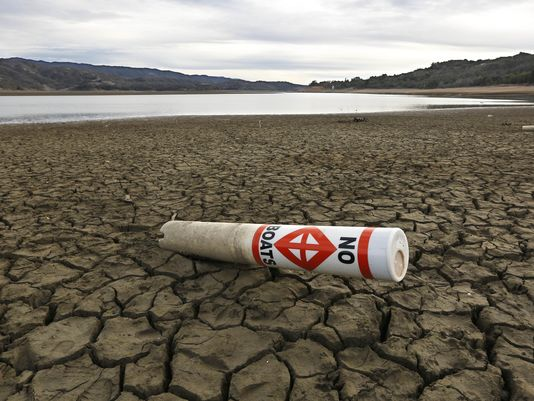
california drought.jpgYesterday, an op-ed piece  was printed in the Chicago Tribune that has gotten under my skin. It was about the California drought; I think the author was intending a little humor. I didn’t think it was funny.  Humor at it’s best helps uncover the truth, and the author seemed to be pushing the truth that we can distance ourselves from the water crisis in California.

The gist of it was this: all winter long, Californians gloating over their pleasant, balmy, shirt-sleeves weather while we in the middle west are suffering in the deep freeze.  Now, the author suggested, we can turn the tables on those braggadocious left-coasters:  “So, how’s your lawn looking these days?” “Guess what I did this morning? I took a 30 minute shower.” (You can read the op-ed for yourself here: http://www.chicagotribune.com/news/opinion/commentary/ct-spring-chicago-california-perspec-0407-20150406-story.html)

But I think this little yuck- yuck is insidious at it’s heart. It presumes that we can segregate and regionalize our crises. “What happens in California doesn’t matter to me; I have plenty of water.”  Pretty soon we’re extending the principle: “the mining of sand along the Mississippi River in Wisconsin doesn’t matter to me; I can’t see it from here” or “the oil spill in the (you name the river) doesn’t matter to me; I don’t live there.” As long as it’s not happening in my backyard, then I don’t need to be all that concerned about it.

There are a few practical reasons why the drought in California should matter to us in the middle west.

  • A disproportionate amount of fruits and vegetables come to our tables from California. A lot of what we eat and drink is at risk. If the drought persists, that supply will shrink and what is available will be much more expensive.
  • The water shortage is likely not going to go away, and neither are the almost 39 million people who live in the most populous state in the U.S. They will get water from somewhere, and as time goes on, it will come from further and further away.
  • Climate change scientists are suggesting that what’s now happening in California is merely the pre-cursor to something that will be happening on a much larger scale in other parts of the country, including the middle west. Gloating over the abundance of water may be short-lived.

But I think there’s something much more substantial at stake here. Something fundamental, spiritual, theological, if you will. We are all connected. We’re all in this together. The land that is California is the same as the land that is Illinois. It’s a single, unified creation. People identified as Californians are of the same human family as the people identified as Illinoisans. Whatever borders we create are artificial bureaucratic structures that create misleading divides among the family. When the middle west experiences abundant harvest, the plenty ripples far beyond the narrow Great Plains geography. And when creation is in travail in California or in The Philippines or at the Arctic Circle, then we all share that travail. Part of the stewardship of my life as a follower of Christ is the stewardship of creation, not just the little postage stamp that I live on, but all of it. The small things I do to conserve or waste inevitably have in impact on my brothers and sisters, not to mention the created order, around the world. We are all connected. Which means that my carelessness or wastefulness is stealing from the life of another.

I learned something of the stewardship of the land from the farm families I grew up around. A good farmer doesn’t just steward the land that he can see from his kitchen window. He takes care of the whole of his farm, all thousand acres. And in fact, he cares for his own land in a way that he doesn’t cause harm to his neighbor and his 500 acres. And both he and his neighbor take care of their land in a way that benefits his neighbor’s neighbor and her 2000 acres, because they all know that while fences and legal documents define boundaries between his farm and his neighbor’s farm, it’s all the same land. For everyone to be cared for, all of it has be be cared for well.

So, there’s no room to gloat over our abundance of water here in the backyard of Lake Michigan. Instead we ought to be caring for the abundance of that resource as if the California drought was ours. Because, after all, it is; we’re all connected.