
Category Archives: pastoral ministry

In Praise of Church Being Church

GWOH worshipAbout that tricky, risky relationship between pastors and congregations? I often hear a tale of dysfunction, hurt, suspicion, betrayal. . . you get the idea.

I have a different story to tell.

When our granddaughter, Eliana was born on February 17, the elation at her birth quickly turned to uncertainty and concern. When our son first texted us with the message of her birth, he told us that she had been transferred to Lurie Children’s Hospital; there was something wrong with her skin. My immediate reaction was concern, but only mild. “Probably something minor that will be taken care of in a few days; she’ll be home soon.” That’s what I told myself. It wasn’t true. Eliana was born with epidermolysis bullosa, a rare and serious skin condition. Eliana died on April 16, a day shy of her 2 month birthday.

Those two months were filled with a range of emotions, uncertainty, heartache, exhaustion, anger, sadness. . . Through it all, the people I serve with at Faith Lutheran Church demonstrated to me what church is.

When I first announced to the congregation Eliana’s condition, and especially that it was serious and potentially life-threatening, I asked them to give Sheryl and me some space as we tried to process and come to some understanding and acceptance of what this all meant. While they were curious and wanted to know so much more, they honored that request. A few weeks later when I indicated that I was ready to talk about things, they reacted in such a caring way, offering kind words of support and  constant prayer. On the Sunday that I first announced Eliana’s condition, our retiring congregational president emailed me with words to this effect: “you take whatever time you need. Let go of little things; not everything needs to be done. And we will cover what has to be done that you can’t do.” We had a council retreat just 10 days after Eliana’s birth, and the council surprised me with a collection of gifts for my wife and me, for our son and daughter-in-law, and for Eliana. Our newly elected council president said to me in front of the whole council, “You need to know we have your back. This is an important time for you. Do what you need to do. We have your back.” (It brings tears to my eyes remembering that moment.) Through weeks of trying to be present at the hospital and also keep up with my work, members of the council provided gas cards, train tickets, gift cards for meals and coffee, cards, letters, notes, emails — so much that I can’t even remember it all.

And the staff that I work with? Simply amazing. Nearly daily, my co-workers stopped by the office with a hug, a kind word, a card or note, a Starbucks card, and the never-ending assurance that they were praying for me, for our family, and for Eliana. And they spoke her name to me. That became more important than I knew at the time. More than words and gestures of encouragement, they took over things that I normally do. We have two midweek bible classes and I usually teach at least one of them each week, often both of them. They completely took those over. They offered to do Sunday preaching. We were entering into a major discernment campaign, a project with which I intended to have close involvement. One of our staff members and a lay leader completely took over that planning. Those conversations have start this week, and what my colleagues in ministry have planned is bearing fruit in powerful and meaningful gatherings.

Eliana lived her entire life in the Neo-natal Intensive Care Unit at Lurie Children’s Hospital. I am not privy to what her medical bills were, but it must be extraordinarily expensive. A couple of staff members set up a Go Fund Me account so that people had a vehicle for helping Chris and Liz with their medical expenses. The people at Faith were generous beyond my imagination.

After Eliana died, it became clear that my relationship with the people of Faith was anything but superficial. People here grieved deeply with us. They cried with us, they shuddered with us at the death of an infant; they helped carry our sorrow, our sadness, and our anger.

What happened at the funeral was a moment full of light in the midst of deep darkness. Though my son is a pastor, he and our daughter-in-law asked that the funeral be held at Faith. We anticipated a large attendance, larger than his small congregation would have been able to host.  When the people of Faith got the news that we would be hosting the funeral, they went far beyond what I could have asked for or imagined. We had teams of ushers, communion servers, acolytes, greeters, altar guild servants, who made sure everything for the service was just right. Our music director recruited a choir and made sure the music was excellent. People were volunteering to help with the reception even before our funeral coordinator could send out the request. My staff colleagues took care of details to make sure I had time and energy to prepare for the service and be with my family.

And they showed up. For the funeral. Nearly four hundred people showed up for the funeral. It was a mix of people from the many relational circles of Eliana’s parents and grandparents, including people from the congregation that my son serves with. So many people from Faith came. It was our time together. It was our time to bear our burdens together, to sing together, to pray together, and to hear the word and promises of God together.

There are a thousand more things I could name.

I am by nature an independent person. For most of my life, when I have a problem, my default position is to solve it myself. Add to that the fact that I am a problem-solver and will help others solve their problems, even as I sometimes ignore my own. When I am hurting, it has been difficult for me to ask for help and difficult for me to receive care from others.

Somehow this was different. I don’t know that I explicitly asked for care from the congregation I serve with, but they gave it and I received it. The love that I believed they had for me as their pastor was demonstrated in such depth and concreteness that it has taken me by surprise. They have loved me. They have cared for me. They have carried my burdens and made them their own. They have shown me what it means to be church.

Something that I’m having a hard time putting a finger on has happened in our relationship. There is a strength and trust that is palpable. I am so grateful beyond my ability to express. I didn’t know that church could be this good or this meaningful or this sustaining.

I want the whole world to read this word of tribute: Dear People of Faith Lutheran Church, “I thank my God every time I remember you.”

Sermon at Eliana’s Funeral

IMG_0086On Sunday afternoon, we held the service to commend Eliana to God’s care. It was a hard and beautiful time. The church was packed beyond capacity; so many family and friends came to help us sing Eliana across the river: family from all over, friends, neighbors,  members from Faith Lutheran Church where I am the pastor, members from Acacia Park Lutheran Church where Chris is pastor, pastoral colleagues from across the Chicago area, colleagues and partners in our community work. It was a glorious gathering. Todd Carrico, our music director did a fabulous job of leading the song, and did the assembly ever sing! They sang for us when the words were stuck in our throats or held back by tears. 

I don’t usually publish my sermons as part of this blog. Sermons are contextual and best heard in the assembly as they are preached. This one is no exception. However, in some ways, this sermon is a continuation of what I have written in the past few posts I’ve shared here, thoughts about promises and resurrection and what all that could mean as we grieve Eliana’s death, a life too short and in which there was too much pain. 

The sermon was based on the lessons Chris and Liz chose for the service: Isaiah 43:1-3a, 4-7, 18-19, Psalm 139:1-17, Romans 8:26-27, and John 4:1-15. Often in the sermon, I use what in the printed word seems to be an ambiguous “you.” In most cases, I’m addressing Eliana’s parents, Chris and Liz Honig.

Eliana Frances Honig. Eliana. God hears. What a beautiful name for a beautiful little girl. Eliana’s world was pretty small and pretty limited. Nearly her entire life was spent in the confines of a small room on the Neo-Natal Intensive Care Unit of Lurie Children’s Hospital in downtown Chicago. Yet, she was Eliana. There is both joy and a deep sense of sadness today. Only in her death do you get to introduce her to the world. When you penned her obituary, you told us about a beautiful, brave little girl who was a fighter, who sparred with her nurses and had her own unique way of curling up her feet and touching her bandaged hand to her cheek, who in spite of her near constant pain tried to soothe herself, and was responsive to the gentle sound of your voice and touch, even when there were so few places you could touch her.  I think she must have been the most well-read 8 week old on the planet.

What you have described is Eliana, a girl with her own personality in spite of her EB, a unique human being who was not defined by her disease. God created Eliana. God created her in God’s image. From the very beginning God knew her and God loved her. While her skin disorder made her life difficult and painful, she was formed wonderfully, and you, her parents, were able to see how extraordinarily she was knit together, how remarkable and complex she was. She was, in spite of her disease, in spite of her short life, a precious human life with consciousness and will and the ability to connect with those few people who were able to come to know her.

And she was loved. Oh, was she loved. She was loved by mama and papa, Grampa Frank and and Gramma Luann, Grampa Jim and Gramma Sheryl, Aunt Shannon, Uncle Tim and Aunt Stacey, nurses Kate and Ursula and Sara and Stephanie, Dr. Henna, Dr. Mancini, Dr. Chamlin. Oh, that child was loved. And not because she was any of those amazing things that appear in her obituary. She was loved because of her life. Your love for Eliana allowed you to see those amazing things in her. The mutual love of child to parent and back again brought joy to you and to everyone who got to know Eliana.

That joy is muted today because the sad truth is we are not intended to bury our babies. I have no words to make sense of why we have to do that. For all of my faith and all of my theology, I have never been able to put together a cogent explanation for the kind of suffering that Eliana experienced, and the suffering of parents who lose their children.

At first glance, the gospel lesson has little to say to those who are grieving the death of a child. Jesus is enjoying a little verbal sparring with a woman from the wrong side of the tracks. They happen to be at the old well of Jacob in the middle of the day. Neither Jesus nor the Samaritan woman should be talking to each other. Yet the conversation goes on and in response to the woman’s questions and yearnings, Jesus talks about water and thirst and the possibility of never being thirsty again and about how one’s deep thirst can be slaked by a water that brings eternal life.

On April 7, on the morning before she went to surgery to have a feeding tube inserted, Eliana was baptized into Christ’s death and resurrection. Though it wasn’t an abundance of water, it was water with the Word that brought to your precious daughter the gushing springs of life. It wasn’t exactly the baptism that you had imagined. It was not at church, and beautiful Eliana traded a lacy white baptismal dress for Aqua-phor soaked dressings that wrapped her wounds. Still, in the application of water of from a tiny plastic vial along with the words of the gospel, it was living water; it was water that gave her springs of life with God.

When we mention this promise of eternal life, though, I hope we won’t immediately and automatically fall into the pious platitudes that offer little help when our grief is so raw. “Well, she’s in a better place,” some are quick to say.  I say that being held in her parents arms would be a fine place. There is truth in the promise of eternal life. We don’t have to speak of Eliana as if she has disappeared, disintegrated into nothing. She lives, having passed through the gateway of death into life in God’s nearer presence. God has welcomed her with the loving arms of one who says, “Fear not, precious little girl. I have called you, Eliana, and you are mine.” The pain that was so much a part of her life her on this side of the river is over. She has been made whole. Her baptismal promises she has received in all their fullness.

Those promises, true though they may be, seem small consolation in the face of Eliana’s death. Her death came way too soon and it leaves us feeling empty and cheated. I’m not ready to hear words that tie it all together in a nice clean bow so that now we are expected to make sense of it all and move on.

So many people were praying for a miracle. Frankly, I would have settled for less than a miracle. I would have settled for a little luck and a little time.  Those gifts were not given. And I can’t for the life of me imagine why. If asking God for healing is something we are allowed to do, then why are some prayers answered and others not? Another theological conundrum for which I have no answer.

Is that why you chose the passage from Romans? Because words for prayers have run dry after the one thing you so desperately prayed for has been denied?

The Spirit will hold you up. The Spirit will gather your sighs and your cries, your bone-deep sobs and your anger and the sadness and take them to God and God will hold them in God’s heart, loving you in the midst of what is inexplicable. The promise that the Spirit will hold you is nearly identical to the strong and gentle words of the prophet: “when you pass through the waters, I will be with you; and through the rivers, they shall not overwhelm you; when you walk through fire you shall not be burned, and the flame shall not consume you.”

Somehow God was with Eliana through her ordeal and she has had her homecoming. Somehow God is with you in the midst of facing her loss. And here’s what gives those promises their teeth, what makes them more than nice, empty words.  When God chose to come among us in Christ, God risked becoming vulnerable to all that this broken and fallen word might have to offer. In the last days of his life, Jesus experienced the worst that a broken and fallen world could throw at him: abuse, and beating and mockery and finally a cruel, torturous death. There is no place we can go where God has not already been; there is no horror we can experience that God has not already endured. In Eliana’s cries of pain, God was not distant but by her side. In your grief and sorrow, God has not abandoned you, but is in fact carrying you. When you pass through such unspeakable loss, God says, I will be with you, I will carry you.

Look around you Chris and Liz. Look around you at the community that has carried you and promises to carry you into the future. When you can’t believe, they will believe for you; when you can’t pray, they will pray for you. When you don’t feel like taking even one step, they will be here to walk with you. The loving arms of God hold you fast through the people of Acacia Park Lutheran Church, Faith Lutheran Church, your family, your friends and all the others gathered here today. We are holding you today.

In a few moments, you will be invited to this table to receive the fruit of Jesus’ death and resurrection. We will sing. With saints and angels we will sing. We sing because that’s what we do when there is nothing else that we can do. For a brief moment, the curtain that separates us from those who have already crossed over is opened and we join the saints and angels in their song. Eliana is singing that song, and we sing with her. She is enjoying that feast of victory at the banquet table of the Lamb. When we receive our morsel of bread and taste of wine, we join her at table, she eating the feast of victory, and we a meal in which God promises to sustain us for the journey that for us is not yet over. In the bread and wine comes the promise one more time: when you pass through the waters, I will be with you.

Which Story Will We Tell?

groundbreaking
The stories we tell have a powerful influence in determining the life that we will lead. In our national life, we need a different story.

Every morning when I get up I get to determine which story will guide my day. Some days I am all too aware of my deficiencies.

  • I’m not very organized.
  • I live in my head.
  • It’s easy for me to procrastinate.

Some day’s it’s hard not to let that be the story.

I also recognize that for all my deficiencies, I also have gifts and I get to do my work in an amazing congregation with amazing people who invite me into the celebrations and the sorrows of their lives. I get to be part of God’s big work of bringing hope and life to a hurting world. That’s pretty cool. I want that to be the story that guides my day.


With respect to so many important matters in our national life together, we the people get to decide which story we’re going to tell.

There’s a story being told by the candidates for arguably the most powerful office in the world. They’re telling what is apparently a compelling story.

  • We should be afraid of people that aren’t like us.
  • Religions other than Christianity are dangerous.
  • By virtue of US power and exceptionalism, we have the right to impose our values and inflict violence on people around the world.
  • People who want to provide a life for their families have no right to leave war-torn places or places which offer them no opportunity for work to support their families and come to this land of opportunity.  (Even when, arguably, our own military and economic policies have contributed to the circumstances which have led to their insecurity. I digress.)
  • We have no obligation to our neighbor; I only need to care about myself and my tribe.
  • What makes us different and divides us is much more significant that what makes us similar and unites us.

While it may be a compelling story, it’s also a story that goes against everything I believe about God, about the human family, and about our life together. So, I am determined to tell a different story.

This Sunday, I’m going to be part of a gathering of Muslims and Christians that is sponsored by DuPage United, an organization of organizations committed to developing partnerships and taking action to improve our communities. Just before Christmas, a few of us came together believing that the story that is getting told is not the story we want to live. A little over a month ago, we set the ambitious goal of an event that would include 500 people, roughly equal numbers of Muslims and non-Muslims, to gather for conversation and relational work. Who would have believed that 4 days before the event, we have nearly 700 signed up, and we expect those numbers to continue to grow until we gather on Sunday afternoon? The majority of time will be spent one on one, neighbor with neighbor, getting to know one another; in doing so, we will begin to repair the torn fabric of our communities. We intend this event to be the opening of a long campaign of solidarity and partnership.

We are getting together because we want to be guided by a different story.

  • Our differences are not be be feared, but embraced.
  • We need each other and we can learn from each other.
  • Our neighbors are not strangers to be despised; they are fellow human beings to be loved and served.
  • We are all called to work together to enact God’s vision of a world redeemed and reconciled.

From what I can tell, it’s going to be a pretty good story.

I’ll come back next week and let you know how things went.

Why I Write This Blog

The turn of the calendar sometimes gets me thinking a little bit sentimentally. Last week, I went back and looked at my early blog posts; my first post was January 1, four years ago.

I was a blogging machine that first week, posting four times in 9 days. I didn’t continue at that pace.

I began writing this blog with the hope of building a following that would be useful for the novel that I was getting ready to publish. Everything I read told me to write a blog to that you’d have a following of folks who would be knocking down your door to to read what you wrote. It didn’t quite turn out that way.

I don’t say that with bitterness or regret. The blog has become for me a thing in itself, something that has brought me a great deal of satisfaction and if a few people read it along the way, even better.

Which brings me to the point of what I want to say today. What this platform has become for me is a way to contribute the the conversation that goes on between matters of faith and what’s going on out there in the big, wonderful world. Matters of faith are important to me — no, they are central to me. I also carry this insatiable curiosity about what’s going on in the world, a deep desire for things to work better than they do.  I write because I think I have something to share with the rest of the world that might be useful, something that might be pertinent to the larger conversation. I have no illusions that I have firm or definitive answers to any of the things I write about. But I do have opinions, and sometimes those opinions might be useful beyond my own head.

There is a lot out there in the world that is not right. For most of us, I think, the default position is that there’s nothing we can do. I don’t buy that. I think that when a lot of us care about those intractable problems and we do even little things collectively, we can get something done. I’ve seen it happen over and over in organizing work; some of that I’ve written on these pages. I think of the honeybees, the thousands  of them all going out finding even more thousands of flowers and each collecting their little bits of pollen and returning to they hive. Those communities of bees get done what they need to do to survive and thrive.

Part of what’s necessary for the human community to survive and thrive in the midst of the challenges of the 21st century is to have conversation about those challenges. Conversation is not the whole thing, but it’s a necessary thing. We are a species of language, information, and reflection. Our ability to reflect on our situation is one of the most powerful and magical things about being human. Our reflection and conversation will, I believe, lead to a measure of healing, reconciliation, or making things better.

I want to be part of that larger conversation from the perspective of my Christian faith, and of my position as a leader in the Christian Church. I come to the conversation from my vocation as a Lutheran pastor. I come also fully aware that some lousy versions of Christianity have contributed to the mess the world is in right now. The Christianity that I know and attempt to practice is a faith that is inclusive, inviting, and gracious, a way of being that finds it’s transformative source in the death and resurrection of Jesus and attempts to live consistently and authentically according to the teachings of Jesus.  God has intentions for the world; God is at work moving things towards fullness and completion. My vocation is to be an agent of that reconciliation and healing.
If you’ve read this blog for very long, you know that it’s not about one thing. I suppose that violates a cardinal rule of blogging. I haven’t carved out a niche. I write about the things I’m interested in and I’m interested in a lot of different things. But if you look back at the nearly 120 pieces I have posted, what it looks like is that I’m mostly interested in the intersection of faith and life — in particlular, how the Christian faith gets lived out in the world — and what faith has to say about the gnarly messes that we come into contact every day. Reflecting and writing on that intersection calls on my training in theology, my twenty-seven years of experience as a parish pastor in Lutheran congregations, and my continuing interest in theology. It also calls on that curiosity about this big, wonderful world that I’ve already mentioned.

I write, certainly, because I want people to read what I write. And for those of you who are still with me, thanks. But I’ve also discovered that I write for myself. It’s good for me. I want to be a writer when I grow up, and the more I write, the more I practice, the better I get. This is my version of going in to the piano practice room and doing my scales. And, there’s even something b beyond that. When I write, it helps me to organize and clarify what I really think about something. I’m am prone to fogginess of thought, and laziness when it comes to the hard work of actually naming with clarity what I think. Writing forces clarity.

As we enter this new year, I’m looking forward to continuing this conversation. Thanks for being a part of it. And if it’s like many of the conversations I get to be a part of, it will take us to places that are beyond what I could have imagined.

Today, I Stand with My Muslim Neighbors

groundbreakingToday, I stand with my Muslim neighbors. As a pastoral leader in the Christian tradition and of a Christian congregation, as a leader in my community, I speak out publicly that I stand with my Muslim neighbors and colleagues.

Over the weekend, I’ve seen and read too many stories of Muslims being persecuted, being frightened to go out for fear of harassment, and of church and civic leaders making discriminatory statements about all Muslims on the basis of the horrible actions of radicalized people.

I should note as an aside, that though the perpetrator in the Charleston Mother Emmanuel Church shootings last June was a member of an ELCA Lutheran Church (the denomination in which I serve as a pastor) never once was I called on to defend my faith over against that killing or to distance myself from the shooter. It grieves me to know that my Muslim neighbors are now called on to do that thing they should not have to do.

Over the past 10 years in our broad-based community organizing work (DuPage United) here in DuPage County, Illinois, Muslim mosques and associations and people associated with those institutions have been valued colleagues and partners in our work. I have gotten to know many of my Muslim neighbors; they are people of peace who are concerned with justice and who are loyal fellow citizens of the United States.

We have worked together on concrete issues that matter to our community: government accountability, workforce development, mental health, accountability in our local community college administration, and affordable housing, to name a few.

On several occasions, a Muslim brother or sister has spoken in our congregation, either in worship or in our adult faith formation. They have participated reverently and appropriately in our worship, demonstrating a respectful curiosity for what we believe and how we practice our faith. When they spoke to our adult group, my colleague Ahmed did not avoid the difficult questions some of our folks asked about the treatment of women in Islam, the notion of jihad, and questions about Islam as a religion of peace.

In 2005 when Hurricane Katrina devastated the Gulf Coast, we launched a project to fill a semi-truck trailer with food and other supplies needed by those displaced because of the hurricane. While we received a consistent trickle of support from local Christian congregations, it was the Muslim girls’ school in Lombard who appeared one afternoon with a rented van and a couple of minivans filled to the brim with supplies they had collected from their institutions.

In late 2011 and early 2012, MECCA, an association of Muslims, purchased land and made plans to build a mosque and community center in the southwest corner of our county. In response, the County Planning and Zoning Commission began proposing a number of restrictions that would have prevented the construction from going forward. Several Christian congregations — partners in DuPage United — appeared before county meetings on behalf of MECCA. In the end, the restrictions were not enacted, permits were granted, and construction was able to begin. As a sign of their gratitude, they asked me to be the speaker for their groundbreaking ceremonies. It would have made so much sense to ask one of their own to speak and for me to attend as an honored guest.  Yet, they asked me to speak. That was an extraordinarily generous gesture.

I could go on with story after story of my own life and ministry being enriched by the gift and blessing of being able to work together with Muslim partners. The relationships I have formed have been meaningful and mutual. I am a better person and pastor for having had the opportunity to work with them.

I am saddened, disappointed, and angry that these fellow American citizens are experiencing persecution because of misunderstanding of Islam and the fear of the other. I cannot control what others do or say. But I can make sure that my voice of support, admiration, and respect is heard in the public square.

Today — and every day — I stand with my Muslim brothers and sisters.

Relationship. Relationship. Relationship.

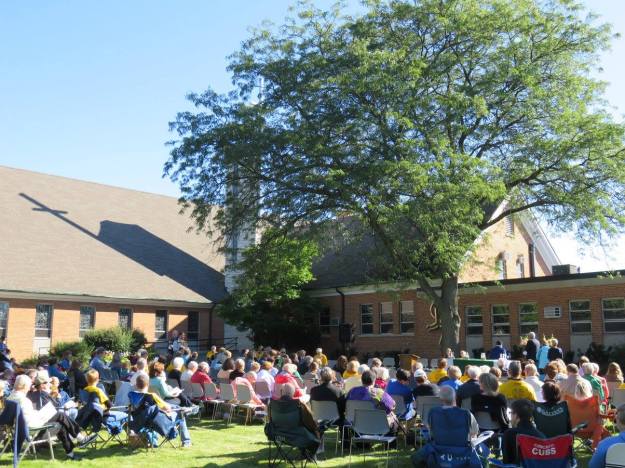
picnic2Here’s what happened on Sunday afternoon at church. Nine people who didn’t even know each others’ names at 12:00 noon, 90 minutes later were hugging one another, shedding a few tears, and demonstrating a general reluctance for the meeting to be over.

It was the first gathering of folks who want to become members of our congregation. We did it differently than we’ve ever done it before; not surprisingly, the outcome was different than it ever has been before.

Thirty years ago, my pastoral training told me that I have the responsibility to impart a certain body of information to those who want to join our church. They need knowledge of the very basics of the Christian faith: who Jesus is, what he did, what we believe about God and the Spirit, what faith is, how we are saved, what the church is, the sacraments, stewardship, and on and on. I’ve had this sense that if people are going to join a confessional church , then they ought to have an idea of what they are confessing.

As if that weren’t enough, I’ve thought it would help them to assimilate into the congregation if they were given information about our church: our worship and why we do what we do, our various ministries, Sunday School and Adult Faith Formation, the stuff we do in the community. We’ve brought in staff members to describe their ministries, and folks who are already members to tell them a little about what they love about Faith.

In the back of my mind, it’s always felt a little like we were going through the motions, that people showed up, but they weren’t transformed in any meaningful way. It was like we had set up this relatively benign obstacle course that they had to complete in order to join the club; they did it; and they were in.

We did something different on Sunday. We had lunch together and enjoyed some casual conversation as we ate. Then we did bible study. Here’s the catch: not informational, knowledge-based bible study. Instead, we used Eric Law’s Kaleidoscope Bible Study method. The passage is read three different times; each time, the group is given a different question to reflect on while the passage is read and then there are three rounds of sharing. We also used Law’s process of mutual invitation:  after each person shares, they invite  someone else at the table to share.

It would not be appropriate for me to relate the conversation that happened in that room, but I can say that it got very real very quickly. People told stories of loss, of the difficulties of life, of the challenges of parenting, and of the struggle to believe. Matters of faith became intertwined with the realities of life and the Christian faith bloomed into something intensely relevant. What’s more, an almost miraculous personal bond developed among people who walked into that room not knowing each other’s names. In 28 years of ministry, I can’t ever remember that happening with a group of new members.

I’m pretty sure I haven’t discovered the holy grail of assimilating people into the faith. It was one meeting. We have a long ways to go.

But that experience was one more in a long line of experiences that is reinforcing for me just how critically important relationships are to the work of the church. I did not get into this work leading with my heart; I got into this work with my head. I love theology and books and bible study. I began pastoral ministry with the central notion that it was my job to impart a body of knowledge that would help people be Christians. “Faith comes by hearing. . .” and all that. It was never that relationships were unimportant; they just weren’t primary.

It’s been a long, long transition — one that I am still learning, and still trying to live into — to come to the place of putting my head in the background and leading with my heart, to know that all church work is about relationship and that while the cognitive aspects of the faith are not unimportant, they mean almost nothing apart from relationship. After all, a relationship with God is very, very different than knowledge about God.

“Together” x 5; Building a Strong and Healthy Church Staff

staffI’ve gotten the news in the past few weeks that a handful of my younger (much younger!!) pastoral colleagues are moving from their calls as associate pastors in a multi-staff setting to head of staff. The news brought to mind my own similar move 22 years ago.  It also got me to thinking: in the intervening years, what are the most important lessons I’ve learned about cultivating a healthy and productive staff team?

1.  Pray together.  Worship is at the heart of what we do as God’s people. At God’s invitation, we gather each week in the Sunday assembly to receive God’s gifts and to be sent into the world to live as God’s people and to be a part of God’s mission. But Sunday is not the only time for worship. Throughout the centuries, local assemblies have gathered for daily prayer, hearing the word, singing, and praying, keeping the cycle of prayer going around the world as the earth rotates in its 24 hour cycle. As a staff, we are a part of that ongoing rotation of prayer. Once a day, Monday through Thursday, everyone in the building gathers for a 15 minute service in which we sing, listen to the Word, share a reflection, and pray. Sometimes members of the congregation join us — we publicize daily prayer on our weekly calendar — but mostly it’s just members of the staff. In addition to being a part of the the larger church in our calling to prayer, praying together daily is a powerful means to staff cohesiveness. It’s hard to stay in conflict with the ones with whom we gather each day in prayer.

2.  Meet together.  There’s no substitute for meeting together. We meet together once a week. Every paid employee is attends our staff meeting. All church work is relational work, and to be in relationship, there must be time together.

Staff meetings are about more than just business. Years ago, I learned from a great mentor, Les Stroh, a model that comes from the world of organizational behavior; it’s known as the Task Team Development model.  Teams that are high functioning in terms of their task get that way because they also pay attention to the relational aspect of their team. Often work groups focus only on task, never achieving a high function because they never develop relationships of trust. Other groups only pay attention to their relationship and they never get anything done; they are essentially lifestyle groups of people who hold similar interests. The Task Team Development model suggests that working teams that pay attention to developing relationships of trust will become high functioning teams with regard to task.

To that end, our staff meetings always include an element of conversation that invites us to share something about ourselves apart from our work. We have a question for conversation in which each member of the staff is invited to share. Some examples: talk about a Christmas tradition from your childhood. Talk about a book or movie that you read or saw recently and what you liked about it. One of the most popular is the kindergarten game of show and tell. Each person brings something from home that is significant to them, tells the rest of us about it, and why it is significant. In addition to this relational time at the beginning of our meeting, every week’s agenda includes “Ministry Stories,” a time when we encourage staff to tell the times and places where they saw God at work in our ministry in the past week. Oh, and leadership of the staff meeting rotates each week. Everyone gets to practice being a leader.

3.  Read and study together. It’s important for pastors to continue to grow intellectually and vocationally. And I think it’s important for pastors to model that virtue for the congregation and for the staff. To that end, our staff reads together and talks about what we have read. Think in terms of a staff book club. I usually choose the book, though I have used suggestions from staff members. We meet every three weeks or so. We have shared the task of leading the discussion. Sometimes it’s a book of pretty serious theology — we’re just finishing Walter Brueggemann’s The Prophetic Imagination; a few years ago, we read one of Chip and Dan Heath’s books. The point is, it may or may not be anything directly connected to theology; it is always something that we can grow together with.

4.  Have fun together.  There’s just something irreplaceable about laughing and let our hair down together. Twice a year, we have day-long staff retreats. One is some kind of serious continuing education thing. And one is just plain fun. One of the best was the year we went to the Field Museum in downtown Chicago. It’s one of the premier natural history museums in the country. But instead of just walking around the museum, I formed the staff into two teams and asked them to come up with a story, using themselves as the characters, based on what they saw in the exhibits. Imagine “Night at the Museum,” but the characters are people you know and work with. Over lunch, we shared our stories and howled with laughter. We have taken architectural tours of downtown Chicago, rode through the city on a 50 year old fire truck, and drove to Springfield to experience the Lincoln Museum together. The staff that plays together stays together.

5.  Break bread together.  A long-standing tradition in the congregation I serve is for the staff to go out to a local restaurant once a week and have lunch together. It’s always dutch treat, except when we’re celebrating a birthday. When it’s someone’s birthday week, they do not pay for their lunch and the rest of us split the bill equally. There’s never any requirement that anyone does this, but over the years, every staff member makes it a priority to be a part of this weekly gathering to break bread together away from the work place.

Two other things: don’t neglect the secretaries and custodians. The secretaries and custodians are essential to a fruitful ministry. Someone once said that God is in the details; these are the people who take care of the details. They typically hold an immense amount of institutional memory, and are often the first contact that members and folks from the community make with the church. You need their expertise and you need them to be on your side. While they may not be seminary trained or in some cases even college trained, they have an incredible storehouse of practical wisdom that will contribute immensely to good ministry. Pay attention to them.

Say thank you. In every way you can, say thank you. Write notes; compliment your staff to members of the parish; acknowledge them publicly. When they do something good, tell them specifically. In fact, we’ve institutionalized this public recognition in our staff meetings. The very last item on every staff meeting agenda is an item we call “Blessings.” It gives everyone a chance to publicly recognize the good work that someone else on the staff has done in the past week. And it’s a great way to end a meeting.

What have you discovered that contributes to the well-being and productivity of your staff?