Author Archives: Jim Honig

Unknown's avatar

About Jim Honig

Lutheran pastor in the western suburbs of Chicago. I'm a writer, a runner, an avid outdoorsman, and a curious student of people and the human condition.

“I Want to Make the Cross on You.”

sign of the crossIn the baptismal rite, after the child is baptized, the pastor anoints the child with oil, the ancient sign of being set apart and being commissioned for a calling from God. Words are spoken as the sign of the cross is made on the child’s forehead:  “You have been sealed by the Holy Spirit and marked by the cross of Christ forever.” It’s not just a call. Baptism is  branding. We are marked bodily as a child of God in Christ.

In our Sunday morning worship, children who do not receive the bread and the wine of the eucharist receive a blessing. Always that blessing is a call to remember the covenant that God made with them at baptism. I make the sign of the cross on their foreheads and speak words that echo from their baptism, “You have been sealed by the Holy Spirit and marked with the cross of Christ forever.”

On Sunday, one of God’s chosen ones, an exuberant, energetic child who will enter kindergarten this fall, a precious little one full of spirit and the Spirit came running down the center aisle when church was over, bypassed the intern who had preached that morning, made a 90 degree turn and came at me in full sprint.   She dived at me, clasping her skinny arms around my knees before grabbing my chasuble at mid-chest level and pulled down with all her might.

“I want to make the cross on you,” she exclaimed.

I leaned over as she mimicked my own action at the table: fingers folded in on her palm, her thumb protruding as a fleshy stylus. With that tiny thumb, she made the cross on my forehead.

Just as quickly, she moved on to get a few cookies from the Sunday morning table of goodies.

When Being Weird Is Good

WeirdChurchA review essay of “Weird Church: Welcome to the 21st Century, by Beth Ann Estock and Paul Nixon, (Cleveland: The Pilgrim Press, 2016).

A good bit of my reflecting time and my conversation time these days is taken up with trying to figure out a way into the very uncertain and ambiguous future of congregational ministry. So many cultural shifts have taken place over the past 25 years that the context in which the local congregation does its ministry is hardly recognizable compared to the context in which I entered parish ministry 29 years ago. There’s no time to waste in engaging the challenge of adapting the form, structures, and practices of parish ministry. I’m so grateful for colleagues, congregational leaders, and indeed, a whole congregation willing to enter into this uncharged territory with me.

As we embrace the conversation and try to figure things out, we are always looking for dialogue partners who can help inform our own hunches about what lies in the future. Yes, I believe they are really little more than hunches; no one has firm, well-shaped answers for what’s next.

I most recently found a worthy dialogue partner in the book Weird Church: Welcome to the Twenty-First Century, by Beth Ann Estock, and Paul Nixon. I know that I’ve uncovered something useful when a book pushes my thoughts in multiple directions, and when I can’t wait to talk about what I’ve read with colleagues and other lay leaders.

Estock and Nixon begin their book with a brief explication of Spiral Dynamics, a theory of human bio/psycho/social evolution. The theory suggests that throughout human history the species has followed a particular pattern of change and growth in human and cultural development. In these opening decades of the 21st century we are witnessing a transition from the rigid rules of character and morality, through the secular organization of society for the sake of the individual, and into a values system that goes beyond the needs of the individual and begins to focus on the needs of the larger community. In part, they suggest, the convulsions the church is currently experiencing is because our model for ministry is still focused on the spiritual needs of the individual, and we have not until recently paid more than lip service to the communal work of caring for all people, issues of equality, consensus, reconciliation, and care for the planet. I’m not enough acquainted with Spiral Dynamics to make any evaluation of its pertinence to congregational ministry; however, I’m also not sure that one has to buy into the theory to find value in their analysis and provocations for thinking about ways to move forward in fruitful congregational ministry.

The first half of the book offers a brief explanation of seven shifts that the authors believe are essential if Christian congregation ministry is going to be viable and sustainable in the coming decades.

  1. Let go of our fears of decline as measured in the things the church under Christendom has measured — attendance, members, budgets. Move into the freedom of a hopeful future guided by the Spirit. Clearly this is an attitudinal shift more than a behavior shift.
  2. Shift the focus from seeing the congregation and the current members as the primary constituency for ministry and  move towards seeing the neighborhoods and other people gatherings that our members are a part of as the primary constituency and location for ministry.
  3. Give up the illusion that the society in which we live is a Christian society; the society in which we live is governed by economics and politics that are in contradiction to a Christian understanding of the world and human community. Instead, adopt the mindset of the early church of going into that world as subversives for the sake of God’s rule.
  4. Give up the mindset that views people as either in the church or out of the church. Rather begin to view all people as God’s people; the witness of the church is to accompany people in trying to make vibrant and living the relationship with God that they are already seeking and yearning for.
  5. Give up the notion that the ministry of the church is to give people the right knowledge about Christianity. Rather, our ministry is to draw people into a lively relationship with God which is more a matter of the heart than the head.
  6. Shift from trying to control how things work and develop through an institutional structure (the local church) and just start stuff and let it go, giving our work the permission and the freedom to grow organically in ways that we can’t predict.
  7. Shift our understanding of leadership from skillful managing of an institution to incarnational leaders who enter into relationship with others and mentor them to do the same.

Even as I write these down for this review, it strikes me that no one of them is unrelated to what I’ve come across before. Still, I found it helpful to have them stated clearly and succinctly. (I’d encourage taking a look at the book to get the full treatment of each of the shifts.) I’m interested in having the leaders of my congregation take a look at these chapters and engage in conversation of the implications for this little corner of God’s kingdom.

The second half of the book is a collection of 18 short examples of how congregations and ministries around the US have experimented with these various shifts. I’m grateful that the authors explicitly offered these examples not as blueprints for what any other congregation should do, rather as examples of the creativity of faith communities seeking to do God’s work in the world and respond to the cultural changes going on around us. I can’t wait to lift these up with my leaders and see what creativity it might spark among us.

Here again is a hopeful treatment of the church today, a book that isn’t forecasting the complete demise of Christian congregations in the US. I also do not think that’s where we’re headed. With the authors of Weird Church, I, too, am tremendously hopeful for what will emerge and tremendously excited to be part of both conversation and action as we seek to do God’s work in the world in our very specific corner of the kingdom.

When Silence Is not Golden

troubled mindsA review essay of “Troubled Minds: Mental Illness and the Church’s Mission,” by Amy Simpson

You might think that I would be that pastor who is out in front, leading the charge to make the church a safe place to talk about mental illness, that guy who makes sure that my congregation carries out effective ministry to those with mental illness and their families. After all, I have been closely connected to mental illness my entire life.

I think both of my parents spent much of their adult life suffering from depression. My father’s depression was never diagnosed, at least as far as I know, and consequently, he never received any treatment. My mother’s depression was diagnosed, and some medication of the early generations of anti-depressants were prescribed — I remember her talking about Prozac —  though I have no idea how faithful she was in taking her medication. When I was a pre-teen, my mother attempted suicide twice. An uncle went through decades of electro-convulsive therapy (ECT). An aunt had what my parents referred to as “a nervous breakdown.” Just what that was, we never really talked about. In the brief year between college and seminary, I spent a short time working at a university research hospital on the pysch floor as a pshychiatric technician; one of my responsibilities was to assist with ECT. Throughout my pastoral ministry, I have walked with and ministered to many families facing significant mental health issues. When approached, I have tried my best to be helpful.

Yet, despite all this, I have been complicit in the church’s silence about mental illness.

That’s the conclusion I have come to after reading Troubled Minds: Mental Illness and the Church’s Mission, by Amy Simpson.

Ms. Simpson begins by telling her own story of growing up as a preacher’s kid and of her mother’s descent into psychosis and the decades long impact that disease has had, not only on her mother, but the entire family. In fact, the entire book is peppered with firsthand accounts of mental illness in her own family and in the families of people she interviewed in writing this book.

After beginning with her own family story, she goes on to make the argument that mental illness is mainstream; nearly every family has to deal with it in some fashion. Yet as common as it is, there is a cultural code of silence, and still, there is a sense of shame about its invasive presence into our lives. I have found the same thing to be true in my own experience. As I start down the list of active families in the congregation I serve, it is remarkable how many of them are touched by diagnosed mental illness (not to mention the many more whose illness goes undiagnosed.) Yet somehow, still we operate in the church under the cultural code of silence.

The rest of the book is a systematic deepening of our understanding of mental illness and the variety of ways in which the church might be a beacon of hope for individuals and families dealing with mental illness. In no place does Simpson go into a lot of detail, but at every turn, I found helpful information that has broadened my understanding. From thumbnail sketches of the varieties of mental illness, to first hand accounts of what its like to suffer from mental illness, to the ways both individuals and families forge mechanisms for coping, to the extraordinarily difficult task of navigating the healthcare system to get proper treatment, the book provides the basics for individuals and congregations to be inspired and empowered to take action. I came away from this book with a renewed commitment that I am no longer going to be that pastor whose silence contributes to the stigma that mental illness carries. By my own commitment to speak, I am resolved to make the congregation I serve a safe place for those who suffer from mental illness and their families. By coming out of our silence, I’m hopeful that we will also begin to take action.

Preaching to High Schoolers after a Tough Week

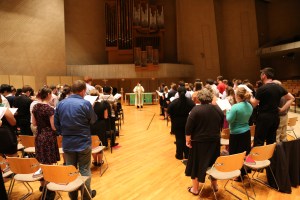
LSM2015worshipDuring the month of July, I have the honor of serving as chaplain to the community of the Lutheran Summer Music Academy and Festival, held this year at Luther College in Decorah, Iowa. The Academy brings together high school students from all over the US, young adults (mostly college students  or recent graduates) who serve as counselors and interns, and outstanding faculty musicians who teach in colleges and universities all over the country. The community is based on the values of musical excellence, building community, and worship and faith formation in the Lutheran tradition. This is my sermon from yesterday, based on the parable of The Good Samaritan from Luke 10 to this diverse community that formed on June 26 and will disperse on July 24. 

Remember that book you just loved as a kid? That one you made your mother read over and over and over so that you had it memorized. The parable of the Good Samaritan is kind of like that. It’s the one we love, the one we read over and over. It’s the one that just might be the most familiar of any of the stories of the bible.

Because the story is so well-known, we’re pretty sure we know what it means, right?  When you see someone in need we have both the Christian and the human obligation to provide assistance.  Just like the Samaritan did for the man in the ditch, right?

Except maybe not exactly. Recall that the story comes in response to a couple of questions from one of the elite members of the society in which Jesus lived. Our translation says, “lawyer.” Elsewhere they’re called scribes. He was an expert in interpreting the law of Moses. So, when he asks what he has to do to inherit eternal life, this was not a seeking question, it was a trapping question. He knew good and well the answer to the question. He was hoping he could trap Jesus into an answer that would put Jesus in hot water. Typical of Jesus, he answers the question with another question. “What does the law say?”  Now, that’s a no brainer for a lawyer, the guy who knows the law better than he knows his own kids. He answers ‘you shall love the Lord your God with all your heart, and with all your soul, and with all your strength, and with all your mind; and your neighbor as yourself.’ “Well played,” Jesus says. “Do this and you will live.”

But the pesky scribe isn’t finished. He asks another question, not from a place of curiosity, but wanting to justify himself, to have Jesus say what a fine, upstanding man he is. And here’s where we get to the point that I hinted at earlier. The question he asks is not, “What should I do if I see someone in need?”  The question is, “Who is my neighbor?” That is a much more difficult and condemning question. See, I don’t think this story is a morality play. It is a condemnation of every one of us who divide our world into those who are like us and those who are not; people we like and people we don’t; people we are comfortable around and people we are afraid of. People who are our friends and people who are our enemies. It’s a story for people like us who want to justify ourselves because we think we’re pretty good people. The moment we fall into that ancient trap of justifying we somehow forget about caring about those around us.

So, back to the central question: who is my neighbor? In the story, the man who is least like the man in the ditch is the neighbor — the hated Samaritan becomes a neighbor to someone in need. Who is your neighbor?

So, let me tell you how it is in your high school. I know because it was that way in my high school, and my kids’ high school and and when I talk to the high school kids in my church they tell my it’s like that in their high school, too. The choir kids and the band kids. The jocks, the computer geeks, the airheads, the popular kids. We divide ourselves into tribes. We can take that high school micro-culture and expand it to nearly every corner of our society. Hillary supporters and Trump supporters and those who feel the Berne. Pro-immigrant, anti-immigrant. Christians and Muslims. City dwellers and country dwellers. Blue collar and white collar. And the the list goes on and on and on. Especially in times of instability and uncertainty, sociologists tell us, we divide ourselves into like-minded tribes and circle the wagons. We are loyal to the ones like us, and if they are not like us, we pass by on the other side of the road and leave them in the ditch. We have seen this week the violent and tragic consequences of what happens when we divide ourselves into us and them.

By contrast, Jesus’ answer to the scribe suggests that even the ones least like us, those we would most easily categorize as outsiders and even as enemies — those are our neighbors.  Think of that kid that is least like you in your high school. He is your neighbor. She is your neighbor. If you are a Republican, the Democrat Facebook friend that annoys you, she is your neighbor and vice versa. The families fleeing war in Syria, families who happen to be Muslim — they are our neighbors. The children and men and women fleeing brutality in El Salvador, those fleeing economic hardship in Mexico, trying to find a life in the US — they are our neighbors. Alton Sterling, the black man shot outside a convenience store in Baton Rouge is your neighbor. Philando Castile, the black man shot near St. Paul, Minnesota after he was pulled over for having a broken tail light — Phil is your neighbor. The five Dallas police officers that were shot and killed by a sniper — they are your neighbors.

Btu what can be done? Doesn’t it seem like the problems are so big that there is not a single thing that you and I could do about it? The despair comes from the false belief that the problem is out there. That’s not true. While the world is a messed up and broken place, the brokenness doesn’t start out there; it starts in here. Jesus reminds us that the problem is in each of our hearts. We are the lawyer in the story who constantly wants to justify ourselves; I’m a pretty good person. I’m not prejudiced; I’m not racist. But the problem is in here. The problem starts with our own diabolical impulse to see some as friends and others as strangers. The great spiritual writer and Trappist monk, Thomas Merton wrote, “Instead of hating the people you think are warmakers, hate the appetites and the disorder in your own soul, which are the causes of war. If you love peace, then hate injustice, hate tyranny, hate greed — but hate these things in yourself, not in another.” And with respect to the tragedies of this week, I might add, hate the racism in yourself not in another.

Our embrace of the stranger and our call to regard the stranger as our neighbor is rooted in the very heart God. We have been God’s stranger. We are the ones who have wandered away from the Father’s estate, the sheep who have wandered, the children who have rebelled. Yet in Christ, God has come close to us and loved us. With no guarantee that anyone would receive accept the invitation to come home, to be reconciled to God, God left God’s home and made a home with us in Jesus. We are that wounded man lying in the ditch; God is the one who has come close to rescue us and to bring us healing.

That’s what changes everything. That’s what makes this not so much a morality tale as much as a new-life-in-Christ tale, a life-that-flows-from-the-font-and-the-table kind of tale. Regarding the stranger as a neighbor is not natural; but we are no longer naturally born. We are divinely born and are called and empowered to go in to the world and see the ones the world doesn’t see, no longer walking by on the other side of the road, but getting down in the ditch, binding wounds, filling empty bellies, clothing naked bodies, sitting with the lonely, crying with the grieving. And for those us us with white skin, I think the life that flows from the font and the table means recognizing that we have a different experience in this country than what our brown-skinned brothers and sisters experience. Being a neighbor means sitting with them, standing with them, and walking with them and refusing to rest until justice flows down like waters.

Jesus finished the story by telling that the Samaritan went to the wounded man and poured oil and wine on the wounds and then bandaged them. He put him on his own animal, brought him to an inn, and took care of him. He paid for his hotel room and then gave him his credit card number in case he needed anything else.  And here’s the last thing Jesus said, the punchline of this whole story.

Go and do likewise.


What If the Problem Is in Our Hearts?

fearoftheothercoverI’m reprinting here a review of the profound and timely little book by William Willimon, “Fear of the Other”. I had the privilege of reviewing this book for the Englewood Review of Books, and the review is reprinted here as it appeared in ERB. I think every person of faith should read this book. In this foggy time of fear and uncertainty, Willimon calls us back to the fundamentals of the Christian faith.

The long months of the presidential campaign have given people of faith plenty of self-righteous high horses from which to rail at those who would stir up the juices of our all too common human fear of the other.

Reminds me of that delicious story in Luke’s gospel of a Pharisee named Simon who throws a dinner party and invites Jesus (Luke 7). When a woman with a reputation crashes the party, Simon takes the occasion for some self-righteous harrumphing about Jesus’ rusty skills as a prophet. Jesus doesn’t even know who it is who is wetting his’ feet with her tears and wiping them dry with her hair, Simon says to himself. In a brief and masterfully told parable, Jesus turns the tables on that highly religious man, exposing Simon’s self-righteousness and need for forgiveness.

While it’s quite easy — and satisfying in a self-righteous kind of way — to point at those who stoke our fear of Muslims and Mexicans, and anyone else who is different, what if the problem is not them, but us. What if the problem is that we are so naturally inclined to a fear of the stranger, even we people of faith who claim to love our neighbors. What if we unwittingly operate from a position of fear over against the one who is not like us, the one who for any of a number of reasons is outside our tribe? What if the problem is not out there, but in our own hearts?

That’s the point from which Bishop William Willimon begins in his masterful little book, Fear of the Other. In the introduction he draws the reader in, particularly the reader who takes their faith seriously, that serious Christian who decries the fear-mongering rhetoric of our public discourse. Willimon won’t let us stay in our comfortable place of pointing our fingers at the public figures. We are the Other; we are the ones who have been separated from God by our own sin and brokenness; we are the Other with respect to God. And God has come to us in Christ. The command to welcome is rooted in that very basic salvific event at the heart of the Christian faith, the crashing of the divine into our lives by way of incarnation. And just like the welcome that we received in Christ was costly, so we are commanded to welcome regardless of the cost. Christianity’s default position is hospitality, even as we have received hospitality at the cross of Christ.

Willimon doesn’t try to explain away or deny the reality of fear. We are hardwired for fear. It’s part of who we are as humans. And with good reason. In the ancient days when human interaction with predators was a part of daily life, a quick flight or fight response was the difference between living to tell about it or not. But that’s not how most of us live. We have unwittingly allowed ourselves to fixate on what we perceive as a danger and misplace that fear towards those who are different. When we allow ourselves either to misplace our fear, to fear excessively, or to be dominated by the avoidance of evil rather than the pursuit of the good, then we no longer are responding faithfully to the brokenness of the world around us. The faithful response is to recognize how we have been changed in the relational and redemptive transaction with a God who has come to us in Christ. All the signifiers that serve to divide us and engender suspicion and fear of the other: class, gender, tribe, race, and history are being reframed and reinterpreted by this single qualifier: we are the baptized.

In the national climate of ramped up fear of the Other, Willimon argues that the church is particularly needed. The church is how God gets what God wants out of us and for getting what God needs for the sake of the world. The gospel of Jesus that saves us does not allow us to turn in on ourselves, but thrusts us toward the Other. Especially in an age of increasing diversity, the church has to answer the challenge of whether we will follow the expanding boundaries of God’s kingdom or not. When it comes to the church’s response, Willimon gets practical, offering a long list of concrete suggestions and challenges for how the local congregation might embody the welcome and hospitality of the Gospel.

I love this book. I want every member of my congregation to read this book. I want this book within reach every time I sit down to write a sermon. It’s not only timely in the sense of a clear response to the fear that has consumed our public discourse, but it’s timeless in the sense that it offers solid biblical and theological reflection for that symptom of our human brokenness that lies pretty close to the heart of things. In his inimitable style, Willimon not only offers profound theological insights and a crystal clear call to living as a Christian in a broken world, but he does so with abundant stories, blending his his keen gift for storytelling with an engaging sense of humor that brings a chuckle as well as a challenge.

I only have one bone to pick, and it’s not with the author, but with the publisher. This is a tiny book in comparison to nearly everything else on your desk; it’s 90 pages and the cover is the size of a 5×7 photograph. It almost feels more like a pamphlet than a book, the kind of pamphlet that, literally, I want to put in the hands of every member of my congregation. But at $15 a copy, I won’t be doing that. I don’t know the exigencies of book publishing and I’m sure it’s more complicated than I can imagine, but how I wish there were a less expensive way to get this in the hands of my people.

As I said, that’s a small criticism. Go buy the book. Take the two hours that it will take you to read it. And then spend the rest of your life attempting to put it into practice.


To My Friends

blackI believe in the power of words. I believe language gives us the ability to call worlds into being.

Yet, I feel like all the words have been used. There is nothing left to say. And I despair that we are using words to call a world into being that is full of violence, hatred, and fear.

To my LGBTQ friends: my heart aches. I have never been anything but white, male, and straight. In other words, I am usually the majority and the one with the power whenever I walk into a room. I do not know what it means to be marginalized. And I do not know what it feels like to be afraid simply because of who you are. I do not know what this massacre must feel like to your community. I want to be an ally. I am always, ever learning in my own stumbling way how to do that. For whatever that’s worth.

To my friends in the Muslim community: my heart aches. Here we go again. What happened in Orlando obviously bears no resemblance — not even a tiny resemblance — to the faith that I see you profess and practice. Yet you are being lumped in with the most radical and extreme adherents of your religion, even though you have said over and over that they do not represent your religion at all. You are understandably becoming fearful again to live in a country that wants to the world to believe freedom is our highest value and that it is the land of opportunity for everyone. Our actions too often demonstrate that we really believe freedom and opportunity are reserved primarily for white Christians. I heard my friend Hani Atassi interviewed on NPR, telling that the security fence put up around their mosque after San Bernadino had just been taken down a few weeks ago. Now it is being put back up. I have never given one second’s thought to putting up a security fence around my church. When a deranged Lutheran Christian shot 9 people last summer in a church in Charleston, he was called a disturbed young man with ties to white supremacists. There was no mention of his religion. This weekend, the perpetrator was immediately tied to Islam. It must be particularly difficult that this happened during your holy time of Ramadan, a time that I understand is intended to be full of the joy of practicing your faith in such a concrete discipline. You are my friends. I stand with you.

To my Latino friends: my heart aches. I don’t think we know whether the fact that the attack at Pulse occurred on Latino night by coincidence or design. But at some level that doesn’t matter. The majority of those killed and injured were Latino by ethnic heritage. I also don’t know what that feels like, to be targeted because of where my ancestors came from.

These three communities have been the target of hate, suspicion, and bigotry over the past several months. I don’t want to make a straight line of causation when there’s no proof — and maybe never will be — of the shooter’s motives. But as I said, I believe in the power of words. And the power of words to call worlds into being. And the words being used are calling into being a dystopic world that I want no part of. Naively, I have believed we could do better. NaiveIy, I have believed that we wanted to do better. I’m beginning to wonder.

Make No Big Plans

acornThis morning’s Chicago Tribune included an editorial cartoon by Michael P. Ramirez depicting a herd of elephants and donkeys heading off a cliff. A pair of small rodents sits on the edge of the cliff; one of them opines, “They’re giving us lemmings a bad name.”

There does seem to be a sense of doom and  inevitability. The train is headed for the end of the line and the brakes aren’t working. The engine on the airplane has gone out and we’re headed for a crash landing.

With so much wrong, societal problems that appear intractable, and institutions that people have relied on for so long falling apart, I’m hearing a sense of resignation. What is, is.  What will be will be. Deal with it.

Resignation assumes that we are victims of forces around us; we can’t do anything about them.  But I don’t believe in fatalism; I am not a victim of forces that I can’t do anything about. I don’t believe there is ever nothing we can do. We are human beings capable of action. We have agency. We can take responsibility.

So, what to do in the face of big problems? Alas, there’s the rub.  Big problems can only be solved by big plans, or so we think. When the big problems and the big plans are beyond the reach of mere mortals, hope becomes dim.

Daniel Burnham, the late 19th century and early 20th century architect who had an enormous impact on the development of downtown Chicago, famously said, “Make no little plans. They have no magic to stir men’s blood and probably will not themselves be realized.”

I say to hell with big plans.  Big plans are the nemesis of making progress on the hard things.

Jesus apparently was fine with little plans. Maybe little plans as small as a mustard seed; he used the tiny seed as an image for the kingdom of heaven.  Planted in small, unnoticed ways, it grows imperceptibly and becomes a tree large enough to provide a place for birds to build their nests.

I can speak up for my Muslim neighbors and friends.  I can seek dialogue with people who hold views that are different than mine. I can teach my kids to be kind. I can treat the people I work with dignity and respect. I can invite a local politician or the police chief or the elementary school superintendent  for coffee and find out what’s on their mind and let them know what’s on mine. I can invite a few neighbors over for dinner to discover who it is I’ve been saying hello to all these years. I can put my screens away occasionally and interact with people face to face, eye to eye, real voice to real voice. And I can find people who care about the things I care about and figure out together how to make some small plans.

What will you do? Who will you talk to? What action will you take?

When ordinary people make small plans that become effective action then big things are bound happen.

In Praise of Church Being Church

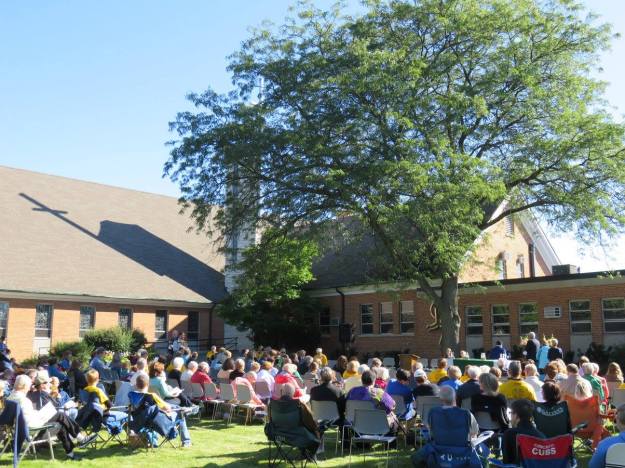
GWOH worshipAbout that tricky, risky relationship between pastors and congregations? I often hear a tale of dysfunction, hurt, suspicion, betrayal. . . you get the idea.

I have a different story to tell.

When our granddaughter, Eliana was born on February 17, the elation at her birth quickly turned to uncertainty and concern. When our son first texted us with the message of her birth, he told us that she had been transferred to Lurie Children’s Hospital; there was something wrong with her skin. My immediate reaction was concern, but only mild. “Probably something minor that will be taken care of in a few days; she’ll be home soon.” That’s what I told myself. It wasn’t true. Eliana was born with epidermolysis bullosa, a rare and serious skin condition. Eliana died on April 16, a day shy of her 2 month birthday.

Those two months were filled with a range of emotions, uncertainty, heartache, exhaustion, anger, sadness. . . Through it all, the people I serve with at Faith Lutheran Church demonstrated to me what church is.

When I first announced to the congregation Eliana’s condition, and especially that it was serious and potentially life-threatening, I asked them to give Sheryl and me some space as we tried to process and come to some understanding and acceptance of what this all meant. While they were curious and wanted to know so much more, they honored that request. A few weeks later when I indicated that I was ready to talk about things, they reacted in such a caring way, offering kind words of support and  constant prayer. On the Sunday that I first announced Eliana’s condition, our retiring congregational president emailed me with words to this effect: “you take whatever time you need. Let go of little things; not everything needs to be done. And we will cover what has to be done that you can’t do.” We had a council retreat just 10 days after Eliana’s birth, and the council surprised me with a collection of gifts for my wife and me, for our son and daughter-in-law, and for Eliana. Our newly elected council president said to me in front of the whole council, “You need to know we have your back. This is an important time for you. Do what you need to do. We have your back.” (It brings tears to my eyes remembering that moment.) Through weeks of trying to be present at the hospital and also keep up with my work, members of the council provided gas cards, train tickets, gift cards for meals and coffee, cards, letters, notes, emails — so much that I can’t even remember it all.

And the staff that I work with? Simply amazing. Nearly daily, my co-workers stopped by the office with a hug, a kind word, a card or note, a Starbucks card, and the never-ending assurance that they were praying for me, for our family, and for Eliana. And they spoke her name to me. That became more important than I knew at the time. More than words and gestures of encouragement, they took over things that I normally do. We have two midweek bible classes and I usually teach at least one of them each week, often both of them. They completely took those over. They offered to do Sunday preaching. We were entering into a major discernment campaign, a project with which I intended to have close involvement. One of our staff members and a lay leader completely took over that planning. Those conversations have start this week, and what my colleagues in ministry have planned is bearing fruit in powerful and meaningful gatherings.

Eliana lived her entire life in the Neo-natal Intensive Care Unit at Lurie Children’s Hospital. I am not privy to what her medical bills were, but it must be extraordinarily expensive. A couple of staff members set up a Go Fund Me account so that people had a vehicle for helping Chris and Liz with their medical expenses. The people at Faith were generous beyond my imagination.

After Eliana died, it became clear that my relationship with the people of Faith was anything but superficial. People here grieved deeply with us. They cried with us, they shuddered with us at the death of an infant; they helped carry our sorrow, our sadness, and our anger.

What happened at the funeral was a moment full of light in the midst of deep darkness. Though my son is a pastor, he and our daughter-in-law asked that the funeral be held at Faith. We anticipated a large attendance, larger than his small congregation would have been able to host.  When the people of Faith got the news that we would be hosting the funeral, they went far beyond what I could have asked for or imagined. We had teams of ushers, communion servers, acolytes, greeters, altar guild servants, who made sure everything for the service was just right. Our music director recruited a choir and made sure the music was excellent. People were volunteering to help with the reception even before our funeral coordinator could send out the request. My staff colleagues took care of details to make sure I had time and energy to prepare for the service and be with my family.

And they showed up. For the funeral. Nearly four hundred people showed up for the funeral. It was a mix of people from the many relational circles of Eliana’s parents and grandparents, including people from the congregation that my son serves with. So many people from Faith came. It was our time together. It was our time to bear our burdens together, to sing together, to pray together, and to hear the word and promises of God together.

There are a thousand more things I could name.

I am by nature an independent person. For most of my life, when I have a problem, my default position is to solve it myself. Add to that the fact that I am a problem-solver and will help others solve their problems, even as I sometimes ignore my own. When I am hurting, it has been difficult for me to ask for help and difficult for me to receive care from others.

Somehow this was different. I don’t know that I explicitly asked for care from the congregation I serve with, but they gave it and I received it. The love that I believed they had for me as their pastor was demonstrated in such depth and concreteness that it has taken me by surprise. They have loved me. They have cared for me. They have carried my burdens and made them their own. They have shown me what it means to be church.

Something that I’m having a hard time putting a finger on has happened in our relationship. There is a strength and trust that is palpable. I am so grateful beyond my ability to express. I didn’t know that church could be this good or this meaningful or this sustaining.

I want the whole world to read this word of tribute: Dear People of Faith Lutheran Church, “I thank my God every time I remember you.”

Sermon at Eliana’s Funeral

IMG_0086On Sunday afternoon, we held the service to commend Eliana to God’s care. It was a hard and beautiful time. The church was packed beyond capacity; so many family and friends came to help us sing Eliana across the river: family from all over, friends, neighbors,  members from Faith Lutheran Church where I am the pastor, members from Acacia Park Lutheran Church where Chris is pastor, pastoral colleagues from across the Chicago area, colleagues and partners in our community work. It was a glorious gathering. Todd Carrico, our music director did a fabulous job of leading the song, and did the assembly ever sing! They sang for us when the words were stuck in our throats or held back by tears. 

I don’t usually publish my sermons as part of this blog. Sermons are contextual and best heard in the assembly as they are preached. This one is no exception. However, in some ways, this sermon is a continuation of what I have written in the past few posts I’ve shared here, thoughts about promises and resurrection and what all that could mean as we grieve Eliana’s death, a life too short and in which there was too much pain. 

The sermon was based on the lessons Chris and Liz chose for the service: Isaiah 43:1-3a, 4-7, 18-19, Psalm 139:1-17, Romans 8:26-27, and John 4:1-15. Often in the sermon, I use what in the printed word seems to be an ambiguous “you.” In most cases, I’m addressing Eliana’s parents, Chris and Liz Honig.

Eliana Frances Honig. Eliana. God hears. What a beautiful name for a beautiful little girl. Eliana’s world was pretty small and pretty limited. Nearly her entire life was spent in the confines of a small room on the Neo-Natal Intensive Care Unit of Lurie Children’s Hospital in downtown Chicago. Yet, she was Eliana. There is both joy and a deep sense of sadness today. Only in her death do you get to introduce her to the world. When you penned her obituary, you told us about a beautiful, brave little girl who was a fighter, who sparred with her nurses and had her own unique way of curling up her feet and touching her bandaged hand to her cheek, who in spite of her near constant pain tried to soothe herself, and was responsive to the gentle sound of your voice and touch, even when there were so few places you could touch her.  I think she must have been the most well-read 8 week old on the planet.

What you have described is Eliana, a girl with her own personality in spite of her EB, a unique human being who was not defined by her disease. God created Eliana. God created her in God’s image. From the very beginning God knew her and God loved her. While her skin disorder made her life difficult and painful, she was formed wonderfully, and you, her parents, were able to see how extraordinarily she was knit together, how remarkable and complex she was. She was, in spite of her disease, in spite of her short life, a precious human life with consciousness and will and the ability to connect with those few people who were able to come to know her.

And she was loved. Oh, was she loved. She was loved by mama and papa, Grampa Frank and and Gramma Luann, Grampa Jim and Gramma Sheryl, Aunt Shannon, Uncle Tim and Aunt Stacey, nurses Kate and Ursula and Sara and Stephanie, Dr. Henna, Dr. Mancini, Dr. Chamlin. Oh, that child was loved. And not because she was any of those amazing things that appear in her obituary. She was loved because of her life. Your love for Eliana allowed you to see those amazing things in her. The mutual love of child to parent and back again brought joy to you and to everyone who got to know Eliana.

That joy is muted today because the sad truth is we are not intended to bury our babies. I have no words to make sense of why we have to do that. For all of my faith and all of my theology, I have never been able to put together a cogent explanation for the kind of suffering that Eliana experienced, and the suffering of parents who lose their children.

At first glance, the gospel lesson has little to say to those who are grieving the death of a child. Jesus is enjoying a little verbal sparring with a woman from the wrong side of the tracks. They happen to be at the old well of Jacob in the middle of the day. Neither Jesus nor the Samaritan woman should be talking to each other. Yet the conversation goes on and in response to the woman’s questions and yearnings, Jesus talks about water and thirst and the possibility of never being thirsty again and about how one’s deep thirst can be slaked by a water that brings eternal life.

On April 7, on the morning before she went to surgery to have a feeding tube inserted, Eliana was baptized into Christ’s death and resurrection. Though it wasn’t an abundance of water, it was water with the Word that brought to your precious daughter the gushing springs of life. It wasn’t exactly the baptism that you had imagined. It was not at church, and beautiful Eliana traded a lacy white baptismal dress for Aqua-phor soaked dressings that wrapped her wounds. Still, in the application of water of from a tiny plastic vial along with the words of the gospel, it was living water; it was water that gave her springs of life with God.

When we mention this promise of eternal life, though, I hope we won’t immediately and automatically fall into the pious platitudes that offer little help when our grief is so raw. “Well, she’s in a better place,” some are quick to say.  I say that being held in her parents arms would be a fine place. There is truth in the promise of eternal life. We don’t have to speak of Eliana as if she has disappeared, disintegrated into nothing. She lives, having passed through the gateway of death into life in God’s nearer presence. God has welcomed her with the loving arms of one who says, “Fear not, precious little girl. I have called you, Eliana, and you are mine.” The pain that was so much a part of her life her on this side of the river is over. She has been made whole. Her baptismal promises she has received in all their fullness.

Those promises, true though they may be, seem small consolation in the face of Eliana’s death. Her death came way too soon and it leaves us feeling empty and cheated. I’m not ready to hear words that tie it all together in a nice clean bow so that now we are expected to make sense of it all and move on.

So many people were praying for a miracle. Frankly, I would have settled for less than a miracle. I would have settled for a little luck and a little time.  Those gifts were not given. And I can’t for the life of me imagine why. If asking God for healing is something we are allowed to do, then why are some prayers answered and others not? Another theological conundrum for which I have no answer.

Is that why you chose the passage from Romans? Because words for prayers have run dry after the one thing you so desperately prayed for has been denied?

The Spirit will hold you up. The Spirit will gather your sighs and your cries, your bone-deep sobs and your anger and the sadness and take them to God and God will hold them in God’s heart, loving you in the midst of what is inexplicable. The promise that the Spirit will hold you is nearly identical to the strong and gentle words of the prophet: “when you pass through the waters, I will be with you; and through the rivers, they shall not overwhelm you; when you walk through fire you shall not be burned, and the flame shall not consume you.”

Somehow God was with Eliana through her ordeal and she has had her homecoming. Somehow God is with you in the midst of facing her loss. And here’s what gives those promises their teeth, what makes them more than nice, empty words.  When God chose to come among us in Christ, God risked becoming vulnerable to all that this broken and fallen word might have to offer. In the last days of his life, Jesus experienced the worst that a broken and fallen world could throw at him: abuse, and beating and mockery and finally a cruel, torturous death. There is no place we can go where God has not already been; there is no horror we can experience that God has not already endured. In Eliana’s cries of pain, God was not distant but by her side. In your grief and sorrow, God has not abandoned you, but is in fact carrying you. When you pass through such unspeakable loss, God says, I will be with you, I will carry you.

Look around you Chris and Liz. Look around you at the community that has carried you and promises to carry you into the future. When you can’t believe, they will believe for you; when you can’t pray, they will pray for you. When you don’t feel like taking even one step, they will be here to walk with you. The loving arms of God hold you fast through the people of Acacia Park Lutheran Church, Faith Lutheran Church, your family, your friends and all the others gathered here today. We are holding you today.

In a few moments, you will be invited to this table to receive the fruit of Jesus’ death and resurrection. We will sing. With saints and angels we will sing. We sing because that’s what we do when there is nothing else that we can do. For a brief moment, the curtain that separates us from those who have already crossed over is opened and we join the saints and angels in their song. Eliana is singing that song, and we sing with her. She is enjoying that feast of victory at the banquet table of the Lamb. When we receive our morsel of bread and taste of wine, we join her at table, she eating the feast of victory, and we a meal in which God promises to sustain us for the journey that for us is not yet over. In the bread and wine comes the promise one more time: when you pass through the waters, I will be with you.

A Monday Morning Sermon to Myself on the Promise of Life and the Reality of Death

burn1Those moments where the personal and the professional collide.

On Friday morning, we were called to Lurie Children’s Hospital to keep vigil with our son and daughter-in-law as they accompanied their 8-week old daughter, Eliana, on her final journey. Late Saturday afternoon, we stood over her bed, her life having slipped away after she had been in their loving arms for the previous 30 hours.

Fourteen hours later, I was standing in the pulpit on the 4th Sunday of Easter, expected to proclaim resurrection when my experience was the raw reality of death. And in this case, a death that seemed particularly cruel and unfair. As fate would have it, I presided at six baptisms on Good Shepherd Sunday.

Eliana was a beautiful little girl. She was active, feisty, and demonstrated extraordinary courage in the face of a disorder that wracked her body with pain. Epidermolysis bullosa is the worst genetic disorder you’ve never heard of. Her skin was finally beginning to heal, but the infection that took over was beyond the reach of even the most powerful antibiotics.

It’s my job to preach Easter, to speak of resurrection and life. Sometimes I find the promises hard to believe. It’s hard to believe the promises in the face of the excruciating physical pain of an infant and the extraordinary emotional pain of two young parents, one of whom is my own child, parents who in so many ways were deprived of the most basic joys of parenting, not to mention handed an unspeakable loss at the death of their infant child. The promise and hope of life seem empty and powerless. At times like these it enters my mind that all the flowery church language we have devised for Christ’s call and promise are nothing more than that. Words. How can those words represent any substantial reality when suffering and brokenness and death seem so much more real, as real as the lifeless body of a tiny baby.

“In the face of this, we have the promises of God?” he asks, a sad and cynical edge to his voice.

“In the face of this, we have the promises of God,”  he replies.

A promise is wonderful in that it brings hope. But a promise isn’t any those things that we would like it to be. We cannot hold a promise in our hands as evidence of its reality. A promise is not the mulligan on the golf tee where you get a do-over when you’ve messed it up. It is not a time machine where we can go back and right the wrongs. A promise is not the fairytale ending of a television show. A promise is not Harry Potter’s magic wand that would allow us to fix things with the flick of a wrist and a fancy incantation.

A promise is a word from God, God who down through the centuries has been faithful to God’s Word. A promise is the word of the Word made flesh, the One who invites us into trusting that in the midst of all the death there will be life. The promise carries with it the image of the Good Shepherd with his arms spread wide open, his hands and feet nailed to a cross, his voice crying out  in desperation, abandonment, and death. The Good Shepherd has promised to meet us in the horrible places that we are sometimes forced to go.

That’s the voice that calls to me and will keep calling even when what it says is hard to believe and my heart may not be ready to hear because the stench of death still lingers. The Crucified One reminds me that the tomb is still empty; Easter still offers hope and life. Especially in the midst of so much death.