
Category Archives: Uncategorized

The Wisdom of Restraint

I think I first read Aldo Leopold’s A Sand County Almanac when I was in high school. I took a science elective course in Ecology which turned out to be one of the best classes I’ve ever taken. Shamefully, I can’t remember the teacher’s name, but I’m wondering if he took a clue from Leopold in the way he conducted the class. Sure, we had to read a textbook and understand principles of ecology, but regularly he took us out in to the prairies, the forests, the marshes and bogs so we could experiences the ecosystems up close and personal. He was encyclopedic in his ability to identify the flora around us; he shared that knowledge with us and taught us, as well, the wisdom of being on a first-name basis with the plants and animals.

The first part of A Sand County Almanac is like that. Leopold was a forester, working in the early stages of his career for the U.S. Forest Service in the teens and twenties. He eventually went on to teach at the University of Wisconsin where the university established a chair in game management for him. While he was at Madison, he bought a farm and spent weekends and summers there. He chronicles the natural life of his farm, month by month, isolating, identifying and commenting on the birds or mammals or plants or trees, their behavior, their place in the ecosystem, and how it’s all interconnected.

I’ve found that familiarity with what’s around me in the natural world to be important to my own sense of connectedness with the natural world. It somehow seems to make a difference to be able to walk in the woods and recognize a Bloodroot or a May Apple. My sense of kinship with creation is enhanced when I can tell the difference between a hickory tree and a red oak. There is no joy like the joy of recognition.

Included in most editions of A Sand County Almanac is a collection of essays on a variety of topics related to the care of the natural world. As many times as I’ve read the the almanac, I don’t know that I’ve ever read the essays. I had no idea what I was missing. I found his words, written in the 1940’s for the most part, to be both wonderfully and troublingly prophetic. He foresaw both aspects and root causes of the crisis we now call climate change.

Among the many pertinent observations, one of them struck me as important for the contemporary crisis. He references a scene in the Greek tragedy, The Odyssey; Odysseus comes home and hangs on a single rope a dozen slave girls whom he suspected of misbehaving while he was gone. The Greeks had a highly developed moral code, but his action was still regarded as within the bounds of proper behavior because the servants were seen as property, chattel to be done away with or not depending on expediency.

He goes on to use this scene as an analogy for the relationship of human beings to the land. As long as we regard the earth and resources as property, we will continue to see our home as things to be used or not depending on what we need or want.

Our entitlement attitudes are so deeply entrenched; our environmentally abusive behaviors are so woven into the fabric of our lives. We continue to behave towards the land as if its a commodity, something solely for the sake of our own utilization. We’ve tended to view the use of resources purely in economic terms. What’s there is ours to use as long as its furthering the advance of human progress. Humankind is the one species that has the capability to radically alter the created world. Over the millennia, we have forged out a pretty life for ourselves, all things considered. But with all the advances we’ve made in technology, the one aspect of wisdom that we do not seem to have developed is restraint.

Barry Lopez eloquently comments on the same theme in his classic, Arctic Dreams:

Because mankind [sic] can circumvent evolutionary law, it is incumbent upon him. . .to develop another law to abide by if he wishes to survive, to not outstrip his food base. He must derive some other way of behaving toward the land. He must be more attentive to the biological imperatives of the system of sun-driven protoplasm upon which he, too, is still dependent. Not because he must, because he lacks inventiveness, but because herein is the accomplishment of the wisdom that he has aspired to. Having taken on his own destiny, he must now think with critical intelligence about where to defer.

I’m acutely interested in the environmental crisis from the standpoint of faith. Is it possible for the church to have a role in changing behavior? From a theoretical and theological standpoint, the answer ought to be “yes.” The earth and it’s resources is yet one more gift of a loving and gracious God, given or our use and enjoyment, but also given with the responsibility to care for it well.

In faith communities, we’re used to talking about restraint for the sake of our human neighbors. We give up some of our money, for instance, to care for the poor. This is an exercise of restraint. We don’t spend all we can so that we can share with others.

We’re not so used to talking about restraint when it comes to how we care for the earth. We do because we can. But it’s a value and a practice whose time has come, a way of living that we’ve got to embrace. We are all connected. We exist in a relationship with the world around us and it’s time to start seeing and talking about our place in relational terms. Indigenous peoples have known in and lived it for a long time. In the West, we have mostly lost that sense.

I really do think it’s possible for people and communities of faith to make a difference. After all, relationship is a the heart of who we are and who we live. If God is going to do something new with regard to caring for the earth, then we can start by behaving in a way toward that land that sees our place in relational terms.

Come, Holy Spirit, Come

acornIn exactly 15 days, I will check out of my office and walk into the doorway of sabbatical. Four months. No sermon writing. No staff meetings. No evening meetings. No hospital calls. No funerals. No newsletter articles. No proofing the bulletin. No teaching bible classes three times a week. Four months.

I’m not sure what to do.

Twenty-six years ago in June, I was ordained into pastoral ministry at St. John’s Lutheran Church in Arnold, Missouri. I had been training both academically and practically for four years; pastoral ministry was something I had been looking forward to even longer than that. I was ready.

Yet I remember feeling anxiety about the unknown. I was supposed to know what to do, but would I? Would I be any good at it? Would there be a sense of joy about this vocation? It was going to be so different than school, and I had been in school for so long. I remember that last semester of seminary being so busy — not only finishing classes, but all the paperwork and arrangements that had to be made with regard to graduation and ordination and receiving that first call. And then, boom. I was a pastor. Feeling like an imposter.

In these last busy day before my sabbatical — days filled with long to-do lists —  I’m experiencing some of the same feelings. I have been looking forward to this for so long. Along with my own preparations, the staff and leadership and whole congregation has been preparing for me to be away for four months.

On the one hand, I am ready.  I’m excited so about it. I’m looking forward so much to being able to step away from the routine, to read and study, to write, to pray, to spend time in the created world. And honestly, I’m really looking forward to four months without any meetings in the evening. (Did I mention that already?) I have been planning for more than three years, and the things I plan to do will, I think, bring a great sense of refreshment and renewal.

Yet, I am also anxious. Similar to that anxiety of my first call, I’m also experiencing a little of the anxiety of the unknown. Because I have never taken a sabbatical, I don’t know what to expect. Is there a right and wrong way to do it? Will I be any good at it? Will I experience that sense of joy and refreshment that I am so longing for?

A colleague who not only has taken several sabbaticals, but has written the manual for sabbaticals used in many Christian denominations, recommended that I pick up Wayne Muller’s book, Sabbath, and read one of the short chapters each day for the first 30 days just to get myself conditioned to the whole notion of sabbath. I plan to take that advice. (Thank you, Dick Bruesehoff.)

When I was on my internship, my supervisor told me, “Remember, Jim. Pastoral ministry is a marathon, not a sprint.” It was his way of saying, “Pace yourself. Don’t spend all that youthful energy in the first few years only to get burned out and have to quit the race.”

When I run marathons, I have learned that one of the most important keys to finishing the race is to plan strategically short intervals of walking. At each aid station, I usually grab a cup of water, run for another 50 yards or so, and then just walk for a minute or so while I sip that cup of water. It’s amazing how one can feel replenished in such a short time.

This sabbatical feels a little like that in the long marathon of a pastoral career. I will be 53 this summer; I observe 26 years of ministry in June. I have probably somewhere in the neighborhood of 15 years of ministry left, deo volente. I see this as an important interlude of refreshment and recharge for the next 10 years. I’ve learned over the years that one of the important pieces of preventing burnout is to find new things to be excited and energized about. I expect that also to happen during this time. There are several things that I want to explore about the church, pastoral ministry, and integrating spirituality into my own life as a pastor and into the life of a congregation. I will read and I will write, and I will have the time and the space to reflect.

At this point, I am trying not to be very rigid in terms of expectations. I am going to try simply to experience things as they come, and trust the Spirit to lead me to paths of refreshment, renewal, and visions for ministry that will bring new life to ministry when I return.

In these few days leading up to the Feast of Pentecost, my prayer takes on new meaning. Come, Holy Spirit, Come.

A Review: Welcome to the Wisdom of the World

chittisterTwo confessions: First, I love Joan Chittister. Anything she’s written. I love. She could write about NASCAR and I would love it. (Ok. Maybe not NASCAR.)

Second, I’ve come lately to acknowledging the value of wisdom received through other religious traditions. I grew up in a very conservative Lutheran tradition that taught me that all religion outside a narrowly defined orthodox Christianity was not only misguided but was mistaken. With horrible eternal consequences. In that economy, what value could there be in poring over the sacred texts of other religions in an attempt to learn from them and to gain from the accumulated wisdom?

The migration out of my own narrow box has been slow and gradual. After 9/11, I realized that I knew so very little about Islam. So I read Karen Armstrong’s little volume, The History of Islam. Almost 10 years into my ministry, as a member of the ministerial association in Naples, Florida, I got to know the local rabbi; believe it or not that was my first encounter with Judaism (unless you count the New Testament!). Somewhere in there came a conversation with a friend who had spent years in Hong Kong; she thought I might enjoy Jesus and Buddha, by Thich Nhat Hanh, so I read that one and a couple others of his. In my work with community organizing, I’ve developed relationships with several Muslim congregations and their leaders, but I’ve never spent much time talking theology with them or about the wisdom that flows from their tradition. Hindus? I haven’t a clue.

So, over the years, I’ve come very gradually to appreciate the authenticity and truth in other religions and have established some good relationships with faithful people who live out their lives as God’s children in a different way. Still, delving into the unique wisdom that flows from the various religious streams has never been a passion for me. Mildly interesting, but not a passion. I have a hard enough time incorporating into my life the wisdom of my own tradition, much less that of others.

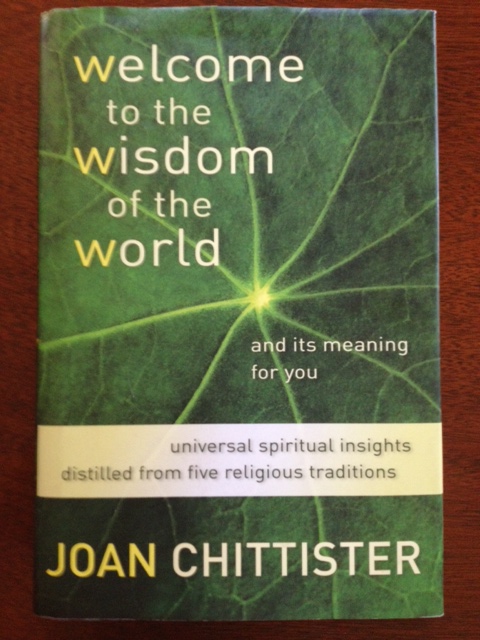
Enter Joan Chittister. (Did I mention that I love Joan Chittister?) Several years ago, I picked up what at that time was her relatively new book, Welcome to the Wisdom of the World. The subtitle reads, universal spiritual insights distilled from five religious traditions. That it sat on my shelf for a few years before I actually got around to reading it reinforces what I’ve already said, delving into what other religions have to say has not been a passion for me.

Last month I finally read it. Am I ever glad I did.

The premise of the book is to let the wisdom of five traditions — Hinduism, Buddhism, Judaism, Christianity, and Islam —  speak to the fundamental questions and challenges of human life. She doesn’t deal with the wisdom of the religious traditions in a theoretical fashion, rattling off the main points of each tradition. Instead, she accumulates a long list of life’s persistent questions, and then lets a particular tradition speak to a particular question.

Each chapter deals with a single question, and each chapter follows a standard format. Open with a story from someone whom Chittister has known in her long years of ministry; fashion some commentary that lets that real life story speak to the reader; tell a story from the sacred text or the oral tradition of that religion; make some comments anc come to a conclusion. The story and Chittister’s subsequent commentary on the story is where the real pay-off comes. That’s where the wisdom gets appropriated and opens up possibilities for how it might work for the reader.

For instance, over the last couple of months, I’ve been faced with some pretty big decisions. I’m not sure I do that well with big decisions, and I seem to spend too much time wondering if I did the right thing. In this case, she lets the Buddhist tradition speak to the question, “How do I know the right thing to do?” The wisdom hit home for me; there is no such thing as making the right decision. There is only the truth that I cannot be anything other than who I am. And when I make these big decision, I am making them as who I am. I can do no other. Since nothing in life is permanent, I can give up the need to label decisions right or wrong. “What is right is only that which must be done at the present moment, even when we are not sure exactly what that is. It is about living the best we can in circumstances that demand more than what we have at the ready.”

I have a hunch that this little volume will not be collecting dust. FIve religions; five chapters devoted to each religion, each dealing with a different question, and then five chapters of conclusion, summarizing the wisdom of each tradition. Feels a little like an introduction to world religion, except that the classroom turned out to be my own life.

In Honor of Boston

running shoesI am a runner. Not a very good one, but a runner, just the same. For a long time, I’ve been a runner. I started as a really lousy cross country runner in high school in the 70’s and for most of my life, I’ve been a runner. Lousy. And persistent.

A few years ago, at age 47, I accomplished one of the top items on my bucket list. I finished a marathon. Not fast. Nothing to write home about. I simply finished.

And I cannot describe in words the exhilaration I felt when I crossed that finish line. No matter how you slice it, 26.2 miles is a helluva long ways. It seemed to me superhuman. I am not superhuman. And yet I did it. The Green Bay Press Gazette will attest to the fact that I indeed crossed the finish line. In four hours and sixteen minutes.

In fact, that exhilaration is the very reason that I’ve run 5 more marathons since then. I don’t really enjoy the training. I don’t really enjoy the race. I exult in the feeling of accomplishment when the finish line stands behind me. Crazy, huh? That I would endure 16 weeks of hard training and four and a half hours of hell just for those fleeting moments of exhilaration? Yet, I speak the truth. All of that for a brief moment of accomplishment.

So, the news of the bombings at the Boston Marathon touched me deeply. I think about my own wife and son cheering me on at the finish line just outside Lambeau Field. I think of what has felt for me like the triumph of the human will and spirit. And how that was brutally stolen from so many people today.

I decry the violence. I decry the loss of life. I’m sad at the many injured whose lives were changed in a single moment today.

Yet strangely, I am equally saddened at this attack on the human spirit. There is something unique about those who aspire to this extraordinary feat and who accomplish it. It’s not necessarily about speed. It’s not necessarily about competition. It’s about setting out to do something that on the surface seems crazy, impossible, beyond the bounds of human capacity. When I first told our parish nurse that I was training for a marathon, she replied, “Human beings were not meant to run that far!” And yet we do. We find a way.

For me, that’s what evil attacked today. Not just human life, but the human spirit.

I will not give in. Tomorrow, I’m going to discover the next marathon I’m going to run in. I’m going to go for a long run tomorrow in honor of those runners who did not get to finish and those spectators who were injured and in memory of those who lost their life.

And I am resolving once again to honor what I believe is wonderful in the way God has created us: to aspire, to work, to train, to accomplish, to push, to use these wonderfully created bodies for good and not for evil.

And in the morning when I run, this will be my anthem (thanks to Bishop Desmond Tutu):
Goodness is stronger evil;
love is stronger than hate;
light is stronger than darkness;
life is stronger than death.
Victory is ours, victory is ours,
through Him who loved us.

An Open Letter to John Kass

marriage equality icon(This post is in response to an editorial by Mr. Kass that appeared in the March 27 issue of the Chicago Tribune. Unfortunately, that column is currently available only to Tribune subscribers.)

Dear Mr. Kass,

I’m a Christian pastor. In my tradition it’s Holy Week; I should be working on sermons.

But your editorial this morning captured my attention. My response is not borne out of intolerance, but out of conviction and a genuine hope for dialogue.

First, let me thank you bringing several matters to public expression. I’m grateful for your willingness to articulate the position that your religion is deeply felt, deeply important, and deeply influential in your understanding of marriage and gender matters. I think for a lot of people, religion does play a role and as a culture, we’re all better off to acknowledge that.  Our founding fathers insisted that the government cannot show a preference for any one religion over another. They did not mandate that our faith has to be checked at the door when it comes to issues we care about.

I thank you for your moderating voice, that you speak not out of anger, but out of conviction. Me, too. I’m not angry. But I do hold my position out of a place of deep conviction.

I thank you for raising the matter of religious freedom as a laudable goal in this dialogue and debate about marriage equality. You have suggested that were the Supreme Court to issue decisions that would allow gay and lesbian persons the legal designation of marriage, that it would feel like the court was severely limiting your religious freedom.

Here’s where my gratitude dissolves into disagreement and the hope for dialogue: I fail to see the logic of your position. By allowing same sex couples to marry, the court would not mandate that you agree with the position or practice, sanction it, or become the agent of those unions. They would simply allow those who wish to make that covenant and to bind themselves to each other with a legal agreement the freedom to do so. I fail to understand how that impinges on your religious freedom.

I’m also puzzled by your association of same sex marriage with sin. I agree that our post-modern culture’s propensity is to let everyone decide what’s right and wrong based on what’s right and wrong for them; that’s problematic for me, too. But I disagree that the action of two people committing themselves to one another for life in an exclusive relationship of love and trust is “sin.” Where sin exists, let’s point it out and hold one another accountable for it; but let’s not call committed love “sin.”

For what it’s worth, I don’t think you’re a “drooling white bigot of the Jim Crow era” for holding to your convictions. In the same fashion I hope you won’t consider me a liberal antinomian who is unwilling to set limits to any kind of behavior. I’m not. I, too, consider myself a traditional Christian. And the moniker of traditional Christian probably allows for a broad spectrum of views on many issues of morality.

Traditional Christians hold the bible in high regard. You obviously do, and so do I. Yet throughout the centuries Christians have looked at the bible and found the support for lots of different views about lots of different things. In the Old Testament, it’s difficult to find any correlation between the ancient practice of marriage and our own cultural definition of marriage. The practice of men taking many wives was commonplace; we have declared that illegal. Married men were freely given sexual privileges with servants; we consider that deeply immoral. (Just ask Arnold Scharzenegger.) To me, it’s difficult to find a rationale for our cultural view of marriage based on the bible. If we want to say that marriage equals one man and one woman and there can be no variation from that, then ok, let’s say that. But let’s be clear that it’s our cultural decision and that it’s not based on the bible. And to be clear, I believe that position to be an unduly exclusive understanding of mutual human love and the drive we have to commit ourselves to one we love.

For the church and “traditional Christians” to be making pronouncements of such certainty about same-sex marriage troubles me.  Institutionally, we have a long history of being wrong in the very instances where we have insisted we have been right. (Take slavery and the role of women as two instances.) I’m not saying we shouldn’t have convictions. I’m just saying that when we do, we should hold them with a healthy dose of humility and an honest admission of our brokenness and fallibility. If you take a look at Jesus’ ministry, it was the institutional “church” that comes out looking like the villain.  It was tradition that Jesus had in mind when he expanded the understanding of ancient laws when he gave the Sermon on the Mount. “If the law says, you shouldn’t kill, I say you break the law when you hate your brother.” “If the law says, you should not commit adultery, I say you break the law when you even look at a woman with sexual longing.” Jesus was willing to sully his hands and his reputation by associating with those who were considered outsiders. He consistently expanded the reach of narrowly defined behavior to include much broader matters of the heart. His ministry was about expanding the understanding of who was included in the big thing God was doing in the world.

So, why not expand the boundaries of who’s included in this construct we call marriage. After all, when you boil it all down, it’s not about gender, is it? It’s not about body parts and how they fit together, is it? It’s about a committed, covenantal love that publicly pledges the exclusivity of love and faithfulness. And when we look around us and see examples of that, we are all strengthened, regardless of whether those promises take place between a man and a woman, a man and a man, or a woman and a woman.

So, I hope you won’t consider disagreement and putting forth a different view intolerance. I cherish the opportunity for dialogue. And I’m sure you’re eager to extend the same tolerance that you long for to traditional Christians who may hold a different view with the same sense of conviction with which you hold your view.

Pr. Jim Honig
Senior Pastor
Faith Evangelical Lutheran Church
Glen Ellyn, Illinois
630.469.2361

Some Thoughts about Climate Change, Courtesy of the Generation Who Will Have to Deal with It

tree silhouette“Because it’s hard.”

The wisest and truest words of the entire evening, from 17-year-old Bryce.

I spent some time this past week in conversation with a dozen or so of our high school youth about climate change. I was curious what they thought about it.

I asked lots of questions and did a lot of listening. I wanted to know if they thought it was real, if they had any sense of urgency, what they were doing about it personally, what they thought the larger community should be doing. There were moments when someone expressed a sense of hopelessness; “I’m only 15; what can I do about it?” Mostly, they believed that we’d figure out a way to turn the tide. And there was also a sense that the burden of the challenge would fall on the shoulders of their generation.

They pretty quickly came to the realization that our thoughts and attitudes about climate change are not matched by our behaviors. Intellectually, most of us are coming to the realization that climate change is real. And that there are no easy answers. And that there are a lot of big players out there who do not have much incentive to change. And that every last one of us individually has the responsibility to change our behavior. But we don’t.

So, I asked the group, “Why is there this disconnect between what we believe is true about climate change and our lack of change in behavior?”

That’s when Bryce spoke such true words. “Because it’s hard.”

Bingo. That’s why I still drive my car the two and a half miles from my home to church instead of walking or riding my bike. That’s why our family still buys most of our vegetables, even in the summer, instead of turning our front lawn into a garden. That’s why I don’t give a second thought to hopping on a plane to go visit my aging mother a couple of times a year.

My behavior multiplied by millions of people who have the resources to live pretty much the way we want and the way it’s convenient doesn’t bode very well for turning the tide of climate change. I’m afraid that the changes that we need to make are ALL hard, and we are not used to living like that.

So, what would it take to change our behavior?

In Defense of Fasting

I fast.

I know that according to Jesus’ Sermon on the Mount, I’m not supposed to tell you that.

But I have a reason for telling you. I think it would be a good thing if more Christians would engage in the practice of regular fasting.

I’m in my 50’s, a Christian pastor, and I’ve been fasting with at least annual regularity since I was in college when I fasted one year from dinner on Maundy Thursday to Easter Sunday breakfast. Over the years, I have found it to be a meaningful spiritual practice. Yet, I find that most people view it as an oddity, something perhaps even to be admired, but certainly not something to be emulated. For the most part, Christians in America will engage a whole array of spiritual practices except for fasting.

I think there are some reasons for the aversion to fasting that are rooted in our unique American culture. Culture is the thing we can’t really avoid. I live in it; you live in it; we all live in it; and we are all influenced by it, both positively and negatively. It’s the soup in which we swim. Let me make some cultural observations and then I’ll come back to fasting.

Observation #1 — we live in a culture of abundance. Most of us have not only what we need, but way more than we need. Closets full of shoes. All you can eat buffets. 3 and 4 car garages. We are really good at excess.

Observation #2 — We don’t have to think about where our stuff comes from.  When you ate whatever you ate for dinner tonight, did you give any thought to the ground where the grain was grown, any wondering about the name of the farmer who grew it or the truck driver who drove the grain to the mill or the mill worker who supervised the huge machine that milled the flour or those who worked in the test kitchen so that the proportions of ingredients were just right to make whatever prepared or processed food you ate work and taste like food? Or when you get in your car do you think about where the iron was mined to make the steel or where the crude oil came from that made the plastics possible or the workers on the assembly line that put the whole thing together? We don’t have to think about where things came from. We need them, we buy them, we have them. We don’t have to think any further than our own front door.

Observation #3 — We have an inordinate attachment to things. You name it — I’m sure there’s something for you — shoes or books or cars or cash or electronic gadgets.  Food is one of those things we get attached to. We obsess about diets and restaurants and what to eat and what not to eat.  When we get stressed, we eat; when we celebrate, we eat; when we meet friends, we eat; when we get together with family, we eat. I’m not saying that’s bad; I’m saying that food and eating are central to nearly everything we do. We may go all day without thinking about God’s presence in our lives, but we will never forget to have dinner!

Observation #4 — We live as if there are no limits to what we can or should do. If we want food, we take food. If we want new shoes, we buy new shoes. If we want a new cars, we get a new car. If we want new electronic gadgets, we research and we shop and we revel in how this new phone is going to make our life so much better.  The goal of life in this culture is always more — more things, more experiences, more stimuli, more capacity. We can have it all, do it all, and we deserve it all.

None of which, of course, is true. We have written a false story that we are dependent on no one but ourselves. A life that recognizes no limits has no place for God. When the things of this life become the object of life, then we no longer have life.

And here’s where fasting comes in. Fasting is a way to remember that I am dependent on God. When I interrupt that normal routine of sitting down for a meal, I remember why. Food is a wonderful gift. It comes from God.  I remember that my life is a wonderful gift. All that I am and all that I have come from God. When I feel that mid-afternoon pang of hunger and instinctively get up to get a snack, I remember.

When it comes right down to it, there is not all that much about my life that I can control. I am dependent on God’s goodness for almost every aspect of my life. It’s not normal to think that we are self-sufficient. In fact, that’s how sin got started in the first place, when Adam and Eve thought they could make better decisions for themselves than the one who created them. When they ate that forbidden fruit, they were saying to God, “I’ll decide; I’m the captain of my own ship.” But that’s not normal life in relationship with God. Normal life is for the creature to acknowledge the creator.

One of the mantras of lent is this passage from the prophet Joel: “Return to the Lord your God, for he is gracious and merciful, slow to anger, and abounding in steadfast love.” So, could I be so presumptuous as to invite you to return? Return to normal life. Return to a life that acknowledges your dependency on God for all that you are and all that you have. And if fasting a meal a week or a day a week or whatever you decide can help you to do that, then what a gift it will be.  That’s why the discipline of fasting is so important. Fasting is renouncing something, it’s not depriving yourself of something — it’s a way to remember the good providence of a good God and because of that, it is a way for new life to be released in us.

Want to Be Relevant? Quit Trying So Hard

Last week I finished a seven-week class on the history of Lutheranism for the members of the congregation I serve.  Admittedly, in seven weeks, we didn’t go into a lot of detail. Rather, we tried to establish the long narrative arc, the view from 20,000 feet.

To be honest, I’m not sure what possessed me. In people’s busy lives, who would come? I was certainly under no illusion that people would be knocking down the doors to learn about stuff that happened centuries ago. On the first night, I got there early, was setting things up, and kept wondering, what was I thinking? Who will come to this? Why would anyone be interested? I am, but so what?

Yet, over the course of teaching the class at three different times, over 50 people have attended. Astonishing. That’s way, way beyond what I expected.

Why’d they come? I’m not sure, except that it’s part of their story, and a part that most of them don’t know very much about. Most know the rudimentaries of Martin Luther; maybe Western Civ. classes do a decent job of situating the Protestant Reformation as a significant movement in European history. Most of us in the Lutheran tradition still observe Reformation Sunday; if nothing else, we know the 95 Theses and the castle door in Wittenberg and A Mighty Fortress Is Our God.  For most folks it doesn’t go very far beyond that. But they’re interested.

What most surprised me most was how engaged people were in the whats and whys and hows. Far more often than I expected, our treatment of highlights from the dustbin of church history led to fascinating conversations about life in the world and in the church today. One class used a conversation about the emerging church structure in the transition to Orthodoxy in the early 17th century to launch into a conversation about social media and the church. Don’t ask me how we got there. But of all the conversations about social media and the church — and I’ve had quite a few of them — this was one of the most interesting and stimulating.

I would never have thought about this class as an attempt to make the church relevant in contemporary culture. In fact, my gut told me I was going in the opposite direction. Yet  my impression is that people found it wonderfully and surprisingly relevant. Why? I’m still trying to figure that out.

I have some hunches. I’m wondering if relevance is one of those things that remains elusive as long as we are seeking it. That relevance is the by-product of something else, not a a goal that can be sought for its own sake. My son reminded me that relevance is related to meaning and we can’t impose meaning for people. They will find it on their own. We can provide context and information and a good setting for conversation. But meaning — that’s something each of us will find.

Furthermore, I’m going to try this out for a while:  relevance and meaning will come when leaders and congregations are interesting and interested,  engaged and engaging, and just plain foster a spirit of curiosity about this pretty danged awesome world God has placed us in. I don’t think every pastor ought to teach a class on the history of Lutheranism. If you’re not interested in it, don’t do it. But I am. I suspect that curiosity and my firm belief that our history does have something to say to our life together right now probably showed through. On the other hand, I’m not that interested in the intersection of religion and science. maybe you are. And if so, that interest and curiosity would, if I’m on target here, translate to a very relevant class for your parish.

Here’s what I’m suggesting as a working hypothesis: when the church accepts that gifts are given and assumes that they are to be used for the sake of God’s big thing in the world and takes action, then what we do will be relevant.

Ashes to Go

ashes to go2013This past Wednesday — Ash Wednesday — our pastoral staff stood at the local commuter train station with our Episcopalian counterparts offering an ashen cross on the forehead of commuters who were willing to take 30 seconds out of their busy day for a spiritual moment. We’ve done this now for 4 years and it always gets a lot of attention in the press. This year, my colleague appeared in a photo on the front page of our local daily newspaper. It’s good for the church to out in the world, right?

I’m here to express a pretty strong tension and ambivalence about this practice.

Four years ago, when we began the practice annual tradition, it was new and fresh; I’ve got the personality that is always eager to try something new, just to see if it will work or not. I had heard of the practice from St. Gregory Episcopalian parish in San Francisco, though I understand it was actually conceived by an Episcopalian parish in St. Louis. I talked to my colleague at St. Mark’s Episcopal Church; he also was aware of the practice and we agreed to make it a joint project.

Here’s what we do. We stake out a little corner of the parking lot near the commuter train station that the majority of the commuters have to pass by on the way to their preferred train. We have a little table, a cross, a sandwich board sign, and two or three clergy are positioned near the table. We seek to be upbeat and hospitable, greeting people as they pass by. Some ignore us, refusing to make eye contact. Some make eye contact, smile, say a warm “hello” and keep walking. Some actually stop and ask for the ashen cross. We ask their first name and then make an ashen cross speaking the words, “Roger, remember that you are dust; to dust you shall return.” Then we hand them a card with a one-paragraph explanation of Ash Wednesday, an Ash Wednesday prayer, and the service times of our parishes printed on the back side.

On the one hand, it’s good for the church to get out in the world. Too often we do our thing inside our safe buildings and we expect people to come to us. Except they’re not coming to us. We are seen as irrelevant or worse. So, it’s good to take our message of our mortality, of the temporariness of life, of our brokenness and God’s work of healing and reconciliation to the street. It’s good to communicate that we care about more than our members, that we can be warm and hospitable, and that we don’t have to be judgmental.

On the other hand, I wonder if we are not giving the wrong impression of the church. That our rituals are paper thin; that no commitment is required; that a little spirituality in the form of ashes on the head can’t do anyone any harm. See you next year, kind of thing.

What I hope for people is that people will know God and know the peace of God’s grace and mercy, and that know the joy of being called to something bigger than themselves and that they, too, will become part of the big thing that God is doing to bring fullness to all creation. I’m just not sure that drive-by ashes at the train station brings them any closer to being a part of that big, wonderful, life-giving project.


Things Don’t Always Work Out

I had to make one of those tough pastoral calls today. I had to bid farewell to one of our senior couples, two people who had lodged deeply in my heart over the past 10 years. They’re moving from their senior living facility to a nursing home because their money has run out.

They’ve been members at Faith for 47 years. He’s 99; she’s a year or two younger. He’s had dementia for the past 10 or 12 years, but still physically pretty strong, at least for 99. She’s solid as a rock, physically, mentally, spiritually, and until recently emotionally. You can imagine the toll that such a situation would play on a woman who was an astute business woman and accountant — she kept the books for a local real estate agency until she was 92.

Until 7 years ago, they were living in their own house. She didn’t want to move out, but finally recognized that she could no longer care for him on her own. They could have moved into one of the facilities that promised perpetual care, but instead they moved into the one that they liked better and was closer to church. They knew it would be expensive and would likely use up most of the proceeds from their house and their savings. But they also knew their age and they knew that statistically, they’d die before the money ran out and they would still be able to leave something to their one living son and to the church.

Now here they are, after having spent close to $600,000 over 7 years. They thought that their substantial savings and the profit from the sale of their house would be plenty to carry them through; now it’s all but gone. And they have no choice but to move into a facility which will take the remainder of their money. After the balance sheet reads 0, Medicare will kick in.

There are way, way too many changes for them to endure. They were two blocks from church and church people would show up regularly just to say hello. Now they will be 45 minutes from the place that has been their spiritual and social home. They have been seeing the same doctors for decades. Now they will be faced with a whole line-up of new doctors because their doctors here don’t make house calls there. They go from an apartment where they were surrounded by their own furniture and pictures and keepsakes to a single room with two hospital beds.

Here’s the hard part: having to sit with good, good people who lived their life the right way, worked hard, and planned for the future, who have come to the point of having no good choices. In what will undoubtedly be the last years, or even last months of their life, they are forced to give up the last vestiges of their former life — furniture, photos, momentos, pots and pans, their bed —  everything. And go to a place that they don’t want to be.

I don’t really have any answers. I’m not sure what I would change. But to see the pain in her face and to know the many transitions that they are being forced to make that they don’t want to make, has brought me deep sadness.

I would like to believe the platitude that things always work out. But sometimes they don’t.