Category Archives: biblical reflection

Wednesday in Holy Week

With the gospel lesson for Wednesday in Holy Week, we are getting a little ahead of ourselves. The reading brings us the intrigue that takes place after what we will read tomorrow on Maundy Thursday, the account of the foot washing Jesus performed for his disciples and his teaching about their performing the same kind of loving service for one another.

Strikingly, the story begins by reporting that Jesus was “troubled in spirit”. That’s nothing new. He said the same thing in the story we read yesterday when he felt the burden of his coming hour of death. The reason for his present agony is the imminent betrayal by Judas. Announcing the approaching betrayal, Jesus wore his emotional pain on his proverbial sleeve while catching his disciples off guard.

When Judas left the room and went out, “it was night!” I suppose it’s possible that the gospel writer was indicating the time of day; but I think there’s something else going on here. Remember way back at the beginning of this gospel, when the author announced that light appeared when Jesus appeared? He even reported Jesus saying, “I am the light of the world.” In yesterday’s reading, after identifying himself as the light once again, Jesus promised his disciples they would become “children of light.” Now with the arrival of the Evil One in one of Jesus’ own disciples, “it was night.” Jesus, the light, was about to enter the darkest corners of human existence. Jesus would allow the prince of this world, the ruler of darkness, to have his moment, brief though it would be.

In fact, while the disciples were baffled that Judas would go shopping at this time of night, Jesus announced the moment for the Son of Man to be glorified and with him for God to be glorified as well. The hour has come for his death, his resurrection, and his ascension—all to the glory of God.

Our attention today is drawn to the plan and purpose of God in sending the eternal Word to become incarnate and live among us. The evangelist interprets the crucifixion of Jesus as God’s deliberate and purposeful act, not a divine resignation to the failure of humans to accept his Son. Jesus’ own motive was not a suicidal desire but a faithful commitment to ensuring that God be glorified.

Indeed, “it was a dark and stormy night.” There’s something deeply theological going on here. Jesus was entering the darkness of human evil, fallenness, and brokenness. We know what the night means — it is the evil, fallenness, and brokenness we experience in our own lives. When Jesus enters our darkness, we can be assured that we are never alone; in fact, it may be in those moments of our deepest darkness that we are closest to the crucified Christ.  In the darkness of the impending doom, Jesus is being glorified and God is being glorified in him. Night will have its moment, but God will have the day.

Tuesday in Holy Week

When I was a young associate pastor in St. Petersburg, Florida, at a large Missouri Synod church out in the western part of the city by the beaches, I got to know an older ELCA pastor who was at the historic church downtown. His name was Priit Rebane; I had the greatest respect for Priit; he was soft-spoken, theologically astute, and seemed to be full of pastoral wisdom. At one of our meetings, he told about coming out of the seminary, ready for ordination. He had learned all the theories about the virgin birth, about the resurrection and whether it happened or not, the various criticisms of scripture. A young theological hot shot, he was headed out into the parish ready to unleash all his learning on some unsuspecting parish. His mother sat him down and told him, “Priit, just tell them about Jesus.” 

In the gospel lesson for Tuesday of Holy Week, some curious Greeks come looking for Jesus. Jesus is transparent about who he is and what is coming. The questions and answers of the dialogue don’t provide much new information. We’ve seen all this elsewhere; we know the story. This encounter is less about having the right answers from Jesus than about seeing Jesus as he makes his way gently, persistently toward the cross. All the dialogue  invites us to see Jesus.

In our bones, in our souls, to the depth of our being, we understand that what’s happening this week is at the center not only of the Christian faith, but of our own lives with God and of our life together as a community of faith. We want to see Jesus.

 But what what are we looking for? It’s not enough to say that he was a good man, a good teacher, a miracle worker, an example to follow or even the victim of politics and oppression.

We are invited in today’s gospel to see the glorification of Jesus, the culmination of his whole ministry, the work that he came to do. We are invited to see Jesus lifted up as king of the universe.

Most importantly, we are invited to see the enthronement of Jesus on the cross. We are invited to see that in his death life came to us, that his crucifixion removed the barrier of sin and brokenness that stood before a loving God and a fallen humanity.

We are invited this week to see Jesus in the humble foot-washing and eucharistic meal of Maundy Thursday, in the trial, death, and burial of Good Friday, and finally, in the triumphant resurrection of Holy Saturday.

Carry those images in your mind and in your heart. They are icons of God’s love.

Monday in Holy Week

For the first time in nearly 25 years, I will not be attending formal worship services on Monday, Tuesday and Wednesday in Holy Week. I’m in a new parish and arrived just in time to step into helping to carry out plans made in advance of my arrival.

For these 25 years, I have found the readings appointed for Holy Week to be a wonderful set-up for what happens in the more popular services of the Triduum (The Great Three Days). So, here’s my encouragement to join me in taking a look at these readings. I’ll be posting some introductions and devotional reflections on the readings today, tomorrow, and Wednesday.

 Isaiah 42:1-9  In this selection from one of the servant narratives, God’s voice is heard as a kind of love song for the servant. The servant is God’s chosen delight; the Spirit holds him up. Notice the tenderness embedded in the language, like when a parent holds hands with her child. The beloved servant is called and sent to “bring forth justice to the nations.”  Here is the wonder of it: justice will result from quiet, gentle persistence, not from grand displays of force.

In the church, of course, we see Jesus as servant, the Son called by and beloved of the Father, even from the world’s creation. In the events that unfold this week, Jesus will present himself to the religious and secular authorities with a spirit of meekness; God’s justice and righteousness will result from the gentle persistence of the cross and the quiet of the empty tomb.

Hebrews 9:11-15  The letter to the Hebrews is one the most theologically dense books in the bible. In this reading the author tries to say something about Christ’s death that the gospels never say.  These few verses invite us to think particularly about the Holy Place in the Jerusalem temple, a place entered only very rarely and only by the high priest. Christ as high priest goes to the Holy of Holies once and for all. Except here’s an important distinction: the Holy Place for Christ is not the temple building, but his own body and the sacrifice his own blood, not the blood of animals. But the theological point raises more questions than it gives answers. How can death, particularly the way Christ died, in any way be considered a Holy Place, indeed, the Holy Place? Christ is the victim of injustice, an abuse of both religious authority and imperial power. The cross is an ugly sign of execution, of state-sponsored murder. All of this as Holy of Holies? That’s the strange and astonishing logic of Holy Week and, indeed, of the whole Christian tradition. It’s a place where we’re bound to be frustrated if we are intent on reason and crisp answers; instead, we are invited simply to ponder these perplexing holy mysteries of God’s love poured out for us and for all creation.

John 12:1-11  The story of Mary’s extravagant gesture of pouring expensive perfume on Jesus’ feet and then wiping them with her hair is a rich foreshadowing of what is to come so soon. Of course, just before this story, Jesus had raised Mary’s brother, Lazarus, a reading that should be fresh in our minds from just 8 days ago on the 5th Sunday in Lent. As a result Jesus’ raising Lazarus, there was an active plot to kill Jesus. But we’re getting ahead of ourselves. In thanks for what Jesus has done, Lazarus, Mary, and Martha throw him a dinner party where Mary engages in this ecstatic extravagance that fills the entire house with fragrance. Mary’s offering reflects a deeply loving and tender way of being with Jesus.

In this setting of such love and devotion, there is also ugliness. This dinner party is undertaken with Jesus’ knowledge of the plot to kill him. Judas, who is soon to betray Jesus, complains about Mary’s waste of the costly perfume, secretly desiring, of course, to keep the money for himself.

The experience of God’s love, known in the nature of Jesus’ relationship with us, does not happen in a pristine vacuum, a place and time unspoiled by the ravages of human sin and betrayal. No, the encounter between Jesus and Mary happens in the very thick of the hatred, the plots to kill encroaching, closing in. Mary’s action foreshadows the anointing associated with death.

Soon after the dinner party, Jesus will enter Jerusalem, the beginning of the end. In that holy city, he will initiate the fullness of life and love and joy. No human plot can snuff out the foundation of God’s love known in Jesus. We are invited to enter this reality during Holy Week, and especially in the coming Three Days. Contemplate the extravagance of Mary’s ecstatic act, knowing that her action is but a foreshadow of even more extravagant love that we will come to know in Jesus who is for us the very face of God.

A Little Writing in the Sand

In John’s gospel, it doesn’t take long for things to heat up. Blink an eye and Jesus is already getting into trouble. From the wedding at Cana (John 2), Jesus heads to the Temple in Jerusalem and drives out the moneychangers, snapping a whip and overturning their tables. See what I mean? From the get go, there’s tension with the religious leaders.

The tension continues and continues to intensify. Jesus heals the man at the Bethesda pool and pronounces him a forgiven man. “This was why the religious leaders were seeking all the more to kill him.” When he proclaims strange words about eating his body and drinking his blood to receive life, the leaders understandably take offense. When he goes to Jerusalem to celebrate Sukkoth, the leaders are ready to arrest Jesus. And we haven’t even gotten to the end of chapter 7.

Then Jesus  shows his face again at the Temple. Ok, more than just shows his face. He sits down and holds a little bible study. Before long a crowd gathers.* The religious leaders catch wind of the impromptu meeting and with the snap of their fingers hatch an unassailable plan to catch Jesus red-handed. They will stretch him on the rack between his penchant for mercy and the requirements of the law.

So, they find a woman caught in the act of adultery, strong arm her into the midst of the outdoor lecture hall, and set their trap. Here are the facts, they say. This woman has been caught in the act. Her guilt is clear. The Law says she must be stoned. The Law of Moses. The highest authority in our tradition. Tell us what you would do.

The details of what happens next often go unnoticed. First, Jesus bends down and writes on the ground with his finger. Maybe the text of the commandment? Now he stands up and speaks. I think he was giving them conditional permission to begin the stoning. With one caveat. The one without sin can cast the first stone. I want to imagine that what he said was even juicier than that. I want to imagine that he was giving permission to begin the execution to anyone who was without THIS sin.

Because you notice what he does next? And you notice their reaction? He bends down again and starts writing in the dirt again. And “one by one” — did you notice how specific the text is about that? “One by one” the accusers walk away.

Here’s a thought. Admittedly a speculative thought. But there’s a certain logic to it. What he was writing in the sand — one by one — was the names of their girlfriends.

There’s a large lesson here about the magnanimous character of God’s grace and forgiveness. I am not deserving of the gift of grace and the forgiveness of sins, even the repeated sins I can’t seem to shake off. Yet, I am forgiven. Grace abounds!

And there’s a micro lesson for how I get around in the world.

I have a pretty strong sense of justice. Right and wrong matters to me. When I see someone gaming the system, I get angry. When I see another mistreated, my blood boils. And I often find that the faults I am so quick to notice in others are the ones I hate the most in myself. I’m irritated when others are late for meetings, rarely stopping to wonder what might have gone wrong. When I’m late, there’s always a good reason. It’s easy to notice my wife’s irritability and call her out on it. When I’m irritable, I have a good reason for it. Speeding down Roosevelt Road, cutting in and out of the traffic lanes? The other guy’s a jerk and a menace to all of us. I’m late for an appointment.

Apparently grace is not just something to be received, it’s something I’m called to practice.

*You can find the story in John 7:53-8:11. I know it’s not in the most reliable manuscripts. That doesn’t mean it’s not a great story.

“Together with the Levites and the aliens. . .”


image
This evening at our Thanksgiving Eve service, we will read these words from Deuteronomy:

When you have come into the land that the Lord your God is giving you as an inheritance to possess, and you possess it, and settle in it, you shall take some of the first of all the fruit of the ground, which you harvest from the land that the Lord your God is giving you, and you shall put it in a basket and go to the place that the Lord your God will choose as a dwelling for his name. You shall go to the priest who is in office at that time, and say to him, ‘Today I declare to the Lord your God that I have come into the land that the Lord swore to our ancestors to give us.’ When the priest takes the basket from your hand and sets it down before the altar of the Lord your God, you shall make this response before the Lord your God: ‘A wandering Aramean was my ancestor; he went down into Egypt and lived there as an alien, few in number, and there he became a great nation, mighty and populous. When the Egyptians treated us harshly and afflicted us, by imposing hard labour on us, we cried to the Lord, the God of our ancestors; the Lord heard our voice and saw our affliction, our toil, and our oppression. The Lord brought us out of Egypt with a mighty hand and an outstretched arm, with a terrifying display of power, and with signs and wonders; and he brought us into this place and gave us this land, a land flowing with milk and honey. So now I bring the first of the fruit of the ground that you, O Lord, have given me.’ You shall set it down before the Lord your God and bow down before the Lord your God. Then you, together with the Levites and the aliens who reside among you, shall celebrate with all the bounty that the Lord your God has given to you and to your house. (Deuteronomy 26:1-11)

I think of my grandfather, the grandson of immigrants from Germany who came to America because they were starving in Pomerania and hoped for a better life in the New World. They settled in Kansas and farmed the land. It was a hard life, but they had enough to eat.

Grandpa was the son who went off to college and seminary to become a pastor. Ironically, his first call was to northern Saskatchewan to serve nearly 20 preaching stations of German/Russian immigrants who had fled Europe for the same reason his own grandfather had left. After a dozen or so years in the wilderness, he went home to Kansas to pastor congregations there. Yup. The son of German immigrants could call Kansas home.

I think today of the fact that contrary to the myths that I learned in elementary school about Thanksgiving, it was the indigenous folks already here who made survival possible for those first European immigrants to the North American continent. Thanks. 

Our faith reminds us that we are all pilgrims. We all are on a journey. We are all strangers and aliens. And we are invited to celebrate together the goodness of God. We are invited to remember that none of us does this alone, and none of us does this without provision from the One who has created us. We are creatures, all of us.  The Israelites, the Levites, the Philistines, the Moabites, the Mexicans, the Muslims, the members of the LGBTQ community, the descendants of slaves in the Americas, the descendants of starving Pomeranians. Creatures and fellow celebrants. 

I grew up in a small town in western Nebraska, and all I knew was people who looked just like me. The only diversity I knew was that besides Lutherans, there were Catholics, Baptists, and people who didn’t go to church. How my life has been enriched to know people who are different than that narrow slice of white, European heritage. Of all the things I am grateful for this Thanksgiving, I am most mindful in these tumultuous times of the gift and blessing of friendship and relationship with people who have taught me that life is large and who have shown me the rich mosaic of the human community. Whatever happens in the months to come, I stand with you. You are gift.

Happy Thanksgiving.

Wrestling in the Night, Blessing in the Morning

nightbeforedawn

Today would have been the 8 month birthday of our granddaughter, Eliana. (Happy Birthday, Precious Little One!) She was born on February 17, 2016 and died 6 months ago yesterday, on April 16. In one of those not infrequent coincidences, the first lesson appointed for yesterday told the story of Jacob’s wrestling with God (Genesis 32:22-32). It’s a mysterious story, and one that has received a broad range of interpretations through the  centuries, both in Judaism and Christianity. As I taught through the lesson at two of our bible classes this past week, it touched me deeply and resonated with the wrestling I’ve gone through in the past year.  In yesterday’s sermon, my own story provided the launch point for thinking and talking about an elusive God, about questions that remain unanswered and griefs that remain unresolved, and the God revealed in Jesus. The reference to a parable of Jesus near the end is from the gospel lesson appointed for the 21st Sunday after Pentecost, Luke 18:1-8.  You can also listen to the sermon on Faith’s YouTube channel .

Today marks the 6 month anniversary of the death of our granddaughter, Eliana. She was born on February 17 of this year with a genetic skin disorder called epidermolysis bullosa. Aside from the extraordinary pain that was a constant in her life, she was prone to infection. Her 3rd encounter with infection ravaged her little body and she could not overcome it. On April 16, she died. In these 6 months, I have been Jacob, wrestling with God in the darkness. Some of my fundamental assumptions about faith and about how God works in the world and in peoples’ lives have been called into question. There have been times when I didn’t want to pray, when I couldn’t pray. There have been times when I have wondered even about prayer itself, wondering if prayer works or what, exactly, it is. For all of my struggles and wrestling, I don’t feel like I know very much more now than I did in those first raw days after her death.

In our first lesson this morning, Jacob the conniver becomes Jacob who wrestles with God. The Conniver is going back home. Jacob is the one who decades earlier tricked his way into his brother Esau’s birthright, stealing it outright. Jacob posed as his brother and their aging, nearly blind father fell for the trick. To escape the wrath and vengeance of his brother Jacob left home. Life in a faraway land had been good to Jacob. He had become a wealthy man. But he yearned for home. He prayed for safe travels and he prayed that his brother might receive him in love. But frankly he was worried. Now just before the crucial time when he was to meet his brother Esau, he sent his large family and his servants and his cattle and his sheep and his goats and his donkeys across the River Jabbok onto his brother’s land. And he stayed one more night on the far side of the river. He will meet his brother tomorrow; tonight he must wrestle with God.

This image of Jacob wresting with God gives us a different picture of God. This God is an elusive God, one who comes in the dark of the night and will not let himself be fully known. This God throws Jacob to the ground and holds Jacob’s arm behind his back and puts him in a headlock. This God will not let Jacob get to tomorrow without a struggle. When morning comes and the wrestling is over, Jacob walks with a limp. His hip joint was injured in one of those moments when God threw him to the ground. His encounter with God left a mark.

In my own struggles of the past 6 months, I have never believed like God was not present. But I have felt more acutely the things I cannot know about God. I realize that what I thought I knew about God and about how God works in the world is clouded in ambiguity and mystery. My mind has been changed. My heart has changed. And my faith has changed. Wrestling with God leaves a mark. In fact, I don’t think we can ever have an encounter with the divine and remain the same. I think God is always with us in the middle of struggle and doubting and questioning and seeking; but that doesn’t imply that we remain unchanged in the encounter. The pain we experience in the hard things of life leave a scar, a limp, an empty space. I was talking with someone this week who is grieving and they said they feel like they need to move on. I don’t know if we move on as much as we just keep walking. Sometimes with a limp. Doing the best we can.

When Jacob and God get to morning, they have wrestled to a draw. God has not defeated Jacob, nor has Jacob overcome God’s divine power. For Jacob, wrestling with God to a draw feels like a win. At least he’s alive; to get to morning after struggling with God all night is saying something. So Jacob asks for a blessing. What I think he was asking for was more of the same — the material blessings of sons and cattle and sheep and goats.

God gives him a blessing, but a blessing of God’s choosing, not of Jacob’s choosing. Instead of more material wealth, God gives Jacob a new life, a new name, a new identity. No longer will he be Jacob; he will be Israel. As the father of a people, he will be given a measure of that divine power and will be instructed to put to use for the good of all. 

At the heart of our own life with God is the new name and new identity that God has given us. You are Christian. You are marked on your forehead with the cross of Christ. Somehow, mysteriously, in the waters of baptism we participate in the life-giving event of Jesus’ death and resurrection. Joined to Christ in the baptismal waters, you have a new identity and a new life. That new life is given brand new every day. We wake up in the morning, remember our baptism, make the sign of the cross as a reminder of our new identity, receive the forgiveness of sins. We are given a measure of divine power and instructed to put it to use for the good of all.  It may not always be the blessing we seek, but it is the blessing that gives us life and sustains our life.

Feeling pretty good about this encounter with God, Jacob goes one step further. He wants to know intimately this God with whom he has wrestled. “What’s your name?” Jacob asks. In that question, Jacob wants to bridge the distance between himself and God.  Jacob wants to remove the mystery, Jacob wants all the answers. Just like the couple in the Garden of Eden, Jacob wants to know God on his terms, not on God’s terms. In response to that question, God changes the subject and then turns and walks away. It’s the question that God will not answer.

Though we may wish it be otherwise, God is still God, and we are still creatures. Much of what we would like to know about God and about our place in the world and why things happen and what God is doing about the pain in our own lives and the evil in the world, lies behind the veil. Not every question will be answered. Not every struggle will be resolved. Not every grief will be healed. Not every problem will be solved. Most of the answers to the questions that begin with “Why. . .” will not be answered this side of eternity.  God is still God and we are not. There is still much about God and God’s ways that remains a mystery.

And still somehow we go on. Somehow, still, by God’s grace we trust in God’s goodness. Somehow, in the midst of all we don’t know about God, we do know this about God. That God has come to us in Jesus. What we need to know about God, we know in Jesus. In the God we know in Jesus, there is grace and mercy and peace and hope.

In the gospel lesson, Jesus tells a parable that is supposed to teach his followers to pray always and not lose heart. A widow keeps asking a corrupt judge for justice until he grants her request, just to get rid of her. When we talked about this story in confirmation class on Wednesday, one of the students asked, “Does praying more increase the chances that your prayers will be answered?” I think it’s a pretty logical question, but one that we know from our experience is not true. And I don’t think that’s what Jesus is getting at in this story. I think Jesus knows that things will sometimes be hard. And for whatever reason, the answers we seek are not available to us. The story ends with Jesus asking if he will find faith when he comes back to bring all things to fullness. Maybe that’s a key to living faithfully in the wrestling. To know and to trust that in the midst of things that are hard, things that we cannot fully understand, things which bring pain and sorrow, God is at work, God is good, and God will carry us through.

When daylight had come and Jacob’s combatant had left,  Jacob took a moment for worship. He sang a song, said a prayer, and built an altar to mark the spot where he had wrestled with God. Peniel he called it, literally, the face of God. “I have seen the face of God.” It was time to get across the river, and get on with the business of meeting his brother, and whatever the coming days had in store for him. This morning, we sing a song, say a prayer, come to this altar. And then we go, confident that whatever limp we walk away with, whatever grief or pain we carry, whatever questions and doubts still linger, we have seen the face of God. And we will walk across that River Jabbok facing our own tomorrows in hope, secure in the love of God.

Nostalgia-itis

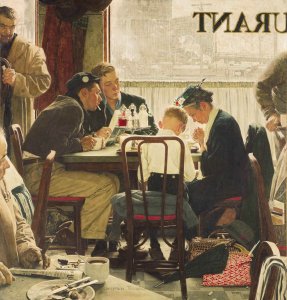
norman-rockwellOnce in a while, I long for the life I had as a child in a small town in western Nebraska. I loved that little town of Bridgeport. With a bicycle and permission from Mom, the whole town became our playground. The North Platte River was close by and we wandered for hours at a time in the river bottoms, oblivious to whose land we were trespassing on. On summer evenings the whole block was the field for a serious game of hide and seek. I remember shopping with my parents at the hardware store that was also the furniture store and the appliance store. There was one barber in town; Dad and I would walk down together to get a haircut. I loved the visits to the lumberyard, especially if it meant going back to the yard to pick out the boards Dad needed for some project; that’s where I learned to love the smell of freshly sawn lumber. The Rexall drugstore smelled like a drugstore and it’s where I bought comic books and magazines.  When I went to seminary to become a pastor, I imagined myself returning to such a place.

It hasn’t worked out that way. I’ve served my entire ministry — a few months shy of 30 years now — in the suburbs of major population centers. Deep inside, a mostly dormant longing is still lodged to return to a place like the place where I grew up. The longing becomes more acute when the frustrations and burdens of serving a large suburban parish overwhelm the joys and satisfactions of my work.

Years ago in one of those points of frustration and burden, I said to a clergy colleague and close friend (who had just retired from parish ministry, a point not irrelevant), “I’m going to resign my call and find a little church in the middle of nowhere.”

My wise friend responded, “No, you’re not. I know you better than that. That’s not who you are. You would go mad if you didn’t have the stimulation and challenge of the ministry that you’ve been called to. You have been called to this place for a reason. Stop yearning for a life that doesn’t exist except in your own mind.”

I think about that conversation a lot, especially the part about a life that doesn’t exist except in my own mind.

I think about that conversation with respect to the current campaign season. Listen to the candidates. The speeches start with a story of what things used to be like, and always the past is golden, a time when unions were strong or America was great. “Just elect me,” the storyline goes, “and we can return to that golden age.”

I think of that conversation with respect to the church. Congregations have been thrown into a state of anxiety as once prosperous and successful institutions look back on the glory years of the mid-twentieth century when they were strong congregations, pews and coffers and Sunday school rooms full. Now, struggling to keep their doors open, they hope that by calling a new pastor or getting a few new members they can return to the good old days.

Which, of course, is never going to happen. The world is different. The America of the mid-20th century which saw the US as an unrivaled global power, brought prosperity to millions of people, and saw the unprecedented expansion of the middle class doesn’t exist any longer. That we are no longer the America of the 20th century and cannot return to that time and place seems obvious, yet as a people, we talk not only as if that’s possible, but that it’s precisely what we need to do. (As an aside, access to that prosperity belonged primarily to white Americans.)

The symbiotic relationship of the church and culture that allowed churches to grow and enjoy substantial stability and institutional prosperity does not either exist anymore.

Bluntly speaking, get over it. We don’t live in the mid-20th century. That world doesn’t exist.

I wish our national leaders could speak honestly about the futility of nostalgia as as operating principle. I wish by some fiat, we could all agree that nostalgia might be a delightful way to spend an evening with family or friends, but it’s not a productive way to address the substantial challenges we face as a nation. I wish the candidates would give us their assessment of the challenges we face today and use their imaginations to articulate their version of policy to address those challenges. Of course, the polices on the right and left would look very different. But wouldn’t it be fun to debate actual solutions that take into account the nowness of our challenges and quit trying to repristinate a world that cannot exist anymore?

In the congregation I serve, mostly we have come to an awareness that 2016 is not the same as 1976 and that if we want to be part of God’s mission, we need to be different and do differently. It’s not to say there isn’t anxiety; there’s plenty of it. I still get people asking me why we have to change when what we’ve done has worked pretty well for us. Even folks who aren’t asking those nostalgic questions still long for the days when Sunday school rooms were packed, 150 kids showed up for Vacation Bible School, 60 kids showed up for the midweek kids’ programming, and the sanctuary was full for 2 services every Sunday. 

In letting go of the past, we open up space to look realistically and hopefully at the world we live in today. When we open that space, we find the energy to look — really look — at the unique challenges and opportunities in the present moment. Then we begin to think imaginatively about how we might address the challenges of the now.

In so many of the gospel lessons we’ve read this summer in our Sunday services, I’ve heard Jesus’ words in light of this lens through which we look at our mission and our challenges. When Jesus began his ministry, he set his face to Jerusalem. He went about his ministry with urgency, resolute determination, and a refusal to be distracted. When those he called wanted to go home and say good-bye first, Jesus cautioned, “No one who puts a hand to the plow and looks back is fit of the kingdom of God.” When he sent his disciples out two by two, he told them to look for welcome and then to stay as long there is work to do and then move on. When he taught his disciples to pray, he told them to ask that the kingdom come (present tense).  He told them to ask for enough bread for the day. There were no words about longing for the bread of the glory days, a sin which the Israelites perfected in their wilderness wandering.

I’m not suggesting that we disregard or dishonor the past. The saints of Faith Lutheran Church whose shoulders we stand on were faithful, energetic, and dedicated folks who established a vibrant ministry that has had an immeasurable impact on thousands of people and the community in which we serve. We can honor and give thanks for the past without attempting to recreate that past.

Like my own longing for my childhood home, there must be something deep within the human psyche that longs for the good old days. I happen to think that the good old days exist mostly in our minds, but even if they were as good as we remember, they aren’t coming back. The sooner we let them go and start really paying attending to the world of now and imagining how we might address the challenges of now, the better it will be for us, for the world, and for all of creation.

Postscript:  The notion of nostalgia as an operating principle for politicians is developed much more fully in The Fractured Republic: Renewing America’s Social Contract in the Age of Individualism, by Yuval Levin. I highly recommend the book. Written by a conservative scholar, the policy solutions Levin offers are not the ones I would support, but he is very fair and balanced in offering both critique and pathways forward for both Democrats and Republicans. He advocates for restoring the strength of mediating institutions, institutions like churches, synagogues, mosques, schools, and neighborhood organizations. This is precisely what the work of broad based community organizing does.

Preaching to High Schoolers after a Tough Week

LSM2015worshipDuring the month of July, I have the honor of serving as chaplain to the community of the Lutheran Summer Music Academy and Festival, held this year at Luther College in Decorah, Iowa. The Academy brings together high school students from all over the US, young adults (mostly college students  or recent graduates) who serve as counselors and interns, and outstanding faculty musicians who teach in colleges and universities all over the country. The community is based on the values of musical excellence, building community, and worship and faith formation in the Lutheran tradition. This is my sermon from yesterday, based on the parable of The Good Samaritan from Luke 10 to this diverse community that formed on June 26 and will disperse on July 24. 

Remember that book you just loved as a kid? That one you made your mother read over and over and over so that you had it memorized. The parable of the Good Samaritan is kind of like that. It’s the one we love, the one we read over and over. It’s the one that just might be the most familiar of any of the stories of the bible.

Because the story is so well-known, we’re pretty sure we know what it means, right?  When you see someone in need we have both the Christian and the human obligation to provide assistance.  Just like the Samaritan did for the man in the ditch, right?

Except maybe not exactly. Recall that the story comes in response to a couple of questions from one of the elite members of the society in which Jesus lived. Our translation says, “lawyer.” Elsewhere they’re called scribes. He was an expert in interpreting the law of Moses. So, when he asks what he has to do to inherit eternal life, this was not a seeking question, it was a trapping question. He knew good and well the answer to the question. He was hoping he could trap Jesus into an answer that would put Jesus in hot water. Typical of Jesus, he answers the question with another question. “What does the law say?”  Now, that’s a no brainer for a lawyer, the guy who knows the law better than he knows his own kids. He answers ‘you shall love the Lord your God with all your heart, and with all your soul, and with all your strength, and with all your mind; and your neighbor as yourself.’ “Well played,” Jesus says. “Do this and you will live.”

But the pesky scribe isn’t finished. He asks another question, not from a place of curiosity, but wanting to justify himself, to have Jesus say what a fine, upstanding man he is. And here’s where we get to the point that I hinted at earlier. The question he asks is not, “What should I do if I see someone in need?”  The question is, “Who is my neighbor?” That is a much more difficult and condemning question. See, I don’t think this story is a morality play. It is a condemnation of every one of us who divide our world into those who are like us and those who are not; people we like and people we don’t; people we are comfortable around and people we are afraid of. People who are our friends and people who are our enemies. It’s a story for people like us who want to justify ourselves because we think we’re pretty good people. The moment we fall into that ancient trap of justifying we somehow forget about caring about those around us.

So, back to the central question: who is my neighbor? In the story, the man who is least like the man in the ditch is the neighbor — the hated Samaritan becomes a neighbor to someone in need. Who is your neighbor?

So, let me tell you how it is in your high school. I know because it was that way in my high school, and my kids’ high school and and when I talk to the high school kids in my church they tell my it’s like that in their high school, too. The choir kids and the band kids. The jocks, the computer geeks, the airheads, the popular kids. We divide ourselves into tribes. We can take that high school micro-culture and expand it to nearly every corner of our society. Hillary supporters and Trump supporters and those who feel the Berne. Pro-immigrant, anti-immigrant. Christians and Muslims. City dwellers and country dwellers. Blue collar and white collar. And the the list goes on and on and on. Especially in times of instability and uncertainty, sociologists tell us, we divide ourselves into like-minded tribes and circle the wagons. We are loyal to the ones like us, and if they are not like us, we pass by on the other side of the road and leave them in the ditch. We have seen this week the violent and tragic consequences of what happens when we divide ourselves into us and them.

By contrast, Jesus’ answer to the scribe suggests that even the ones least like us, those we would most easily categorize as outsiders and even as enemies — those are our neighbors.  Think of that kid that is least like you in your high school. He is your neighbor. She is your neighbor. If you are a Republican, the Democrat Facebook friend that annoys you, she is your neighbor and vice versa. The families fleeing war in Syria, families who happen to be Muslim — they are our neighbors. The children and men and women fleeing brutality in El Salvador, those fleeing economic hardship in Mexico, trying to find a life in the US — they are our neighbors. Alton Sterling, the black man shot outside a convenience store in Baton Rouge is your neighbor. Philando Castile, the black man shot near St. Paul, Minnesota after he was pulled over for having a broken tail light — Phil is your neighbor. The five Dallas police officers that were shot and killed by a sniper — they are your neighbors.

Btu what can be done? Doesn’t it seem like the problems are so big that there is not a single thing that you and I could do about it? The despair comes from the false belief that the problem is out there. That’s not true. While the world is a messed up and broken place, the brokenness doesn’t start out there; it starts in here. Jesus reminds us that the problem is in each of our hearts. We are the lawyer in the story who constantly wants to justify ourselves; I’m a pretty good person. I’m not prejudiced; I’m not racist. But the problem is in here. The problem starts with our own diabolical impulse to see some as friends and others as strangers. The great spiritual writer and Trappist monk, Thomas Merton wrote, “Instead of hating the people you think are warmakers, hate the appetites and the disorder in your own soul, which are the causes of war. If you love peace, then hate injustice, hate tyranny, hate greed — but hate these things in yourself, not in another.” And with respect to the tragedies of this week, I might add, hate the racism in yourself not in another.

Our embrace of the stranger and our call to regard the stranger as our neighbor is rooted in the very heart God. We have been God’s stranger. We are the ones who have wandered away from the Father’s estate, the sheep who have wandered, the children who have rebelled. Yet in Christ, God has come close to us and loved us. With no guarantee that anyone would receive accept the invitation to come home, to be reconciled to God, God left God’s home and made a home with us in Jesus. We are that wounded man lying in the ditch; God is the one who has come close to rescue us and to bring us healing.

That’s what changes everything. That’s what makes this not so much a morality tale as much as a new-life-in-Christ tale, a life-that-flows-from-the-font-and-the-table kind of tale. Regarding the stranger as a neighbor is not natural; but we are no longer naturally born. We are divinely born and are called and empowered to go in to the world and see the ones the world doesn’t see, no longer walking by on the other side of the road, but getting down in the ditch, binding wounds, filling empty bellies, clothing naked bodies, sitting with the lonely, crying with the grieving. And for those us us with white skin, I think the life that flows from the font and the table means recognizing that we have a different experience in this country than what our brown-skinned brothers and sisters experience. Being a neighbor means sitting with them, standing with them, and walking with them and refusing to rest until justice flows down like waters.

Jesus finished the story by telling that the Samaritan went to the wounded man and poured oil and wine on the wounds and then bandaged them. He put him on his own animal, brought him to an inn, and took care of him. He paid for his hotel room and then gave him his credit card number in case he needed anything else.  And here’s the last thing Jesus said, the punchline of this whole story.

Go and do likewise.


Sermon at Eliana’s Funeral

IMG_0086On Sunday afternoon, we held the service to commend Eliana to God’s care. It was a hard and beautiful time. The church was packed beyond capacity; so many family and friends came to help us sing Eliana across the river: family from all over, friends, neighbors,  members from Faith Lutheran Church where I am the pastor, members from Acacia Park Lutheran Church where Chris is pastor, pastoral colleagues from across the Chicago area, colleagues and partners in our community work. It was a glorious gathering. Todd Carrico, our music director did a fabulous job of leading the song, and did the assembly ever sing! They sang for us when the words were stuck in our throats or held back by tears. 

I don’t usually publish my sermons as part of this blog. Sermons are contextual and best heard in the assembly as they are preached. This one is no exception. However, in some ways, this sermon is a continuation of what I have written in the past few posts I’ve shared here, thoughts about promises and resurrection and what all that could mean as we grieve Eliana’s death, a life too short and in which there was too much pain. 

The sermon was based on the lessons Chris and Liz chose for the service: Isaiah 43:1-3a, 4-7, 18-19, Psalm 139:1-17, Romans 8:26-27, and John 4:1-15. Often in the sermon, I use what in the printed word seems to be an ambiguous “you.” In most cases, I’m addressing Eliana’s parents, Chris and Liz Honig.

Eliana Frances Honig. Eliana. God hears. What a beautiful name for a beautiful little girl. Eliana’s world was pretty small and pretty limited. Nearly her entire life was spent in the confines of a small room on the Neo-Natal Intensive Care Unit of Lurie Children’s Hospital in downtown Chicago. Yet, she was Eliana. There is both joy and a deep sense of sadness today. Only in her death do you get to introduce her to the world. When you penned her obituary, you told us about a beautiful, brave little girl who was a fighter, who sparred with her nurses and had her own unique way of curling up her feet and touching her bandaged hand to her cheek, who in spite of her near constant pain tried to soothe herself, and was responsive to the gentle sound of your voice and touch, even when there were so few places you could touch her.  I think she must have been the most well-read 8 week old on the planet.

What you have described is Eliana, a girl with her own personality in spite of her EB, a unique human being who was not defined by her disease. God created Eliana. God created her in God’s image. From the very beginning God knew her and God loved her. While her skin disorder made her life difficult and painful, she was formed wonderfully, and you, her parents, were able to see how extraordinarily she was knit together, how remarkable and complex she was. She was, in spite of her disease, in spite of her short life, a precious human life with consciousness and will and the ability to connect with those few people who were able to come to know her.

And she was loved. Oh, was she loved. She was loved by mama and papa, Grampa Frank and and Gramma Luann, Grampa Jim and Gramma Sheryl, Aunt Shannon, Uncle Tim and Aunt Stacey, nurses Kate and Ursula and Sara and Stephanie, Dr. Henna, Dr. Mancini, Dr. Chamlin. Oh, that child was loved. And not because she was any of those amazing things that appear in her obituary. She was loved because of her life. Your love for Eliana allowed you to see those amazing things in her. The mutual love of child to parent and back again brought joy to you and to everyone who got to know Eliana.

That joy is muted today because the sad truth is we are not intended to bury our babies. I have no words to make sense of why we have to do that. For all of my faith and all of my theology, I have never been able to put together a cogent explanation for the kind of suffering that Eliana experienced, and the suffering of parents who lose their children.

At first glance, the gospel lesson has little to say to those who are grieving the death of a child. Jesus is enjoying a little verbal sparring with a woman from the wrong side of the tracks. They happen to be at the old well of Jacob in the middle of the day. Neither Jesus nor the Samaritan woman should be talking to each other. Yet the conversation goes on and in response to the woman’s questions and yearnings, Jesus talks about water and thirst and the possibility of never being thirsty again and about how one’s deep thirst can be slaked by a water that brings eternal life.

On April 7, on the morning before she went to surgery to have a feeding tube inserted, Eliana was baptized into Christ’s death and resurrection. Though it wasn’t an abundance of water, it was water with the Word that brought to your precious daughter the gushing springs of life. It wasn’t exactly the baptism that you had imagined. It was not at church, and beautiful Eliana traded a lacy white baptismal dress for Aqua-phor soaked dressings that wrapped her wounds. Still, in the application of water of from a tiny plastic vial along with the words of the gospel, it was living water; it was water that gave her springs of life with God.

When we mention this promise of eternal life, though, I hope we won’t immediately and automatically fall into the pious platitudes that offer little help when our grief is so raw. “Well, she’s in a better place,” some are quick to say.  I say that being held in her parents arms would be a fine place. There is truth in the promise of eternal life. We don’t have to speak of Eliana as if she has disappeared, disintegrated into nothing. She lives, having passed through the gateway of death into life in God’s nearer presence. God has welcomed her with the loving arms of one who says, “Fear not, precious little girl. I have called you, Eliana, and you are mine.” The pain that was so much a part of her life her on this side of the river is over. She has been made whole. Her baptismal promises she has received in all their fullness.

Those promises, true though they may be, seem small consolation in the face of Eliana’s death. Her death came way too soon and it leaves us feeling empty and cheated. I’m not ready to hear words that tie it all together in a nice clean bow so that now we are expected to make sense of it all and move on.

So many people were praying for a miracle. Frankly, I would have settled for less than a miracle. I would have settled for a little luck and a little time.  Those gifts were not given. And I can’t for the life of me imagine why. If asking God for healing is something we are allowed to do, then why are some prayers answered and others not? Another theological conundrum for which I have no answer.

Is that why you chose the passage from Romans? Because words for prayers have run dry after the one thing you so desperately prayed for has been denied?

The Spirit will hold you up. The Spirit will gather your sighs and your cries, your bone-deep sobs and your anger and the sadness and take them to God and God will hold them in God’s heart, loving you in the midst of what is inexplicable. The promise that the Spirit will hold you is nearly identical to the strong and gentle words of the prophet: “when you pass through the waters, I will be with you; and through the rivers, they shall not overwhelm you; when you walk through fire you shall not be burned, and the flame shall not consume you.”

Somehow God was with Eliana through her ordeal and she has had her homecoming. Somehow God is with you in the midst of facing her loss. And here’s what gives those promises their teeth, what makes them more than nice, empty words.  When God chose to come among us in Christ, God risked becoming vulnerable to all that this broken and fallen word might have to offer. In the last days of his life, Jesus experienced the worst that a broken and fallen world could throw at him: abuse, and beating and mockery and finally a cruel, torturous death. There is no place we can go where God has not already been; there is no horror we can experience that God has not already endured. In Eliana’s cries of pain, God was not distant but by her side. In your grief and sorrow, God has not abandoned you, but is in fact carrying you. When you pass through such unspeakable loss, God says, I will be with you, I will carry you.

Look around you Chris and Liz. Look around you at the community that has carried you and promises to carry you into the future. When you can’t believe, they will believe for you; when you can’t pray, they will pray for you. When you don’t feel like taking even one step, they will be here to walk with you. The loving arms of God hold you fast through the people of Acacia Park Lutheran Church, Faith Lutheran Church, your family, your friends and all the others gathered here today. We are holding you today.

In a few moments, you will be invited to this table to receive the fruit of Jesus’ death and resurrection. We will sing. With saints and angels we will sing. We sing because that’s what we do when there is nothing else that we can do. For a brief moment, the curtain that separates us from those who have already crossed over is opened and we join the saints and angels in their song. Eliana is singing that song, and we sing with her. She is enjoying that feast of victory at the banquet table of the Lamb. When we receive our morsel of bread and taste of wine, we join her at table, she eating the feast of victory, and we a meal in which God promises to sustain us for the journey that for us is not yet over. In the bread and wine comes the promise one more time: when you pass through the waters, I will be with you.

Because Resurrection Is More Than a Metaphor

resurrection.jpgYesterday I posted this on my Facebook page: it seems to me that the challenge of preaching on Easter is to preach resurrection as something that God really did and still does without turning it into a metaphor for stuff that was going to happen anyway, with or without Christ’s resurrection.

Too often, I think I’ve missed the point in my Easter preaching. In 25 years of Easter preaching, I think I’ve preached a few of those Easter sermons where I talk about our own experience of resurrection.  Someone experiences a reconciliation in a relationship; it feels like a resurrection. Someone is told that they’re cancer-free; it feels like a resurrection. One year, we had come out of a pretty serous congregational conflict; Easter that year felt like resurrection, and I’m betting that’s what I preached. In those cases, I was using resurrection as a metaphor. In a sense, they were resurrections.  A metaphorical sense. I’m not denying God’s presence in those experiences, and I’m not even going to deny that God might have had something to do with them, though I’m less certain about that. Regardless, they aren’t the point of Christ’s resurrection. Those things would have happened whether Christ rose from the dead or not. And if Christ’s resurrection is the game-changer that the New Testament tells us it is, then it has be be more than a metaphor for the places in our lives where we experience rebirth.

In that great chapter that interprets the resurrection (1 Corinthians 15), Paul begins by simply stating that the resurrection happened, that it’s an historical fact. He doesn’t begin by explaining it, but by proclaiming it. He then goes on to say that Christ’s resurrection from the dead means that there will be a general resurrection from the dead; Christ is the first in a long line of those who will rise from the dead. But even that isn’t what Paul is getting at, I don’t think. It’s an aside; not unimportant, but not the point.

What lies closer to the center of what Paul is getting at is embedded in these words:  Then comes the end, when he hands over the kingdom to God the Father, after he has destroyed every ruler and every authority and power. For he must reign until he has put all his enemies under his feet. The last enemy to be destroyed is death. (1 Corinthians 15:24-27)

God’s work is on a trajectory. The kingdom is coming. The work is happening. God is working to foil the powers of evil and sin, to bind the powers, to lay low the authorities. Christ’s resurrection was the decisive turning point in the work of bringing all things to their fullness, to that restoration that God promises, the endgame to which all things are moving.

To do that God has made a people. That’s not our usual language to take about the fruit of Jesus’ death and resurrection. We’re much more likely to talk about personal salvation, of the implications of Christ’s resurrection for me personally. But I don’t think Christ’s work has ever been about personal salvation. It’s been about calling and creating a people.  It’s been about a body, a qahal, an ecclesia. It’s been about  forming a royal priesthood and a holy nation (not to be confused, fellow Americans, with a nation-state).

So, the connection of Christ’s resurrection to our own baptism is not that we have now been saved, it’s that we have now been joined to a body through whom God is working to bring redemption, healing, and reconciliation to all creation.

Here’s why I think it’s important. There’s enough bad stuff going on out there to make any reasonable person give up on resurrection and just let it be a metaphor for nice stuff that happens regardless of whether or not the tomb was empty on that first Easter morning. Truth is, I don’t guess that there is any more wrong with the world than there usually is when Eastertide rolls around. But it seems like it to me. I’ll own that. The bombings in Brussels aren’t anything new. But they are fresh and raw. This crazy circus that we call a presidential campaign has moved from the sublime to the ridiculous to the downright scary. My heart aches at the way we polarize and demonize each other and perpetuate structures of oppression. These are the front lines of the rulers and authorities and powers.

Most personally, for the last month our family has been trying to support each other and find light in our own darkness. Five weeks ago, our grandaughter, Eliana Frances was born; she’s a precious, beautiful little girl. Eliana was born with an extremely rare skin disorder, epidermolysis bullosa, and has been in the neonatal intensive care unit since her birth. EB is a very nasty disorder in which baby Eliana’s skin is deficient in the proteins that allow the layers of skin to adhere to one another. The doctors and nurses work tirelessly to manage her severe pain.

The resurrection of Jesus is not immediately going to change any of that stuff. The presidential campaign is what it’s going to be. Turning around the structures of oppression will take generations. ISIS isn’t going away and there will be more loss of life in terrorist incidents. And the resurrection of Jesus isn’t going to cure Eliana.

So, what does it mean? I think it means that in the midst of all the shit, in the damn middle of all the obvious signs of sin and brokenness and darkness and evil, God is at work. If the resurrection of Jesus was a game-changer, then I have to believe that in the same way that God was at work in Jesus’ death, so God is at work in the midst of the contrary bringing life in the midst of death. It’s a bit of a misnomer to say that death has been defeated; there’s too much of it hanging around to believe that. Paul reminds us that one day it will.

Here’s where we get at what I think is the heart of the game-changing action of God in Jesus’ resurrection. If God is at work in the middle of it all, then the body of Christ must be the incarnation of that work, a body called to live differently.  We are called, reborn, and empowered to be a people who live as if that defeat has already taken place. The powers and authorities are at work: anger, rage, oppression, vengeance, retaliation, fear. Those are the ways of death and they eat away at the human soul. They are the ways of death that God intended to put to rest in Christ’s resurrection. In it’s place a people was created who love without condition, who serve without counting the cost, who honor every human life as a brother or sister made in the image of God.

A people who have been raised from the dead. Not metaphorically. Literally.