Author Archives: Jim Honig

Unknown's avatar

About Jim Honig

Lutheran pastor in the western suburbs of Chicago. I'm a writer, a runner, an avid outdoorsman, and a curious student of people and the human condition.

A Little Writing in the Sand

In John’s gospel, it doesn’t take long for things to heat up. Blink an eye and Jesus is already getting into trouble. From the wedding at Cana (John 2), Jesus heads to the Temple in Jerusalem and drives out the moneychangers, snapping a whip and overturning their tables. See what I mean? From the get go, there’s tension with the religious leaders.

The tension continues and continues to intensify. Jesus heals the man at the Bethesda pool and pronounces him a forgiven man. “This was why the religious leaders were seeking all the more to kill him.” When he proclaims strange words about eating his body and drinking his blood to receive life, the leaders understandably take offense. When he goes to Jerusalem to celebrate Sukkoth, the leaders are ready to arrest Jesus. And we haven’t even gotten to the end of chapter 7.

Then Jesus  shows his face again at the Temple. Ok, more than just shows his face. He sits down and holds a little bible study. Before long a crowd gathers.* The religious leaders catch wind of the impromptu meeting and with the snap of their fingers hatch an unassailable plan to catch Jesus red-handed. They will stretch him on the rack between his penchant for mercy and the requirements of the law.

So, they find a woman caught in the act of adultery, strong arm her into the midst of the outdoor lecture hall, and set their trap. Here are the facts, they say. This woman has been caught in the act. Her guilt is clear. The Law says she must be stoned. The Law of Moses. The highest authority in our tradition. Tell us what you would do.

The details of what happens next often go unnoticed. First, Jesus bends down and writes on the ground with his finger. Maybe the text of the commandment? Now he stands up and speaks. I think he was giving them conditional permission to begin the stoning. With one caveat. The one without sin can cast the first stone. I want to imagine that what he said was even juicier than that. I want to imagine that he was giving permission to begin the execution to anyone who was without THIS sin.

Because you notice what he does next? And you notice their reaction? He bends down again and starts writing in the dirt again. And “one by one” — did you notice how specific the text is about that? “One by one” the accusers walk away.

Here’s a thought. Admittedly a speculative thought. But there’s a certain logic to it. What he was writing in the sand — one by one — was the names of their girlfriends.

There’s a large lesson here about the magnanimous character of God’s grace and forgiveness. I am not deserving of the gift of grace and the forgiveness of sins, even the repeated sins I can’t seem to shake off. Yet, I am forgiven. Grace abounds!

And there’s a micro lesson for how I get around in the world.

I have a pretty strong sense of justice. Right and wrong matters to me. When I see someone gaming the system, I get angry. When I see another mistreated, my blood boils. And I often find that the faults I am so quick to notice in others are the ones I hate the most in myself. I’m irritated when others are late for meetings, rarely stopping to wonder what might have gone wrong. When I’m late, there’s always a good reason. It’s easy to notice my wife’s irritability and call her out on it. When I’m irritable, I have a good reason for it. Speeding down Roosevelt Road, cutting in and out of the traffic lanes? The other guy’s a jerk and a menace to all of us. I’m late for an appointment.

Apparently grace is not just something to be received, it’s something I’m called to practice.

*You can find the story in John 7:53-8:11. I know it’s not in the most reliable manuscripts. That doesn’t mean it’s not a great story.

In Praise of Praise

flyfareellAs the time draws near to take leave of my current call, the days are full and my mind is even more full. In the congregation, there is a never-ending list of details in order to tie up loose ends with the staff, congregational leadership, program, worship, and so many other things. We have our house on the market and when a request comes in to show the house, we have to drop what we’re doing and go home for last minute tidying and vacating our dogs. We are also in the early stages of purchasing a home in Door County, and all the thousands of things on the checklist of a home purchase. You get the picture. A lot going on.

Yet this is also a critical time for me and for the people of Faith to do a good job of saying goodbye. 

Last week, I went to my last church council meeting. We went up the the sanctuary — our version of holy ground — for a ritual of leave-taking. I sat on a chair in front of the altar and one by one, each council member stepped forward, placed a hand or two on my shoulder and recounted something they have appreciated about my ministry and then offered a blessing or good wish for my future. The time concluded with all of them laying hands on me for a prayer of thanksgiving and blessing.

The next evening our Director of Youth Ministry, organized a going away party so that our high school and middle school youth would have a chance to say goodbye in their own setting. Having been here for 15 years, I have baptized a good number of them, which means for them, I have been their pastor for their entire life. We played some silly games, ate together, laughed a lot, and some of the high school kids spoke very specifically about what my ministry has meant to them. The evening ended again with laying on of hands and prayer.

In the nearly month since I announced I was leaving my email inbox has been full of notes of gratitude and remembering. I’m getting them in the mail, too. And in the hallway. And at the door of the nave on Sunday mornings.

It probably sounds like I’m trying to tell you know what a great pastor I’ve been. But that’s not the point.

The morning after the council meeting, Deb Hornell, our congregation president, my friend, colleague, and sometimes coach and mentor, emailed me with this message: “I hope you are able to absorb all the love, gratitude and good wishes coming your way. It struck me last night after Council laid hands on you how emotionally intense this process must be, and also how wonderful for you to experience what you mean to everyone. Few people get the chance to hear how they’ve made a difference for others.”

It’s that last sentence that really grabbed me. I think Deb is right. What I am experiencing is pretty unique. Not many people get the chance to hear how specifically they have made a difference in the lives of other people. For a lot of folks, the nice things that others say about them don’t get said until their funeral. How sad that they never get to hear them in life. All of this has been so wonderful and so wonderfully affirming. I have tried to record much of it in my journaling just so I don’t forget the impact of the experience. Quite simply, it is beautiful and priceless for people to tell you that you have made a difference in their life.

What could happen if we all took a little time in the ordinariness of the day to day to affirm the people who have touched our lives and made our journey more beautiful and vivid and meaningful?

It’s akin to a spiritual practice, and it makes a difference. I have encouraged my staff to join me in sitting down on Monday morning after a busy Sunday and write a few notes to the people who have touched them in the past week or who have gone beyond what they were required or who they witnessed doing something nice for someone else. The last thing on the agenda of our staff meetings has been “Blessings.” We have made space to tell each other when someone has done something well or gone beyond what was required. A culture of gratitude and affirmation is a pretty nice place to live.

So, if you’re still with me, will you do this? Sit down and write an email or, even better, a hand-written note to someone who has touched your life for the good. Tell them specifically what they have done and what it has meant to you. And would you agree to make that a regular practice in your life? As one on the receiving end, I can tell you that it means more than you will ever know.

Of Ending and Beginning

img_0140As a Christian pastor, death and resurrection are pretty real things to me. Jesus’ death and resurrection lie at the heart of the faith I proclaim. In the lives of the people I serve, I am routinely invited into deaths and resurrections of persons and families, though none of them are ever what I would call routine. They are always holy moments.

Death and resurrection imply the reality of endings and beginnings. I have entered into a zone of vocational ending and beginning, a kind of death and resurrection. After a long period of conversation and discernment, I have accepted a call to a new congregation. I will be moving from the western suburbs of Chicago to Door County, Wisconsin to serve as pastor with the people of Shepherd of the Bay Lutheran Church in Ellison Bay. (If anyone is interested, you can read the letter I sent to the people of Faith Church announcing the acceptance of the call.)

This is now the 4th transition I’ve made as a pastor from one place to another, this one at the end of a 15 year tenure. They are always fraught with emotion. As a pastor, you become invested in a place and in the people there. People invite you some of the most intimate and vulnerable times of their life. You get to be part of their celebrations, their heartbreaks, their milestones and their disappointments. In December, I spent the wee hours of the morning two nights in a row in a room with a dying man, his wife, his daughter, and two of his granddaughters. It was a holy moment as the people who loved him most dearly sat vigil with him, sending him across the river to the Promised Land. Somehow, they wanted me to be there. In January, I presided at the wedding of a woman who had known deep disappointment when a previous engagement was called off just before the wedding. When she and her beloved pledged themselves to one another, I got to share the moment with a better than front row seat, so close that their joy spilled all over me.

Take these moments and multiply them by hundreds, and one begins to see how deeply embedded a pastor becomes in the life of a congregation and the people who inhabit it. The moments come and go; one savors the moment and moves on. I don’t mean to suggest they are unimportant. They are extraordinarily important; yet they come with such regularity that I never really spend much time dwelling on them.

Except that now as I prepare to leave, so many moments come flooding back. I look at a family in the pew on Sunday morning and I get a flashback of the funeral we did for Dad, or the time when the infant child who’s now in high school spent weeks in the hospital suffering from seizures. When I get an email from a former congregational president wishing me the best, I recall the capital campaign for which we shared leadership and how much I learned from this wise, faithful man.

One also gets to work with people for the sake of God’s larger purposes in the world. Now as I leave, I see with such clarity the great ministry that the people of this congregation do, the way we have made an impact in the community and in the lives of real people.

In the weeks to come, I will say more about where I am going, but for now, I am beginning the long, heart-wrenching process of saying good-by to people and a congregation that I have grown to love so deeply. We will remember together. We will savor these moments. We will laugh and cry together. And we will give thanks to God for prospering our work together.

When a colleague heard I was leaving, she sent me a Facebook message reflecting on her own pastoral partings, reminding me that as the Sent Ones, we love deeply but loosely. I like that phrase. Encapsulated in it is the transient nature of life. I picture life as a moving stream heading towards the ocean. For a time, we get to float along with the same people. Then the current changes and we get diverted to other channels in the same river, together, yet apart.

I had not anticipated that I would be leaving Faith at this point in time. Yet, the Spirit blows where she wills. She had created a restlessness that has found opportunity for a reset, to enter into a new season of life and ministry, and to do the work that I love in a landscape for which I have long yearned.

So, a heart-wrenching ending and a life-giving new beginning. Always held together in the love of the One who has called us his own.

We Are Going to Need Each Other

mlkspeech-1On Monday evening, I had the honor of delivering the keynote speech for the DuPage County Martin Luther King, Jr. Celebration. It was a great evening that included great music and a dramatic delivery of Dr. King’s “I Have a Dream” speech. Here is the text from which I gave my remarks on Monday.

I don’t have the words fully to express to you how honored I am to have the chance to stand in this pulpit this evening. I am humbled I am to stand in the line of the fine speakers you have had addressing God’s people on the occasion when we honor the legacy of Dr. Martin Luther King, Jr. I sat right there in the front row last year and was deeply moved by the words of Dr. Tracy Malone. I am grateful to my colleague and friend, Pastor Kevin Williams, and the people at Second Baptist Church for extending the invitation and for all the work that has gone into organizing and publicizing this event.

Pastor Williams called me on Friday afternoon to check in and see how things were with me.  “Man, something has changed,” he said. “We are going to need this gathering and each other more than ever.”  Amen to that.

When I accepted this invitation back in September, most of us thought we would be on the cusp of swearing in the first woman president of the United States. It didn’t work out that way. Instead, we are about to inaugurate a new president who campaigned on division, bigotry, and xenophobia. He won the presidency by way of the electoral college, though he lost the popular vote by nearly 3 millions votes. Some people have said that we have taken a step back in progress we had made in addressing the challenges of a racialized society. I wonder if that’s true. I have a hunch that the curtain has been pulled back revealing who we have been all along; but the ugliness is no longer hidden. It’s out there in the open for all of us to see; and it seems to legitimize action that comes of the darkest corners of our collective psyche.

I remember 8 years ago at inauguration time. There was almost this giddy sense of excitement and optimism. I invited our church staff over to our home to watch the inauguration. We ate snacks and toasted with champagne. The theme was hope, and in every place where a crowd gathered you could hear the chants, “Yes, we can.”  What a contrast to “Lock her up.”

Something has shifted. I don’t know many who are feeling that sense of unbridled optimism, even among those who voted for the president elect. Instead it’s like a pall of fear has descended on our whole country. Fear seems to be consistent among those who voted for him and those who didn’t. I’ve spent some time talking with those who voted for our president-elect. I’ve wanted to understand. Among many things I’ve discovered is that even those who are happy with the results of the election are not feeling a great sense of optimism and hope; they don’t feel like we have taken some giant step forward. It’s hard to know for sure what’s going on.

Fear is nothing new. In an age of iphones, social media, and the constant, 24/7 barrage of headlines and sound bites it’s a wonder we ever come out of our homes. The evening news is often little more than an update on what we should be afraid of today. What we eat, what we drive, what’s going on halfway around the world, what’s going on in our own city — the list of things we should be afraid of is never ending.

But the present fear goes beyond that. The campaign language of bigotry has unleashed a storm of bigoted actions. The disregard for truth has left us with an even greater suspicion of the institutions that are so vital to our democracy. We’ve even coined language for it, as if it’s perfectly acceptable and normal — they say we now live in a post-truth culture.

But it’s not normal. And it’s not the kind of country that I want to live in. I do not want to live in a country where truth doesn’t matter. I do not want to live in a country where fear and suspicion and hatred and stridency are the dominant forces that drive our public life.  Do we want communities where we are suspicious of each other? Where we choose to highlight our differences? Where there is no room for the stranger or for the person trying to make a new start, for the family trying to make a life for themselves, to escape the violence of their neighborhood or their home country? Do we want communities where we slice and dice and categorize based on color of skin or which street you live on or which symbols are in your house of worship or where your parents were born?

Dr. King had a vision for something greater and grander. On Christmas Eve, 1967, just a few months before he was assassinated he preached these words at Ebenezer Baptist Church in Atlanta, where he was co-pastor:  This Christmas season finds us a rather bewildered human race. We have neither peace within nor peace without. Everywhere paralyzing fears harrow people by day and haunt them by night. Our world is sick with war; everywhere we turn we see its ominous possibilities. And yet, my friends, the Christmas hope for peace and good will toward all men can no longer be dismissed as a kind of pious dream of some utopian. . .Let me suggest first that if we are to have peace on earth our loyalties must become ecumenical rather than sectional. Our loyalties must transcend our race, our tribe, our class, and our nation; and this means that we must develop a world perspective. No individual can live alone, and as long as we try, the more we are going to have war in this world. . .As nations and individuals, we are interdependent. . .All life is interrelated. We are all caught in an inescapable network of mutuality, tied into a single garment of destiny. Whatever affects one directly affects all indirectly. We are made to live together because of the interrelated structure of reality.

That’s what we want. An interrelated community that reflects how the creator has made us. When God created that first man, God said it is not good for the man to be alone. So, God created the woman; in that moment began the interrelatedness of the human species. We are created to be in community. Not just created in community, but created to care for and love and support one another.

In my religious tradition, Jesus is kind of a big deal. Throughout his ministry, Jesus lifted up the necessity of caring for one another. When he was preaching for a crowd of thousands and saw that they had no lunch, he fed them. When he encountered a blind man, he restored his sight, the deaf man could hear again, the lame man could walk again, the lepers he cleansed. He authorized his followers to do the same thing. He told a story about how some folks had given food to the hungry and a drink of water to the thirsty and clothing to the naked. And when they did that, Jesus told them that they had done it for him. When we serve our neighbor, we are serving God. We see God in the face of our neighbor. Caring for one another in community and relationship is holy work. That’s the beloved community of our dreams.

The challenge always is to turn our dreams into reality. This week, all our attention is on Washington, there being an inauguration and all. Some folks think there’s this big thing called government that’s going to take care of stuff. We elect the right people and the right things will happen. And when we don’t elect the right people, well, bad things happen and that’s government. It’s too big and the forces are too strong and we can’t do anything about it. After all, you can’t fight city hall.

But I refuse to believe in that kind of determinism, that we are subject to inevitable and unassailable forces. We are not victims of the vagaries of history. If there’s anything the legacy of Dr. King has show us it’s that common, ordinary people have the agency to be a force for the good in the communities where they live.

Too many people subscribe to a narrative of the civil rights movement that is simplistic and simply not true. In his book, I’ve Got the Light of Freedom, Charles Payne summarizes that popular narrative like this:

Traditionally, relationships between the races in the South were oppressive. Many Southerners were very prejudiced against Blacks. In 1954, the Supreme Court decided this was wrong. Inspired by the court, courageous Americans, Black and white, took protest to the street, in the form of sit-ins, bus boycotts, and Freedom Rides. The nonviolent protest movement, led by the brilliant and eloquent Reverend Martin Luther King, aided by a sympathetic federal government, most notably the Kennedy brothers and a born-again Lyndon Johnson, was able to make America understand racial discrimination as a moral issue. Once Americans understood that discrimination was wrong, they quickly moved to remove racial prejudice and discrimination from American life, as evidenced by the Civil Rights Acts of 1964 and 1965. Dr. King was tragically slain in 1968. Fortunately, by that time the country had been changed, changed for the better in some fundamental ways. The movement was a remarkable victory for all Americans. By the 1970s, Southern states where Blacks could not have voted ten years earlier were sending African Americans to Congress.

Simplistic. And wrong. The movement was much more than that. That’s not how it happened. The civil rights movement didn’t start in Washington with the courts or with federal government. It started in the towns and villages of Mississippi and Alabama where people whose names we don’t remember went door to door and did the long, slow, hard work of relating with people and organizing them, folks like Amzi Moore and Mrs. Haner and Mrs. McGhee and Annie Devine. Dozens of college students and a handful of high school students spread across Mississippi and went door to door getting to know people and finding out who would show up for actions and what people were worried about. When big actions were planned, actions like bus boycotts and the March from Selma to Montgomery, leaders and ordinary folk gathered to plan and to train. They role played about what would be said or done in certain situations. They trained people in how to take a beating. A younger version of U. S. Representative John Lewis was present for that training, and maybe that’s what allowed him to take the beating at the hands of the Alabama State Police that left him bleeding on the Edmund Pettis Bridge with a fractured skull. By the way, you can say many things about U. S. Representative John Lewis. But you cannot call him a man of all talk an no action. He is one of the living heroes of our democracy.

The leaders of the civil rights movement understood that when citizens want to get serious about becoming agents for the common good in their own communities it takes a lot of long, slow, persistent, consistent, and mostly unglamorous work. It requires sitting down one on one, talking to people. It requires painstaking research to discover what actions can be taken that will move us towards justice, righteousness, and that peaceable kingdom. It involves knowing the power structures in a community and institutions. It demands planning actions that will elicit a reaction. When the civil rights movement leaders planned marches and put school children in the front of those marches so that they would be the first ones to encounter Bull Connor’s police dogs, that was not an accident. It was planned to elicit a certain reaction. Those young people who went door to door building relationships and training leaders began to coalesce their power. They were organizers. It was long, slow work, but it was respectful work, work that was intentional and the kind of work that was absolutely essential to their success.

Weeks ago, when I was thinking about these remarks, and making some notes, I wrote this note to myself:  “I don’t want to make this speech into a commercial for community organizing.” A few weeks later, I came back to that note and I wrote in the margin, “But maybe I do.” 

What I have experienced in organizing is that we can turn our care for our communities and our neighborhoods and our neighbors into action that is more than symbolic. Symbolic action has its place. This gathering this evening is mostly symbolic. That doesn’t mean it isn’t important. It’s just to recognize the limitations of a symbolic gathering. Hopefully, it will be inspirational, and we will leave here with a sense of hope and a determination to go to work. At its best, this gathering will prod us to action. But this gathering makes no plan for action.

If we were to make a commitment to join together for the sake of working together, that would be something different. If we made a commitment to plan together and to work together and we began organizing ourselves to actually do that, we could expect that we would begin to enact the vision that we have for what our community should be. If we were to make specific determination about the challenges of our community and pull together the power of the people, we would discover that we can do things, we can make a difference. It doesn’t have to be all talk.

What I have experienced in community organizing is the best chance we have to enact God’s vision for what the world should be. I am a leader with DuPage United, an affiliate of the Industrial Areas Foundation, a national parent organization for organizing work that is being done across the country. We are doing real work. Here in our community, we have taken action to stand in solidarity with our Muslim brothers and sisters in the face of ramped up Islamophobia. We have pushed the DuPage County sheriff’s Department to provide Crisis Intervention Training for all of the sheriff’s deputies out on the beat. We are in the process of setting up community mental health crisis centers so we keep people who are having a mental health crisis out of the emergency room and out of jail, and most importantly, insure that they get the help they need. We can’t rely on the state to get this work done. The state of Illinois is broken. We’ve got to take things into our own hands, and we can do it. Yes, we can. 

In the next four years we are going to need each other. We are going to need to be in relationship. We are going to need to be organized. We simply must do the hard, slow, painstaking work of meeting with one another, developing a web of relationship in our community, so that I stand with you when you need me, and you stand with me when I need you. It remains to be seen whether the hateful and divisive rhetoric of the campaign will turn into policy and action. In a sense, it doesn’t matter; we’re going to need each other. You need to know that when your health insurance stops covering pre-existing conditions, your neighbors will stand next to you and fight for what’s right. When you are required to register because you are a Muslim, you need to know that there will be Christians who will stand in that line and get registered right along with you. When the school to prison pipeline keeps growing and flourishing, you need to know that you will have neighbors who will take action with you to demand that fairness and equality and justice are blind to skin color. We will need each other more than ever. I believe that’s the work that Dr. King was involved in. I think that’s the work that preserves and continues his legacy. It doesn’t matter who is president of the United States or what the Congress does or doesn’t do. We will join hands and we will work and plans and organize and fight and demand together, until justice flows down like water.

Indulge me with just a few more minutes to speak to those of you here tonight who are members of the white Christian church. If this speech was a letter, this would be the P. S. The white church has a miserable record of silence, complacency, and complicity when it comes to matters of race in this country. Too often, the white church has worked to maintain the structures of racism that have oppressed our fellow citizens of African descent, systems that have denied them the same opportunities that we white people have taken for granted.

I confess that I am late to this work. I confess my own complicity. I confess that it took the shootings at Mother Emmanuel Church to wake me up. The shooter was a member of a church in my denomination. He grew up in a white Lutheran church and attended confirmation class, probably not all that different from the confirmation classes I teach. Yet somehow his connection to church, to my church, could not erase a deep hate based only on race.

Shortly after that shooting,  I went to a colleague who pastors a church with a significant African American membership and asked if we could get members of our congregations together; I said I needed them to help us understand the problems and challenges of racism.  He schooled me; he told me “That’s not our job.” He told me, “You white people need to do your work, begin to understand racism and white privilege and how racialized our society has become.” I was taken aback. I had never heard that before. So, I got on the Facebook page for the clergy of my denomination. And I asked the question there. And I got schooled again, this time not so gently. “You white people need to do your own work. When you have done your work, come back and then we can talk.” So, that’s what I’ve been trying to do. In my congregation, all of our staff have been through anti-racism training. We have sponsored anti-racism training for our members. We are reading; we are having conversations; we are learning. We are waking up.

In the past year, Jim Wallis of Sojourners and Drew G. I. Hart have both written compelling books on racism and the church. While they disagree on certain points, they both believe that we will not make substantial progress in dismantling racism in our country until the white church shows up and starts making it a priority. That is not to say that white liberals are going to bring racial equality to the people of color. That’s a colonial attitude that has been part of the problem. I mean to say that we have our own work to do in recognizing white privilege and doing our work to begin dismantling the structures of racism.

This is my challenge to you, white church. Show up. Do your work. Have the conversations. Read TaNehisi Coates, Between the World and Me, Michelle Alexander, The New Jim Crow, Isabel Wilkerson, The Warmth of Other Suns, Nell Ervin Painter, The History of Whiteness, Debby Irving, Waking up White.

We are going to need each other. And if we in the white church are going to be our best selves and really be neighbors, then we simply must do our own work.

No matter the darkness, there is always light. No matter the fear, there is always hope. Together we can do this work.

This is a song that I learned as a child and I will never out grow it. Dr. King said that darkness cannot drive out darkness; only light can do that. Together we will shine the light into the dark places.

(And we sang:)This little light of mine.I’m going to let it shine. . .

Ev’ry where I go, I’m going to let it shine. . .

Christmas. If not Merry, then Blessed and Hopeful

15439961_10211363540473869_796496761573532180_nA cold winter chill has settled into our little spot on the earth. Snow covers the ground and the temperatures are a bone-chilling cold. For those of us in the northern hemisphere winter and Christmas go hand in hand. Even the songs tell us to wish for a white Christmas.

It’s easy to romanticize the cold of winter while sitting next to the fire with a soothing cup of hot chocolate. But the cold and snow can’t be romantic for everyone. Some have to work in it. Some even have to sleep in it. And some wonder how they will stay warm when there’s no money to pay the gas bill.

On the one hand. . .on the other hand.  Life is always a little like that. The good and the bad. The romantic and the reality. The pain and the relief. The sorrow and the celebration. The light and the darkness. The manger and the cross. The cross and the empty tomb.

We are vulnerable creatures, subject to the physical realities of time and disease. While some families celebrate coming together for Christmas, some know the acute pain of separation. Our Advent and Christmas observances are somehow of one piece, one complete woven fabric, with Good Friday and Easter. The manger is never very far from the cross. And the cross is seen in it’s fullness when we can also see in the three-day distance the empty tomb.

Christmas begins the story of God taking on our vulnerability, our pain, our sorrows, our joys, and our celebrations. The Word becoming flesh is God’s commitment to the inherent vulnerability of humanity, God’s commitment to the entirety of what it means to be human. The death of the Son of God is one location of that commitment. But so is womb of Mary, the stable, and the manger. This is what God chose. The Word became flesh and dwelt among us. The habitation of God with us brings us a life that is real life and a kingdom that is love and peace and freedom.

Regardless of how much things appear to be corrupt, corrosive, cruel, and confusing, there is another reality at work. God has come among us. God has inaugurated a new kingdom. So, in spite of the hurt we might be bearing, there is hope. The immaculately conceived Christ-child is conceived also in us so that we might be the agents of the kingdom for the whole world.

If Christmas cannot be merry for you, may it bring blessing and hope.

Advent and the Spirit of Joyless Urgency

urgencyI’m reading Marilynne Robinson’s relatively new collection of essays, The Givenness of Things, and came across this elegant and weighty phrase, “the spirit of the times is one of joyless urgency.”

She’s found words to describe what I see going on in my own life and around me. My to-do list is long and always growing. We crave relationship and intimacy and yet make no time for it, allowing Facebook and such to become a false and diabolical substitute. We neither make nor allow space — not for thinking, not for silence, not for people, not for God. It’s always on to the next thing. In fact, the urgency of the next thing makes it hard to focus on the now thing.

A few years ago, I convened a group where we talked about ancient spiritual practices and what they might look like in our highly technological, fast-paced world. When I talked about making space in our lives for silence, for doing nothing, for sitting and reflecting, for being with our loved ones in an unhurried, no-thought-given-to-productivity kind of way, one of the persons in the group responded that they simply could not do that. Their brain and their body would not allow it. And neither would their bank account. They had to be constantly busy and working. Alas.

Advent offers a profound antidote to urgency. We’re invited simply to wait with the prophets for the coming of the Messiah, prophets who waited for centuries, who did not see that which they were waiting for, but trusted in the promise that it would come.

Even the shortened days (at least in the northern hemisphere) of these last weeks of the calendar year invite me to sit in the quiet dark and wait and think and reflect and pray.

And when I do? I find that the image of God in which I have been created is more apparent when I slow down and when I make space. I am more generous to people, more gracious about their faults, less fearful about a broken world, more inclined to see things from the perspective of faith.

And what of the joy?

I sit in my reading and writing place on a gray morning. I’m tired from a long weekend of heavy responsibilities, sitting with a long list of things that need to get done, and little energy to get up and do any of them. This is just the kind of day to ignore the joy around me.

Yet, to see and experience those things around me that could bring joy is a decision, a choice. I think of some pretty amazing Advent worship on Sunday, of the buzz after the services about what people found meaningful. To know that people were touched by God is one of the reasons I do what I do. Surely, there is joy in that.

At one of those services, a husband and wife who had two days earlier lost their 30-something son to death by cancer were in church. I watched as they wept, as they smiled at the ways their young granddaughters engaged in the service, and as countless numbers of their fellow pilgrims shared hugs and tears with them after the service. Surely there is joy in deep human connection.

Last night as I laid on our bed reading, our 40 pound poodle mix jumped up and threw herself against me, pawing at my hand until I began to scratch her neck. As I did so, she began to relax, and laid her head down looking into my eyes as she fell asleep. A mysterious moment of connection between man and beast. Surely, there is joy in that.

The point here is not that there is no chance for moments of joy. It’s that I have not become very adept or practiced at noticing them, countless numbers of them day in and day out. Perhaps too consumed by the urgent?

So, this will by my advent discipline. To step away from urgency. And to find joy.

“Together with the Levites and the aliens. . .”


image
This evening at our Thanksgiving Eve service, we will read these words from Deuteronomy:

When you have come into the land that the Lord your God is giving you as an inheritance to possess, and you possess it, and settle in it, you shall take some of the first of all the fruit of the ground, which you harvest from the land that the Lord your God is giving you, and you shall put it in a basket and go to the place that the Lord your God will choose as a dwelling for his name. You shall go to the priest who is in office at that time, and say to him, ‘Today I declare to the Lord your God that I have come into the land that the Lord swore to our ancestors to give us.’ When the priest takes the basket from your hand and sets it down before the altar of the Lord your God, you shall make this response before the Lord your God: ‘A wandering Aramean was my ancestor; he went down into Egypt and lived there as an alien, few in number, and there he became a great nation, mighty and populous. When the Egyptians treated us harshly and afflicted us, by imposing hard labour on us, we cried to the Lord, the God of our ancestors; the Lord heard our voice and saw our affliction, our toil, and our oppression. The Lord brought us out of Egypt with a mighty hand and an outstretched arm, with a terrifying display of power, and with signs and wonders; and he brought us into this place and gave us this land, a land flowing with milk and honey. So now I bring the first of the fruit of the ground that you, O Lord, have given me.’ You shall set it down before the Lord your God and bow down before the Lord your God. Then you, together with the Levites and the aliens who reside among you, shall celebrate with all the bounty that the Lord your God has given to you and to your house. (Deuteronomy 26:1-11)

I think of my grandfather, the grandson of immigrants from Germany who came to America because they were starving in Pomerania and hoped for a better life in the New World. They settled in Kansas and farmed the land. It was a hard life, but they had enough to eat.

Grandpa was the son who went off to college and seminary to become a pastor. Ironically, his first call was to northern Saskatchewan to serve nearly 20 preaching stations of German/Russian immigrants who had fled Europe for the same reason his own grandfather had left. After a dozen or so years in the wilderness, he went home to Kansas to pastor congregations there. Yup. The son of German immigrants could call Kansas home.

I think today of the fact that contrary to the myths that I learned in elementary school about Thanksgiving, it was the indigenous folks already here who made survival possible for those first European immigrants to the North American continent. Thanks. 

Our faith reminds us that we are all pilgrims. We all are on a journey. We are all strangers and aliens. And we are invited to celebrate together the goodness of God. We are invited to remember that none of us does this alone, and none of us does this without provision from the One who has created us. We are creatures, all of us.  The Israelites, the Levites, the Philistines, the Moabites, the Mexicans, the Muslims, the members of the LGBTQ community, the descendants of slaves in the Americas, the descendants of starving Pomeranians. Creatures and fellow celebrants. 

I grew up in a small town in western Nebraska, and all I knew was people who looked just like me. The only diversity I knew was that besides Lutherans, there were Catholics, Baptists, and people who didn’t go to church. How my life has been enriched to know people who are different than that narrow slice of white, European heritage. Of all the things I am grateful for this Thanksgiving, I am most mindful in these tumultuous times of the gift and blessing of friendship and relationship with people who have taught me that life is large and who have shown me the rich mosaic of the human community. Whatever happens in the months to come, I stand with you. You are gift.

Happy Thanksgiving.

God Is in Charge?

nightbeforedawnLet me get rid of the question mark. That was just click bait.

God is in charge.

I have no doubt of that truth. I’ll stake my life on it.

But I’m not sure it means what we think it means. For the people around me — white, middle and upper middle class church people — what I hear when I listen between the lines is this: “Oh, yes, this election is disappointing, (or for some, encouraging) and there may be some things happen that I don’t like or that I will disagree with, maybe even some things that will be inconvenient for me, but it will all come out in the wash. It will be fine, because after all, God is in charge.”

That sentiment itself is privilege. Sure, it will probably be fine for me and people like me. But there’s a whole lot of people who are at much greater risk this morning than they were yesterday morning, at least if the president-elect chooses to keep his xenophic, homophobic promises for the privileged.

To all the people out there who look like me, can you imagine what it would have been like to wake up this morning Muslim? Or Mexican? or LGBQT? Or any of the other people who have been demeaned in this campaign? Imagining that things will be all right is a luxury that none these, our siblings, are afforded.

And there’s more. Believing that God is in charge has never meant that we can escape the consequences of our active participation in or complicity in evil. To target and implicate as terrorists an entire religion is evil. To act on the premise that women are objects for the sexual gratification of men is evil. To refuse to welcome to the stranger is evil. To treat LGBQT persons and their intimate relationships as if they are not as fully human and therefore not valid is evil.

Got any notion what happens when God’s people are participants in or complicit with evil?  If you need a review, read through Isaiah again or Micah or Amos, or, for that matter any of the Old Testament prophets. Oh, God is in charge all right.

I think it might be time for the church of Jesus Christ — dare I say the white church? — to put on some sackcloth and ashes. There’s enough sackcloth to go around for those who wear blue and those who wear red. Because this isn’t about party loyalty; this is about being honest about who we are as a people. And the evil to which we have become complicit. It’s time for a gut check about what we mean when we confess “Jesus is Lord.” Maybe a little sackcloth and ashes could bring the freedom that would empower us as church to do better. To live as if we truly are the body of Christ. To take the ethical implications what has too long been a privatized faith and live it as if we really believed it.

Whether we do or we don’t, God is still in charge. It just might not mean what you think it means. 

Wrestling in the Night, Blessing in the Morning

nightbeforedawn

Today would have been the 8 month birthday of our granddaughter, Eliana. (Happy Birthday, Precious Little One!) She was born on February 17, 2016 and died 6 months ago yesterday, on April 16. In one of those not infrequent coincidences, the first lesson appointed for yesterday told the story of Jacob’s wrestling with God (Genesis 32:22-32). It’s a mysterious story, and one that has received a broad range of interpretations through the  centuries, both in Judaism and Christianity. As I taught through the lesson at two of our bible classes this past week, it touched me deeply and resonated with the wrestling I’ve gone through in the past year.  In yesterday’s sermon, my own story provided the launch point for thinking and talking about an elusive God, about questions that remain unanswered and griefs that remain unresolved, and the God revealed in Jesus. The reference to a parable of Jesus near the end is from the gospel lesson appointed for the 21st Sunday after Pentecost, Luke 18:1-8.  You can also listen to the sermon on Faith’s YouTube channel .

Today marks the 6 month anniversary of the death of our granddaughter, Eliana. She was born on February 17 of this year with a genetic skin disorder called epidermolysis bullosa. Aside from the extraordinary pain that was a constant in her life, she was prone to infection. Her 3rd encounter with infection ravaged her little body and she could not overcome it. On April 16, she died. In these 6 months, I have been Jacob, wrestling with God in the darkness. Some of my fundamental assumptions about faith and about how God works in the world and in peoples’ lives have been called into question. There have been times when I didn’t want to pray, when I couldn’t pray. There have been times when I have wondered even about prayer itself, wondering if prayer works or what, exactly, it is. For all of my struggles and wrestling, I don’t feel like I know very much more now than I did in those first raw days after her death.

In our first lesson this morning, Jacob the conniver becomes Jacob who wrestles with God. The Conniver is going back home. Jacob is the one who decades earlier tricked his way into his brother Esau’s birthright, stealing it outright. Jacob posed as his brother and their aging, nearly blind father fell for the trick. To escape the wrath and vengeance of his brother Jacob left home. Life in a faraway land had been good to Jacob. He had become a wealthy man. But he yearned for home. He prayed for safe travels and he prayed that his brother might receive him in love. But frankly he was worried. Now just before the crucial time when he was to meet his brother Esau, he sent his large family and his servants and his cattle and his sheep and his goats and his donkeys across the River Jabbok onto his brother’s land. And he stayed one more night on the far side of the river. He will meet his brother tomorrow; tonight he must wrestle with God.

This image of Jacob wresting with God gives us a different picture of God. This God is an elusive God, one who comes in the dark of the night and will not let himself be fully known. This God throws Jacob to the ground and holds Jacob’s arm behind his back and puts him in a headlock. This God will not let Jacob get to tomorrow without a struggle. When morning comes and the wrestling is over, Jacob walks with a limp. His hip joint was injured in one of those moments when God threw him to the ground. His encounter with God left a mark.

In my own struggles of the past 6 months, I have never believed like God was not present. But I have felt more acutely the things I cannot know about God. I realize that what I thought I knew about God and about how God works in the world is clouded in ambiguity and mystery. My mind has been changed. My heart has changed. And my faith has changed. Wrestling with God leaves a mark. In fact, I don’t think we can ever have an encounter with the divine and remain the same. I think God is always with us in the middle of struggle and doubting and questioning and seeking; but that doesn’t imply that we remain unchanged in the encounter. The pain we experience in the hard things of life leave a scar, a limp, an empty space. I was talking with someone this week who is grieving and they said they feel like they need to move on. I don’t know if we move on as much as we just keep walking. Sometimes with a limp. Doing the best we can.

When Jacob and God get to morning, they have wrestled to a draw. God has not defeated Jacob, nor has Jacob overcome God’s divine power. For Jacob, wrestling with God to a draw feels like a win. At least he’s alive; to get to morning after struggling with God all night is saying something. So Jacob asks for a blessing. What I think he was asking for was more of the same — the material blessings of sons and cattle and sheep and goats.

God gives him a blessing, but a blessing of God’s choosing, not of Jacob’s choosing. Instead of more material wealth, God gives Jacob a new life, a new name, a new identity. No longer will he be Jacob; he will be Israel. As the father of a people, he will be given a measure of that divine power and will be instructed to put to use for the good of all. 

At the heart of our own life with God is the new name and new identity that God has given us. You are Christian. You are marked on your forehead with the cross of Christ. Somehow, mysteriously, in the waters of baptism we participate in the life-giving event of Jesus’ death and resurrection. Joined to Christ in the baptismal waters, you have a new identity and a new life. That new life is given brand new every day. We wake up in the morning, remember our baptism, make the sign of the cross as a reminder of our new identity, receive the forgiveness of sins. We are given a measure of divine power and instructed to put it to use for the good of all.  It may not always be the blessing we seek, but it is the blessing that gives us life and sustains our life.

Feeling pretty good about this encounter with God, Jacob goes one step further. He wants to know intimately this God with whom he has wrestled. “What’s your name?” Jacob asks. In that question, Jacob wants to bridge the distance between himself and God.  Jacob wants to remove the mystery, Jacob wants all the answers. Just like the couple in the Garden of Eden, Jacob wants to know God on his terms, not on God’s terms. In response to that question, God changes the subject and then turns and walks away. It’s the question that God will not answer.

Though we may wish it be otherwise, God is still God, and we are still creatures. Much of what we would like to know about God and about our place in the world and why things happen and what God is doing about the pain in our own lives and the evil in the world, lies behind the veil. Not every question will be answered. Not every struggle will be resolved. Not every grief will be healed. Not every problem will be solved. Most of the answers to the questions that begin with “Why. . .” will not be answered this side of eternity.  God is still God and we are not. There is still much about God and God’s ways that remains a mystery.

And still somehow we go on. Somehow, still, by God’s grace we trust in God’s goodness. Somehow, in the midst of all we don’t know about God, we do know this about God. That God has come to us in Jesus. What we need to know about God, we know in Jesus. In the God we know in Jesus, there is grace and mercy and peace and hope.

In the gospel lesson, Jesus tells a parable that is supposed to teach his followers to pray always and not lose heart. A widow keeps asking a corrupt judge for justice until he grants her request, just to get rid of her. When we talked about this story in confirmation class on Wednesday, one of the students asked, “Does praying more increase the chances that your prayers will be answered?” I think it’s a pretty logical question, but one that we know from our experience is not true. And I don’t think that’s what Jesus is getting at in this story. I think Jesus knows that things will sometimes be hard. And for whatever reason, the answers we seek are not available to us. The story ends with Jesus asking if he will find faith when he comes back to bring all things to fullness. Maybe that’s a key to living faithfully in the wrestling. To know and to trust that in the midst of things that are hard, things that we cannot fully understand, things which bring pain and sorrow, God is at work, God is good, and God will carry us through.

When daylight had come and Jacob’s combatant had left,  Jacob took a moment for worship. He sang a song, said a prayer, and built an altar to mark the spot where he had wrestled with God. Peniel he called it, literally, the face of God. “I have seen the face of God.” It was time to get across the river, and get on with the business of meeting his brother, and whatever the coming days had in store for him. This morning, we sing a song, say a prayer, come to this altar. And then we go, confident that whatever limp we walk away with, whatever grief or pain we carry, whatever questions and doubts still linger, we have seen the face of God. And we will walk across that River Jabbok facing our own tomorrows in hope, secure in the love of God.

Nostalgia-itis

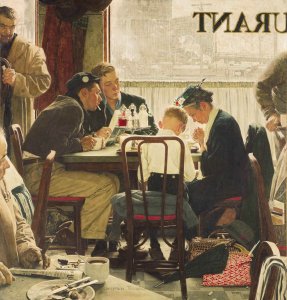
norman-rockwellOnce in a while, I long for the life I had as a child in a small town in western Nebraska. I loved that little town of Bridgeport. With a bicycle and permission from Mom, the whole town became our playground. The North Platte River was close by and we wandered for hours at a time in the river bottoms, oblivious to whose land we were trespassing on. On summer evenings the whole block was the field for a serious game of hide and seek. I remember shopping with my parents at the hardware store that was also the furniture store and the appliance store. There was one barber in town; Dad and I would walk down together to get a haircut. I loved the visits to the lumberyard, especially if it meant going back to the yard to pick out the boards Dad needed for some project; that’s where I learned to love the smell of freshly sawn lumber. The Rexall drugstore smelled like a drugstore and it’s where I bought comic books and magazines.  When I went to seminary to become a pastor, I imagined myself returning to such a place.

It hasn’t worked out that way. I’ve served my entire ministry — a few months shy of 30 years now — in the suburbs of major population centers. Deep inside, a mostly dormant longing is still lodged to return to a place like the place where I grew up. The longing becomes more acute when the frustrations and burdens of serving a large suburban parish overwhelm the joys and satisfactions of my work.

Years ago in one of those points of frustration and burden, I said to a clergy colleague and close friend (who had just retired from parish ministry, a point not irrelevant), “I’m going to resign my call and find a little church in the middle of nowhere.”

My wise friend responded, “No, you’re not. I know you better than that. That’s not who you are. You would go mad if you didn’t have the stimulation and challenge of the ministry that you’ve been called to. You have been called to this place for a reason. Stop yearning for a life that doesn’t exist except in your own mind.”

I think about that conversation a lot, especially the part about a life that doesn’t exist except in my own mind.

I think about that conversation with respect to the current campaign season. Listen to the candidates. The speeches start with a story of what things used to be like, and always the past is golden, a time when unions were strong or America was great. “Just elect me,” the storyline goes, “and we can return to that golden age.”

I think of that conversation with respect to the church. Congregations have been thrown into a state of anxiety as once prosperous and successful institutions look back on the glory years of the mid-twentieth century when they were strong congregations, pews and coffers and Sunday school rooms full. Now, struggling to keep their doors open, they hope that by calling a new pastor or getting a few new members they can return to the good old days.

Which, of course, is never going to happen. The world is different. The America of the mid-20th century which saw the US as an unrivaled global power, brought prosperity to millions of people, and saw the unprecedented expansion of the middle class doesn’t exist any longer. That we are no longer the America of the 20th century and cannot return to that time and place seems obvious, yet as a people, we talk not only as if that’s possible, but that it’s precisely what we need to do. (As an aside, access to that prosperity belonged primarily to white Americans.)

The symbiotic relationship of the church and culture that allowed churches to grow and enjoy substantial stability and institutional prosperity does not either exist anymore.

Bluntly speaking, get over it. We don’t live in the mid-20th century. That world doesn’t exist.

I wish our national leaders could speak honestly about the futility of nostalgia as as operating principle. I wish by some fiat, we could all agree that nostalgia might be a delightful way to spend an evening with family or friends, but it’s not a productive way to address the substantial challenges we face as a nation. I wish the candidates would give us their assessment of the challenges we face today and use their imaginations to articulate their version of policy to address those challenges. Of course, the polices on the right and left would look very different. But wouldn’t it be fun to debate actual solutions that take into account the nowness of our challenges and quit trying to repristinate a world that cannot exist anymore?

In the congregation I serve, mostly we have come to an awareness that 2016 is not the same as 1976 and that if we want to be part of God’s mission, we need to be different and do differently. It’s not to say there isn’t anxiety; there’s plenty of it. I still get people asking me why we have to change when what we’ve done has worked pretty well for us. Even folks who aren’t asking those nostalgic questions still long for the days when Sunday school rooms were packed, 150 kids showed up for Vacation Bible School, 60 kids showed up for the midweek kids’ programming, and the sanctuary was full for 2 services every Sunday. 

In letting go of the past, we open up space to look realistically and hopefully at the world we live in today. When we open that space, we find the energy to look — really look — at the unique challenges and opportunities in the present moment. Then we begin to think imaginatively about how we might address the challenges of the now.

In so many of the gospel lessons we’ve read this summer in our Sunday services, I’ve heard Jesus’ words in light of this lens through which we look at our mission and our challenges. When Jesus began his ministry, he set his face to Jerusalem. He went about his ministry with urgency, resolute determination, and a refusal to be distracted. When those he called wanted to go home and say good-bye first, Jesus cautioned, “No one who puts a hand to the plow and looks back is fit of the kingdom of God.” When he sent his disciples out two by two, he told them to look for welcome and then to stay as long there is work to do and then move on. When he taught his disciples to pray, he told them to ask that the kingdom come (present tense).  He told them to ask for enough bread for the day. There were no words about longing for the bread of the glory days, a sin which the Israelites perfected in their wilderness wandering.

I’m not suggesting that we disregard or dishonor the past. The saints of Faith Lutheran Church whose shoulders we stand on were faithful, energetic, and dedicated folks who established a vibrant ministry that has had an immeasurable impact on thousands of people and the community in which we serve. We can honor and give thanks for the past without attempting to recreate that past.

Like my own longing for my childhood home, there must be something deep within the human psyche that longs for the good old days. I happen to think that the good old days exist mostly in our minds, but even if they were as good as we remember, they aren’t coming back. The sooner we let them go and start really paying attending to the world of now and imagining how we might address the challenges of now, the better it will be for us, for the world, and for all of creation.

Postscript:  The notion of nostalgia as an operating principle for politicians is developed much more fully in The Fractured Republic: Renewing America’s Social Contract in the Age of Individualism, by Yuval Levin. I highly recommend the book. Written by a conservative scholar, the policy solutions Levin offers are not the ones I would support, but he is very fair and balanced in offering both critique and pathways forward for both Democrats and Republicans. He advocates for restoring the strength of mediating institutions, institutions like churches, synagogues, mosques, schools, and neighborhood organizations. This is precisely what the work of broad based community organizing does.