Author Archives: Jim Honig

Unknown's avatar

About Jim Honig

Lutheran pastor in the western suburbs of Chicago. I'm a writer, a runner, an avid outdoorsman, and a curious student of people and the human condition.

Called by Grace

Below is the written copy of a sermon I preached at the ordination service for Nate Sutton on Saturday, June 29 at Augustana Chapel on the campus of Lutheran School of Theology at Chicago.  Nate was the 2011-2012 intern at Faith.  He has been called to serve as Associate Pastor at Sharon Lutheran Church in Grand Forks, North Dakota.  Receiving such gifted young leaders into the church’s ministry is a sign of God’s rich and gracious provision for the church and her mission. It was an honor to be a part of the celebration.  The sermon is based on the gospel lesson for the Feast of Saints Peter and Paul, John 21:15-19image
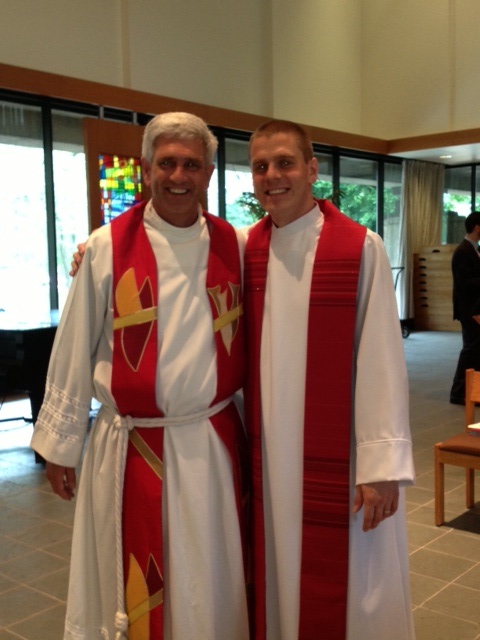
Today is the day of the ordination of Nate Sutton and the Feast Day of Saints Peter and Paul. They share this feast day because tradition holds they were both martyred in Rome on this day c. 64 c.e., although the time and place of their deaths and burials is an unsettled question. In many ways, Peter and Paul could not have been more different. However, one similarity is that at their call, they are both given a new name. Peter is the name given to Simon, and Paul was formerly Saul. So, in keeping with tradition, I’d like to propose that on this day, Nate, we change your name to Mary, thus giving us the rare opportunity to celebrate the Feast of Peter, Paul, and Mary.

Seriously, there is so much I want to tell you today, Nate. I want to tell you what it will be like, what to do, what not to do, what to look for and what to look out for. As your internship supervisor I had a whole year to do that and yet it wasnt enough! However, you have not asked me for advice; you have asked me to preach. So, a sermon on this gospel lesson will have to suffice.

You heard the story of one of the several post-resurrection appearances in John’s gospel. We got just a snippet, the tail end of a longer story where Jesus meets his disciples as they are back at work. He leads them to a miraculous, overwhelming catch of fish, and then fixes a campfire breakfast for them on the beach. After breakfast Jesus addresses Peter directly and individually, though not necessarily privately. Three times he asks him two versions of the same question , “Simon, son of John, do you love me more than these?” and then, simply, “Simon, son of John, do you love me?”

Each time, Peter answers, “Yes, Lord, you know that I love you,” the last time becoming impatient, even indignant, “Yes, yes, you know that I do, what do you want me to say?”

Of course, you students of Greek, will know that actually Jesus doesn’t ask exactly the same question. The first two times, he asks, “Do you love me, agapeo, unconditionally, purely, with the same love that the Father loves me and with the love that I love you?” Peter’s answer doesn’t exactly match: “Yes, Lord, I love you, phileo, a brotherly love, a mutual affection, deep, close friendship.” Only the last time do their verbs match when Jesus asks, Peter, not do you agapeo me, but do you phileo me.

“Do you love me, Nate?” “Do you love me Betty and Carl and Michelle and Robert and Amy?” No matter how we answer that, we know that our love for God is always conditioned by our condition — our brokenness, our fallenness, our ego, our need for attention, in short, our sin. Even what we do in Jesus’ name, for the sake of ministry, in answer of the call is tinged by the same fallenness. Sometimes I wonder why I do this work of being a pastor. Is it because of what I get out of it or because of the call of God? Why do I stand in the pulpit and preach, because I like being the center of attention or because there’s a fire burning in my bones?

Our love for God is always colored by our sin and brokenness. Peter’s love for Jesus was obviously imperfect, imperfect to the point of denial. Perhaps Peter was unwilling to go beyond committing to a brotherly love, knowing better than anyone what had transpired in the past several days.

Yet the call comes. The gracious call of our baptism, and now for you, Nate, the church’s gracious call setting you aside for ordained ministry. Jesus’ call through the church does not demand a perfect love on your part. It does not demand that you have fully purified your motives. It does not demand that you have attained a certain measure of love that sets you apart. It comes. By grace. It comes from God who has loved you, agapeo, unconditionally, decidedly, persistently, eternally. And in that love, you will do the work of ministry.

Speaking of the work of ministry. In each question and answer exchange, Jesus gives a charge. That charge comes in three different forms: feed my lambs, tend my sheep, and feed my sheep.

Ministry is feeding. It is sharing the Word; it is teaching and forming faith; it is administering the life-giving sacraments; it is visiting the sick and the imprisoned; it is comforting the bereaved and troubled.

Ministry is tending. Tending evokes some of the more tension-filled parts of ministry that may not be as pleasant, but are nevertheless necessary. Speaking to the context of the congregation of God’s people to whom you have been called of how brokenness and self-centeredness plays out. Saying that hard word about complicity in oppression about keeping the poor at arms’ length. Pointing out how we have turned our backs on the Crucified One for the sake of the gods of the economy.

Ministry is relating. You know this, Nate. You have learned and practiced and committed yourself to this way of doing ministry. Ministry is not just knowing the names of the sheep, but knowing their story. Sitting down with them and asking the pointed questions, knowing what they are concerned about and what they are energized about so that the work of ministry is done by a true community and not by a collection of individuals. And it is relational ministry with those who may not even be acknowledged members of the flock, but are, nonetheless, sheep whom the shepherd loves.

After this exchange between Jesus and Peter, the text takes a decidedly negative turn. Jesus predicts a life of suffering and a difficult death. Jesus does not candy-coat his call to Peter.

I’ve wondered what to think about that and what to say about that on this occasion of your ordination. Of course, it was an option just to ignore it. After all, we rarely preach on every section of every text in every sermon. Yet, there is something important here.

In calling Peter, Jesus established the expectation that there would be suffering. According to church tradition, Peter met a cruel and violent death by crucifixion. Though it’s unlikely that your ministry will follow that precise pattern, I can virtually guarantee that there will be times of pain and discouragement, times when you feel abandoned by God and by the church. You have been nurtured in Mother Church, and today the whole church is shining its lovely and encouraging face on you; but it will not always be like that. Mother Church can be nurturing and loving, and she can also be harsh and cruel.

Strangely enough I say, embrace those times. Contrary to what the world says, embrace those times of suffering and discouragement and failure and pain. The world says that we should avoid suffering at all cost. But suffering is an inevitable part of life. In suffering and pain and discouragement, we learn the most valuable lessons. As you know, Nate, there are parts of my ministry that have been very painful. I would not wish those things on you or anyone. Yet as I reflect on my own journey, those have been times of deep growth — in faith, in my vocation as pastor, and in my connection to community. Why should I be surprised? It’s biblical. It’s the pattern that has been set. We follow a crucified savior. Not only in the lesson we read today that comes from the end of Paul’s life, but permeating his entire epistolary corpus is this theme that God’s grace worked through Paul’s own suffering. In suffering, our wisdom is refined, our skills are honed, and most importantly, we come to realize that the sufficiency for ministry is from God and not from us. We do, after all, have this treasure in jars of clay.

Nate, you are an extraordinarily gifted young man. Bishop, you will discover what a gem your synod has received, Dave and Ardis and all of your fellow members from Sharon Church in Grand Forks, you will quickly discover what a blessing this young pastor will be to you and your community. I have every expectation that you will become an exceptional leader in the church. But the ministry that you do will not be rooted in your gifts. It will be rooted in the love of the savior that calls you in spite of your imperfect love and imperfect motives. It will be rooted in the promises of God for the people you serve and for all of creation. It will be rooted in the death and resurrection of Jesus the Christ and of God’s intention for the Spirit to be moving in the church and in the world. It will be rooted in the foolish proclamation of the Word and of God’s foolish intention to work God’s grace through water and wine and bread. Your gifts will merely — and I use that word very intentionally — merely the vessels through which God’s work gets done. In short, your call and ministry flow from grace.

After this, Jesus said to him, “Follow me.”



Mike Huckabee: “Jesus Wept.” Really?

I was elated yesterday when I heard the news reports that the U.S. Supreme Court had struck down the Defense of Marriage Act, arguing that it unduly discriminates against legally married same sex couples. But my elation so quickly was tempered when the same program reported that after hearing the news, Mike Huckabee tweeted, “Jesus wept.” I can’t write my first response here. It was full of bile and name-calling. I’ve found that such and emotional reaction isn’t very helpful for me or anyone else.

Mike Huckabee is the master of the cleverly worded sound bite. So, to take this relatively famous and well-known passage, lift it from it’s biblical context, and insert it into another completely different context would, of course, speak to his constituency.  But it’s patently dishonest and uses Jesus’ own words in a way that I think would make Jesus weep.

When Jesus wept at the tomb of his friend Lazarus, I think he was weeping not primarily  over the death of his friend. After all, momentarily he would call forth the corpse from the tomb. I think he was weeping at the cumulative brokenness of the human condition, a brokenness that eventually ends in death for all of us; I think he was weeping at the separation that our brokenness causes between us, a separation over which we grieve not only at death, but all along the journey of life. Because of our separation and brokenness, we experience untold suffering, individually and communally. I can imagine Jesus already outside Lazarus’s tomb weeping over the weight of human sin and all of the injustices we inflict on one another.

So, to say that Jesus wept at the Supreme Court’s decision yesterday rings hollow. In my own understanding of the Christian faith, it’s wrong. In fact, if Jesus was weeping, he would have been weeping at the brokenness that results from laws that stand in the way of allowing loving, committed couples from enjoying the same societal benefits of marriage that heterosexual couples have always enjoyed. And if Jesus was shedding any tears yesterday, I think they would have been tears of joy that finally, the law has fallen down on the side of equality, love, justice, and commitment.

A Whole-Hearted Endorsement from a Reluctant and Stubborn Participant

A Review and Endorsement of the Grace Institute of Spiritual Formation

Countless times, I look back on formative experiences in my life that I’ve only realized were formative as I look back on them. I’ve had that experience over and over; I find that the transformative nature of an experience is not immediately apparent, but only becomes clear after the fact. I’m guessing I’m not unusual in that sense.

The last two years, I participated in 8 two-and-a-half day retreats with the Grace Institute of Spiritual Formation. The Grace Institute promotes itself as a program “designed to immerse participants in core Christian spiritual practices,” with the goals of “deeper personal spiritual formation and development of skills in leading small groups in spiritual practices.” For years I had been getting the brochures and harbored some mild interest; a couple of times I even inquired about the cost and the timing of the retreats. I knew at some gut level that it could be an important and expansive process for me. I’ve always struggled with a regular prayer life. Probably even more significant, as my faith has matured and my theology and understanding of God have developed, I have come to see that prayer has to be more than a daily shopping list that I lay before God; I just hadn’t been able to figure out how to get out of that mold. I read books about prayer, but nothing seemed to grab hold.

In the spring of 2011, I took the plunge and registered for the two-year experience that was to begin in August.

I was not the most cooperative and malleable participant. I missed the first retreat because it happened to fall while family was staying with us, family who we only get to see for two days a year; they live in Europe. Every time the retreat came along, I was crabby about it. They came at the worst times. By the time the two years came to an end, I realized that in my overly busy and scheduled life, leaving for two and a half days was never convenient, a pretty significant learning in itself.

At most of the retreats my recalcitrance softened by breakfast on the morning after the opening of the retreat, and I was able to be present for the retreat. Part of that was the support and grace of my covenant group. At the beginning of the experience, each participant is put into a group of 6-8 that serves as the experiential core of the entire two-year process. What is learned in the classroom is talked about and practiced in the covenant groups. I felt like I was the least practiced pray-er in my group, but they handled my stumbling, my doubts, and my questions with genuine grace.

Each retreat has a different theme, and readings are intended to be completed prior to the gathering. For the most part, I did the readings between sessions; mostly, they were helpful. Each retreat incorporated 3 or 4 classroom-type presentations, mostly helpful, of variable quality, though always engaging. The variable quality shouldn’t be surprising or alarming in a two-year course. In fact, as one would expect, within our own covenant group, we often disagreed about the value and quality of the presentations. We we always all in different places. Some of the material went over territory I had traversed before. Some of it was new. Some of it was just so far outside my experience and my comfort zone that I found it difficult. Some of it I was able to incorporate and begin practicing immediately. Some of it, I’m still trying to learn and wonder whether I ever will. Worship was an integral part of each retreat, always well-done and always meaningful. Brad Hansen, a retired religion prof from Luther College, one of the founders of the Grace Institute, a wise and practiced man of prayer, had a presentation at most of the retreats. I would have been fine if Brad had been the sole presenter at every retreat. He is solid, empathetic, and speaks not as one who has arrived, but as a fellow pilgrim on a long journey.

I realize now that I entered the program with some pretty unrealistic expectations. I hoped for an kind of a fix-it approach to my struggling prayer life. Yeah, I know. Kinda dumb. Thankfully, I didn’t get that.

I left the last retreat with mixed feelings. There was no question that I was glad that I had participated. I had learned much. I had grown in my prayer life. I had learned and experienced things that would have been difficult to ever get to, except in the context of away from home experiences. I have always lived in my head; the heart and soul stuff has been much more difficult for me, sort of like a right-handed person being forced to write with his left hand. I’m not sure I would ever have gone to some of these places were I not essentially forced to and had not only guides, but companions. At the end, I didn’t feel a sense of closure. I had started something, and didn’t feel like it was finished.

Of course. That’s the point. This journey into God is not a destination; it’s a journey. It’s almost two months since that last retreat;the dramatically formative nature of the experience is only now beginning to settle in. Deepening my prayer life has never been as important to me as it is now, and I’m discovering that I have been given the tools that are serving me well in that work. I’m on sabbatical now, with the goal of continuing to deepen my prayer life. And it’s happening. Had I not had that two-year experience of formation, I’m not sure I would even know now to go about it. But I do. And I am. And it makes me so deeply, deeply grateful for that experience. I finally feel like I have gotten out of this stuck place in my prayer life. I am learning, albeit still somewhat stubbornly, reluctantly, and stumblingly, that there are riches of life with God that are just now opening.

What I see now is that Grace Institute was not intended to carry me to a destination, but to serve as a guide and companion for beginning the journey. How deeply grateful I am that I did not get what I was looking for, but it appears, just what I needed.

(More specific information about the Grace Institute for Spiritual Formation can be accessed on their website: http://www.luther.edu/graceinstitute/ )

Learning How to Be Good

Recently I listened to an interview on NPR with country music superstar, Tim McGraw. As another new album comes out, the interviewer prodded McGraw to reflect on his career. When asked what it was like to be at the top of his game, McGraw reflected, “I feel like I’m just learning how to be good.”

His response had the ring of authenticity in my ears. There was an honest recognition of his talent and success, and the truth that he’s looking into an unknown future and still trying to figure it out.

In the past couple of months, I’ve had occasion to step back and reflect on where I am in my own vocation as pastor. Part of it was preparing for the sabbatical that I just began. Where I am? What do I need right now? If I’m going to continue doing this until I retire, what will give me energy and motivation and that fire in my belly to keep going for another 15 or so years?

On the one hand, I have some sense that this vocation has been a good use of my gifts. In general, I think I do this work pretty well. I think I started out with some natural ability. But as in most vocations, natural ability can only get you so far. My natural curiosity and love of learning has helped me get better; I’ve learned both from experience and from books, workshops, seminars, and the like. Some things I do very well; some things I’m just not that good at. Part of my effectiveness, I think, has been to acknowledge that, find ways to do more of the things I’m good at, and find others who are good at the things I’m not.

It also has to do with watching my son, Chris, at the very beginning of his pastoral vocation. He just graduated from the seminary and is awaiting his first call. We’ve had many conversations about his own preparation and how it was different from mine, and about his own sense of call and the kind of work he feels called to do and the things he thinks he’s good at. I don’t know how objective I am, but I think his training was much more sharply focused on the blend of callings in the pastoral ministry:  local theologian, equipper for mission, and seelsorger (one who cares for souls). I think his training was much more realistic about the church that he will be serving and its place in the world.

I’ve often quipped with Chris that I wish I knew when I was starting out what I know now. I would have been pretty good.  But that’s the way it is. You don’t start out knowing everything. You learn as you go. What you’re good at, what you’re not. It was even a pretty significant learning for me to be able to admit publicly that there were some things I’m not very good at. You learn as you go how to integrate the learning from books and conversation and observation and messing up and continuing education into the actual practice of pastoral ministry with the people in the place you are called to serve.

If I can echo the words of Tim McGraw and say that I’m good at this work, I feel that,  like him, I’m only beginning to learn how to be good at it. And I’m afraid that moment when I feel like I’m the best that I could be it will be the time to call it quits and walk away.

But I’m not there yet. I’ve got too much yet to learn.

Phone Surveillance — We Can Do Better

I’m disquieted at the recent revelations of the U.S. governments massive surveillance of the phone logs of hundreds of thousands of Verizon customers.

Yes, it’s an invasion of privacy, but that’s not what bothers me so much. In this electronic age when so much of our lives are spent on-line, I’m realistic about the fact that there are many “thems” out there that know way more about me than I care to think about. Still, I go on-line.

Two things are particularly troubling. First, that it has all been couched in secrecy. We know only because someone leaked the information. Now after the horse is out of the barn President Obama says something about hoping that this incident will foster a healthy conversation about the tension between privacy and security in our country.

Why not have the conversation when the program was proposed? If it’s so good for us, then make the case and let’s have the debate beforehand instead of after when the conversation is prompted by an “Oops!” I find no consolation in the news that Congress knew about the program. Why didn’t the rest of us?

When what is done in secret is revealed mistakenly, it does nothing to further a sense of trust in our leaders. A certain measure of trust is required for the healthy exercise of democracy. When that trust if violated, particularly when it’s violated over and over, trust is replaced by suspicion and, worse, cynicism. Suspicion and cynicism are corrosive to our life together.

Here’s the other thing that is even more troubling. Not only does this secret surveillance program foster a sense of suspicion but it’s another way of telling us that we need to live in fear. “This is for your own good. There are bad things out there and we are just trying to protect you from them. You need us. Trust us. What little privacy you give up brings a hundredfold gain in security. It’s a terrifying world out there.”

This is not how mature societies operate. This is how societies that are falling into authoritarianism operate. It is not symptomatic of healthy, functional societies to teach their citizens to fear all the bad stuff out there and to be suspicious of the neighbor, because, you never know — the person right next door to you may be a terrorist. The more authoritarian a government becomes, the more it has to function on a fearful citizenry.  As citizens, we ought to be both skeptical and critical of any moves by our leaders that teach us to live in fear and that we need them to keep us safe.

I’m disappointed because I don’t believe this is God’s vision for how we ought to live together. The vision of the kingdom is where people live together in trust and a sense of acting for the common good, where there’s a mutual respect and care for one another. We all take responsibility for that; it’s not the king’s job; it’s the citizens’ job. In the community that we yearn for, we are not taught to distrust our neighbor; instead, we are compelled to live in relationship with our neighbor.

The Wisdom of Restraint

I think I first read Aldo Leopold’s A Sand County Almanac when I was in high school. I took a science elective course in Ecology which turned out to be one of the best classes I’ve ever taken. Shamefully, I can’t remember the teacher’s name, but I’m wondering if he took a clue from Leopold in the way he conducted the class. Sure, we had to read a textbook and understand principles of ecology, but regularly he took us out in to the prairies, the forests, the marshes and bogs so we could experiences the ecosystems up close and personal. He was encyclopedic in his ability to identify the flora around us; he shared that knowledge with us and taught us, as well, the wisdom of being on a first-name basis with the plants and animals.

The first part of A Sand County Almanac is like that. Leopold was a forester, working in the early stages of his career for the U.S. Forest Service in the teens and twenties. He eventually went on to teach at the University of Wisconsin where the university established a chair in game management for him. While he was at Madison, he bought a farm and spent weekends and summers there. He chronicles the natural life of his farm, month by month, isolating, identifying and commenting on the birds or mammals or plants or trees, their behavior, their place in the ecosystem, and how it’s all interconnected.

I’ve found that familiarity with what’s around me in the natural world to be important to my own sense of connectedness with the natural world. It somehow seems to make a difference to be able to walk in the woods and recognize a Bloodroot or a May Apple. My sense of kinship with creation is enhanced when I can tell the difference between a hickory tree and a red oak. There is no joy like the joy of recognition.

Included in most editions of A Sand County Almanac is a collection of essays on a variety of topics related to the care of the natural world. As many times as I’ve read the the almanac, I don’t know that I’ve ever read the essays. I had no idea what I was missing. I found his words, written in the 1940’s for the most part, to be both wonderfully and troublingly prophetic. He foresaw both aspects and root causes of the crisis we now call climate change.

Among the many pertinent observations, one of them struck me as important for the contemporary crisis. He references a scene in the Greek tragedy, The Odyssey; Odysseus comes home and hangs on a single rope a dozen slave girls whom he suspected of misbehaving while he was gone. The Greeks had a highly developed moral code, but his action was still regarded as within the bounds of proper behavior because the servants were seen as property, chattel to be done away with or not depending on expediency.

He goes on to use this scene as an analogy for the relationship of human beings to the land. As long as we regard the earth and resources as property, we will continue to see our home as things to be used or not depending on what we need or want.

Our entitlement attitudes are so deeply entrenched; our environmentally abusive behaviors are so woven into the fabric of our lives. We continue to behave towards the land as if its a commodity, something solely for the sake of our own utilization. We’ve tended to view the use of resources purely in economic terms. What’s there is ours to use as long as its furthering the advance of human progress. Humankind is the one species that has the capability to radically alter the created world. Over the millennia, we have forged out a pretty life for ourselves, all things considered. But with all the advances we’ve made in technology, the one aspect of wisdom that we do not seem to have developed is restraint.

Barry Lopez eloquently comments on the same theme in his classic, Arctic Dreams:

Because mankind [sic] can circumvent evolutionary law, it is incumbent upon him. . .to develop another law to abide by if he wishes to survive, to not outstrip his food base. He must derive some other way of behaving toward the land. He must be more attentive to the biological imperatives of the system of sun-driven protoplasm upon which he, too, is still dependent. Not because he must, because he lacks inventiveness, but because herein is the accomplishment of the wisdom that he has aspired to. Having taken on his own destiny, he must now think with critical intelligence about where to defer.

I’m acutely interested in the environmental crisis from the standpoint of faith. Is it possible for the church to have a role in changing behavior? From a theoretical and theological standpoint, the answer ought to be “yes.” The earth and it’s resources is yet one more gift of a loving and gracious God, given or our use and enjoyment, but also given with the responsibility to care for it well.

In faith communities, we’re used to talking about restraint for the sake of our human neighbors. We give up some of our money, for instance, to care for the poor. This is an exercise of restraint. We don’t spend all we can so that we can share with others.

We’re not so used to talking about restraint when it comes to how we care for the earth. We do because we can. But it’s a value and a practice whose time has come, a way of living that we’ve got to embrace. We are all connected. We exist in a relationship with the world around us and it’s time to start seeing and talking about our place in relational terms. Indigenous peoples have known in and lived it for a long time. In the West, we have mostly lost that sense.

I really do think it’s possible for people and communities of faith to make a difference. After all, relationship is a the heart of who we are and who we live. If God is going to do something new with regard to caring for the earth, then we can start by behaving in a way toward that land that sees our place in relational terms.

Come, Holy Spirit, Come

acornIn exactly 15 days, I will check out of my office and walk into the doorway of sabbatical. Four months. No sermon writing. No staff meetings. No evening meetings. No hospital calls. No funerals. No newsletter articles. No proofing the bulletin. No teaching bible classes three times a week. Four months.

I’m not sure what to do.

Twenty-six years ago in June, I was ordained into pastoral ministry at St. John’s Lutheran Church in Arnold, Missouri. I had been training both academically and practically for four years; pastoral ministry was something I had been looking forward to even longer than that. I was ready.

Yet I remember feeling anxiety about the unknown. I was supposed to know what to do, but would I? Would I be any good at it? Would there be a sense of joy about this vocation? It was going to be so different than school, and I had been in school for so long. I remember that last semester of seminary being so busy — not only finishing classes, but all the paperwork and arrangements that had to be made with regard to graduation and ordination and receiving that first call. And then, boom. I was a pastor. Feeling like an imposter.

In these last busy day before my sabbatical — days filled with long to-do lists —  I’m experiencing some of the same feelings. I have been looking forward to this for so long. Along with my own preparations, the staff and leadership and whole congregation has been preparing for me to be away for four months.

On the one hand, I am ready.  I’m excited so about it. I’m looking forward so much to being able to step away from the routine, to read and study, to write, to pray, to spend time in the created world. And honestly, I’m really looking forward to four months without any meetings in the evening. (Did I mention that already?) I have been planning for more than three years, and the things I plan to do will, I think, bring a great sense of refreshment and renewal.

Yet, I am also anxious. Similar to that anxiety of my first call, I’m also experiencing a little of the anxiety of the unknown. Because I have never taken a sabbatical, I don’t know what to expect. Is there a right and wrong way to do it? Will I be any good at it? Will I experience that sense of joy and refreshment that I am so longing for?

A colleague who not only has taken several sabbaticals, but has written the manual for sabbaticals used in many Christian denominations, recommended that I pick up Wayne Muller’s book, Sabbath, and read one of the short chapters each day for the first 30 days just to get myself conditioned to the whole notion of sabbath. I plan to take that advice. (Thank you, Dick Bruesehoff.)

When I was on my internship, my supervisor told me, “Remember, Jim. Pastoral ministry is a marathon, not a sprint.” It was his way of saying, “Pace yourself. Don’t spend all that youthful energy in the first few years only to get burned out and have to quit the race.”

When I run marathons, I have learned that one of the most important keys to finishing the race is to plan strategically short intervals of walking. At each aid station, I usually grab a cup of water, run for another 50 yards or so, and then just walk for a minute or so while I sip that cup of water. It’s amazing how one can feel replenished in such a short time.

This sabbatical feels a little like that in the long marathon of a pastoral career. I will be 53 this summer; I observe 26 years of ministry in June. I have probably somewhere in the neighborhood of 15 years of ministry left, deo volente. I see this as an important interlude of refreshment and recharge for the next 10 years. I’ve learned over the years that one of the important pieces of preventing burnout is to find new things to be excited and energized about. I expect that also to happen during this time. There are several things that I want to explore about the church, pastoral ministry, and integrating spirituality into my own life as a pastor and into the life of a congregation. I will read and I will write, and I will have the time and the space to reflect.

At this point, I am trying not to be very rigid in terms of expectations. I am going to try simply to experience things as they come, and trust the Spirit to lead me to paths of refreshment, renewal, and visions for ministry that will bring new life to ministry when I return.

In these few days leading up to the Feast of Pentecost, my prayer takes on new meaning. Come, Holy Spirit, Come.

A Review: Welcome to the Wisdom of the World

chittisterTwo confessions: First, I love Joan Chittister. Anything she’s written. I love. She could write about NASCAR and I would love it. (Ok. Maybe not NASCAR.)

Second, I’ve come lately to acknowledging the value of wisdom received through other religious traditions. I grew up in a very conservative Lutheran tradition that taught me that all religion outside a narrowly defined orthodox Christianity was not only misguided but was mistaken. With horrible eternal consequences. In that economy, what value could there be in poring over the sacred texts of other religions in an attempt to learn from them and to gain from the accumulated wisdom?

The migration out of my own narrow box has been slow and gradual. After 9/11, I realized that I knew so very little about Islam. So I read Karen Armstrong’s little volume, The History of Islam. Almost 10 years into my ministry, as a member of the ministerial association in Naples, Florida, I got to know the local rabbi; believe it or not that was my first encounter with Judaism (unless you count the New Testament!). Somewhere in there came a conversation with a friend who had spent years in Hong Kong; she thought I might enjoy Jesus and Buddha, by Thich Nhat Hanh, so I read that one and a couple others of his. In my work with community organizing, I’ve developed relationships with several Muslim congregations and their leaders, but I’ve never spent much time talking theology with them or about the wisdom that flows from their tradition. Hindus? I haven’t a clue.

So, over the years, I’ve come very gradually to appreciate the authenticity and truth in other religions and have established some good relationships with faithful people who live out their lives as God’s children in a different way. Still, delving into the unique wisdom that flows from the various religious streams has never been a passion for me. Mildly interesting, but not a passion. I have a hard enough time incorporating into my life the wisdom of my own tradition, much less that of others.

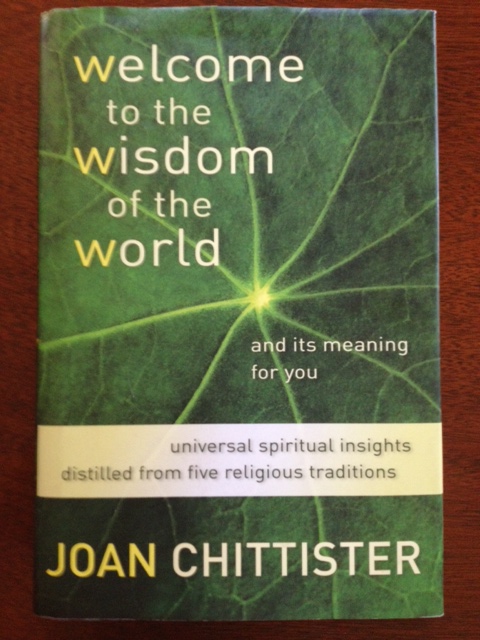
Enter Joan Chittister. (Did I mention that I love Joan Chittister?) Several years ago, I picked up what at that time was her relatively new book, Welcome to the Wisdom of the World. The subtitle reads, universal spiritual insights distilled from five religious traditions. That it sat on my shelf for a few years before I actually got around to reading it reinforces what I’ve already said, delving into what other religions have to say has not been a passion for me.

Last month I finally read it. Am I ever glad I did.

The premise of the book is to let the wisdom of five traditions — Hinduism, Buddhism, Judaism, Christianity, and Islam —  speak to the fundamental questions and challenges of human life. She doesn’t deal with the wisdom of the religious traditions in a theoretical fashion, rattling off the main points of each tradition. Instead, she accumulates a long list of life’s persistent questions, and then lets a particular tradition speak to a particular question.

Each chapter deals with a single question, and each chapter follows a standard format. Open with a story from someone whom Chittister has known in her long years of ministry; fashion some commentary that lets that real life story speak to the reader; tell a story from the sacred text or the oral tradition of that religion; make some comments anc come to a conclusion. The story and Chittister’s subsequent commentary on the story is where the real pay-off comes. That’s where the wisdom gets appropriated and opens up possibilities for how it might work for the reader.

For instance, over the last couple of months, I’ve been faced with some pretty big decisions. I’m not sure I do that well with big decisions, and I seem to spend too much time wondering if I did the right thing. In this case, she lets the Buddhist tradition speak to the question, “How do I know the right thing to do?” The wisdom hit home for me; there is no such thing as making the right decision. There is only the truth that I cannot be anything other than who I am. And when I make these big decision, I am making them as who I am. I can do no other. Since nothing in life is permanent, I can give up the need to label decisions right or wrong. “What is right is only that which must be done at the present moment, even when we are not sure exactly what that is. It is about living the best we can in circumstances that demand more than what we have at the ready.”

I have a hunch that this little volume will not be collecting dust. FIve religions; five chapters devoted to each religion, each dealing with a different question, and then five chapters of conclusion, summarizing the wisdom of each tradition. Feels a little like an introduction to world religion, except that the classroom turned out to be my own life.

In Honor of Boston

running shoesI am a runner. Not a very good one, but a runner, just the same. For a long time, I’ve been a runner. I started as a really lousy cross country runner in high school in the 70’s and for most of my life, I’ve been a runner. Lousy. And persistent.

A few years ago, at age 47, I accomplished one of the top items on my bucket list. I finished a marathon. Not fast. Nothing to write home about. I simply finished.

And I cannot describe in words the exhilaration I felt when I crossed that finish line. No matter how you slice it, 26.2 miles is a helluva long ways. It seemed to me superhuman. I am not superhuman. And yet I did it. The Green Bay Press Gazette will attest to the fact that I indeed crossed the finish line. In four hours and sixteen minutes.

In fact, that exhilaration is the very reason that I’ve run 5 more marathons since then. I don’t really enjoy the training. I don’t really enjoy the race. I exult in the feeling of accomplishment when the finish line stands behind me. Crazy, huh? That I would endure 16 weeks of hard training and four and a half hours of hell just for those fleeting moments of exhilaration? Yet, I speak the truth. All of that for a brief moment of accomplishment.

So, the news of the bombings at the Boston Marathon touched me deeply. I think about my own wife and son cheering me on at the finish line just outside Lambeau Field. I think of what has felt for me like the triumph of the human will and spirit. And how that was brutally stolen from so many people today.

I decry the violence. I decry the loss of life. I’m sad at the many injured whose lives were changed in a single moment today.

Yet strangely, I am equally saddened at this attack on the human spirit. There is something unique about those who aspire to this extraordinary feat and who accomplish it. It’s not necessarily about speed. It’s not necessarily about competition. It’s about setting out to do something that on the surface seems crazy, impossible, beyond the bounds of human capacity. When I first told our parish nurse that I was training for a marathon, she replied, “Human beings were not meant to run that far!” And yet we do. We find a way.

For me, that’s what evil attacked today. Not just human life, but the human spirit.

I will not give in. Tomorrow, I’m going to discover the next marathon I’m going to run in. I’m going to go for a long run tomorrow in honor of those runners who did not get to finish and those spectators who were injured and in memory of those who lost their life.

And I am resolving once again to honor what I believe is wonderful in the way God has created us: to aspire, to work, to train, to accomplish, to push, to use these wonderfully created bodies for good and not for evil.

And in the morning when I run, this will be my anthem (thanks to Bishop Desmond Tutu):
Goodness is stronger evil;
love is stronger than hate;
light is stronger than darkness;
life is stronger than death.
Victory is ours, victory is ours,
through Him who loved us.

An Open Letter to John Kass

marriage equality icon(This post is in response to an editorial by Mr. Kass that appeared in the March 27 issue of the Chicago Tribune. Unfortunately, that column is currently available only to Tribune subscribers.)

Dear Mr. Kass,

I’m a Christian pastor. In my tradition it’s Holy Week; I should be working on sermons.

But your editorial this morning captured my attention. My response is not borne out of intolerance, but out of conviction and a genuine hope for dialogue.

First, let me thank you bringing several matters to public expression. I’m grateful for your willingness to articulate the position that your religion is deeply felt, deeply important, and deeply influential in your understanding of marriage and gender matters. I think for a lot of people, religion does play a role and as a culture, we’re all better off to acknowledge that.  Our founding fathers insisted that the government cannot show a preference for any one religion over another. They did not mandate that our faith has to be checked at the door when it comes to issues we care about.

I thank you for your moderating voice, that you speak not out of anger, but out of conviction. Me, too. I’m not angry. But I do hold my position out of a place of deep conviction.

I thank you for raising the matter of religious freedom as a laudable goal in this dialogue and debate about marriage equality. You have suggested that were the Supreme Court to issue decisions that would allow gay and lesbian persons the legal designation of marriage, that it would feel like the court was severely limiting your religious freedom.

Here’s where my gratitude dissolves into disagreement and the hope for dialogue: I fail to see the logic of your position. By allowing same sex couples to marry, the court would not mandate that you agree with the position or practice, sanction it, or become the agent of those unions. They would simply allow those who wish to make that covenant and to bind themselves to each other with a legal agreement the freedom to do so. I fail to understand how that impinges on your religious freedom.

I’m also puzzled by your association of same sex marriage with sin. I agree that our post-modern culture’s propensity is to let everyone decide what’s right and wrong based on what’s right and wrong for them; that’s problematic for me, too. But I disagree that the action of two people committing themselves to one another for life in an exclusive relationship of love and trust is “sin.” Where sin exists, let’s point it out and hold one another accountable for it; but let’s not call committed love “sin.”

For what it’s worth, I don’t think you’re a “drooling white bigot of the Jim Crow era” for holding to your convictions. In the same fashion I hope you won’t consider me a liberal antinomian who is unwilling to set limits to any kind of behavior. I’m not. I, too, consider myself a traditional Christian. And the moniker of traditional Christian probably allows for a broad spectrum of views on many issues of morality.

Traditional Christians hold the bible in high regard. You obviously do, and so do I. Yet throughout the centuries Christians have looked at the bible and found the support for lots of different views about lots of different things. In the Old Testament, it’s difficult to find any correlation between the ancient practice of marriage and our own cultural definition of marriage. The practice of men taking many wives was commonplace; we have declared that illegal. Married men were freely given sexual privileges with servants; we consider that deeply immoral. (Just ask Arnold Scharzenegger.) To me, it’s difficult to find a rationale for our cultural view of marriage based on the bible. If we want to say that marriage equals one man and one woman and there can be no variation from that, then ok, let’s say that. But let’s be clear that it’s our cultural decision and that it’s not based on the bible. And to be clear, I believe that position to be an unduly exclusive understanding of mutual human love and the drive we have to commit ourselves to one we love.

For the church and “traditional Christians” to be making pronouncements of such certainty about same-sex marriage troubles me.  Institutionally, we have a long history of being wrong in the very instances where we have insisted we have been right. (Take slavery and the role of women as two instances.) I’m not saying we shouldn’t have convictions. I’m just saying that when we do, we should hold them with a healthy dose of humility and an honest admission of our brokenness and fallibility. If you take a look at Jesus’ ministry, it was the institutional “church” that comes out looking like the villain.  It was tradition that Jesus had in mind when he expanded the understanding of ancient laws when he gave the Sermon on the Mount. “If the law says, you shouldn’t kill, I say you break the law when you hate your brother.” “If the law says, you should not commit adultery, I say you break the law when you even look at a woman with sexual longing.” Jesus was willing to sully his hands and his reputation by associating with those who were considered outsiders. He consistently expanded the reach of narrowly defined behavior to include much broader matters of the heart. His ministry was about expanding the understanding of who was included in the big thing God was doing in the world.

So, why not expand the boundaries of who’s included in this construct we call marriage. After all, when you boil it all down, it’s not about gender, is it? It’s not about body parts and how they fit together, is it? It’s about a committed, covenantal love that publicly pledges the exclusivity of love and faithfulness. And when we look around us and see examples of that, we are all strengthened, regardless of whether those promises take place between a man and a woman, a man and a man, or a woman and a woman.

So, I hope you won’t consider disagreement and putting forth a different view intolerance. I cherish the opportunity for dialogue. And I’m sure you’re eager to extend the same tolerance that you long for to traditional Christians who may hold a different view with the same sense of conviction with which you hold your view.

Pr. Jim Honig
Senior Pastor
Faith Evangelical Lutheran Church
Glen Ellyn, Illinois
630.469.2361