Author Archives: Jim Honig

Unknown's avatar

About Jim Honig

Lutheran pastor in the western suburbs of Chicago. I'm a writer, a runner, an avid outdoorsman, and a curious student of people and the human condition.

Reflections on a Church Picnic

picnic2To look at the event from the outside, it didn’t look like anything very special. It was a church picnic. We grilled some hamburgers, brats, and hotdogs. We planned some activities. We brought some food to share.  In fact, to look at the event from the perspective of the weather, its kind of surprising that anyone showed up at all. In the time leading up the the publicized starting time, the skies looked ominous, and there were sprinkles. It looked so threatening that at the last minute, we decided to move the tables for eating into the building. We bought meat to grill for 100 people, and we began to wonder if there would be 25.

O ye of little faith.

They came, they came, and they kept coming. By the time we finished cooking (and a quick trip to the nearby supermarket to replenish the repast), almost 150 came. The energy in the room was high. The conversation was exuberant. The crowd spilled out the doors of the building out onto the patio where, even though no tables were set up, folks found a place to sit, eat, and enjoy each other’s company.

And it wasn’t just one group in the congregation that came. People who have been members for 40 years came and people have been here less than a year came. The young, the old, the greatest generation, the millenials, families with kids, couples with no kids. It was an astonishing mosaic of the people of Faith.

What happened after dinner was even more amazing. We wanted to get together for no other purpose than to celebrate God’s presence and action in our congregation. So, the plan was to have fun and play. When it was time to play, we invited everyone out onto the lawn and got them in a circle. We played a silly game that invited people into saying silly words and doing silly actions. People did it! The laughter and silliness going around that circle became infectious. Even those who didn’t join in the game began to draw in close just to watch and vicariously join in the antics.

After the circle game, the game leader invited us to find a partner — someone not the same age as you, he said. My partner was Avery, a rambunctious first grader (give or take) who had written on his name tag, “The Mayor.”  So, upon the direction of the game leaders, The Mayor and I got into the parallel lines facing each other when they began handing out the water balloons and the raw eggs. Yep, we did that. The luck of the draw gave The Mayor and me an egg which we proceeded to toss back and forth. The Mayor was astonishingly lucky; I don’t think he caught the egg once, but the soft grass kept on preserving the egg. Until it cracked on one of those tumbles into the grass and then broke when he tossed it back to me! But no worries, it gave me a chance to stand back and watch the remarkable thing that was happening as the young and old embraced this play together.

After the games, we formed a new assembly on the driveway. One of our staff members climbed a step ladder and feigned a game of Simon Says. In reality, was teaching the crowd a series of dance steps. By the time she made the reveal, everyone was having too much fun to opt out.  Yep, we did that, too. We danced on the driveway. Pherrel’s Happy blaring in the background. We wouldn’t win any dance competitions, but did we ever have fun.

Yhttp://www.youtube.com/watch?v=u-TUJKd1Szc

A few things have stayed with me in these days since that gathering. We probably don’t get together enough for no reason. Most of the time we invite folks together, there’s an agenda: we’re celebrating the arrival or leaving of a pastor, we have business to do, we need to ask for money, there’s something we want people to learn, there’s music to listen to or a new program to introduce. In this case, we invited people to come together and explicitly told them, “We are getting together for no other reason than to celebrate God’s presence and activity among us and to enjoy one another’s company.” And those who gathered embraced that agenda with extraordinary enthusiasm.

At one point, I stepped back from the circle of silliness and just watched. I became choked with emotion as I began to wonder, “Where else does this happen?” Where else will you find the young and old and everyone in between, people who are not bound to each other by family ties, engaging in that very necessary human activity of play? Yes, in our culture we play softball and futbol and basketball, but that’s very different. Those are competitive activities that require some skill. We were playing together in non-competitive, no-skill-required fun that was packed with silliness besides. There’s something to be said for that, and we’d probably all be better off were we to do it more often.

We, like almost every congregation I know, want to build genuine community. But that’s an elusive thing. I don’t think there’s a formula to it. By definition, community can’t be done casually or superficially. And it’s different than hospitality. It includes welcoming each other and the stranger, but it’s more than that. We work at it; we think about how it can happen. Sometimes it feels like we’re making progress; sometimes, I wonder. While I’m not sure why this particular event worked so well, I think we got some glimpses of what true community is like. And at something as simple as a church picnic. Go figure.

I Love Worship. . .and I’m Not Right

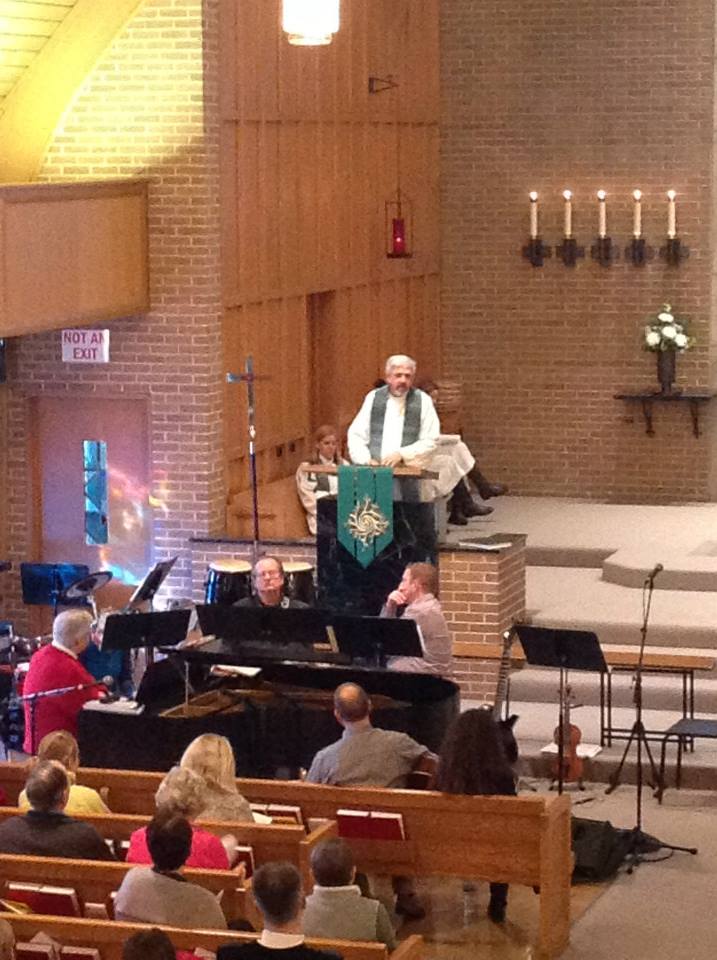
jim at worship
During a recent lunch with a colleague, the conversation turned to a decision they had made at their church to change to a different system of readings for their Sunday morning services. We’re not doing that at the church that I serve. And we had a really rich and stimulating conversation about the matter. It was a reminder to me of the marvelous diversity of the denomination in which I serve, the Evangelical Lutheran Church in America. What an astonishing collection of congregations, individuals, and pastors.

A plethora of Pentecost postings on Facebook last week was another reminder of the rich spectrum of worship practices, pieties, and sensibilities. There are regional differences, ethnic differences, local differences, even differences based on where the pastor went to seminary and the places he or she has been since seminary. I can’t imagine that you could find even two congregations among the almost ten thousand congregations where everything is done precisely the same on any given Sunday morning.

That doesn’t mean to say I don’t have opinions about how things should be done. I do. And I think I have pretty good reasons for most of what we do and why we have made the decisions we have where I serve. I’m even willing to articulate the reasons for those decisions and enter in to conversation around them. Still, it would be arrogant and presumptuous of me to try to prescribe our way as the right way, with the assumption that other ways are the wrong way. Since the beginning of Christianity, worship has been a long process of evolution and it continues to evolve.  It would be better for all of us if we could leave behind the notions of right and wrong about worship practice.

The wonderful diversity of practice also doesn’t mean that everyone gets to do whatever he or she wants, including me. Worship is always about God and who God is and what God has done and how God comes to us in the Gospel of the risen crucified one in whom we have life. Whatever our practices, it should be clear that they point to, and indeed communicate the one gospel, and that our practices become locations for the presence of the risen crucified one and for the faith that comes to birth through him.

That very Gospel becomes also a reforming force for worship, so says Gordon Lathrop in Four Gospels on Sunday.* The very presence of the gospels, and through the gospels the presence of Christ in the assembly, constantly calls us back from worship that is rooted in ourselves, our perceived needs and desires, our drive for control, our knack for falling into the kind of lifeless behavior that aims at nothing more than perpetuating institutions.

In the end, I guess I’m not trying to convince anyone of anything except a couple of very basic suppositions: that there isn’t a right and wrong way to worship, even for those of us anchored to a tradition. And that whatever we do, at the center is the life-giving gospel of the risen crucified One. Really, I think I’m writing this for my own benefit as much as anyone else’s. I need to be reminded constantly in my work as pastor and leader of worship that it’s not about me or my congregation or what we like or don’t like; it’s not about numbers or statistics or coddling the insider or wooing the outsider. It’s about the God who has come near to us in Jesus Christ, who loves us with a love that will not end, and who forms us and shapes us by the presence of the Word in our assembly so that God can send us out, empowered by the Spirit, to enact God’s intentions for the world.

*I’d highly recommend this book for the clergy types out there. While Lathrop is a noted liturgical theologian, it’s clear in this book that he began as a New Testament scholar. His sharp interpretive skills are on keen display in this work, especially as he nuances the different thematic schemas of each of the four gospels and the implications for worship.

Spare Me Your Pious Facebook Sentiments

nogunsI’m going to start by saying that my heart is heavy with yet one more school shooting, this one at a high school in Oregon. It should not be this way. There are way too many of these happening. I was shocked to hear on the NBC Nightly news that there have been 74 school shootings since Sandy Hook. That’s astonishing. I would have guessed half that. Simply shocking.

It’s way too many. No one disagrees with that.

But I’m tired of reading Facebook posts about how upset folks are about this. “Lord, have mercy.” “When will this stop?” “Jesus weeps over this.” “This is beyond tragic.” “When will this end?”, blah, blah, blah.

I don’t disagree with the sentiment.

But it’s too easy. It’s too comfortable. To say something that gives the impression that I care allows me to keep it all at arm’s length.

Just what good do you think it does to post pious platitudes on Facebook? Or do you just feel better doing that?

I don’t really care how much you care. I want to know what you’re doing about it.

In my experience, we are doing precious little in terms of action. (My apologies to those of you who are actually doing something.)

Here are a few suggestions.

  • Get informed. And you might begin by reading James Atwood’s America and Its Guns: A Theological Expose. Atwood is a Presbyterian pastor who has lived what he believes. He has done his research. His work is compelling.
  • Break your silence. Talk about it. You don’t have to be strident. You can simply be conversational. Ask people what they think. Be respectful. Look for opportunities to share a contrary view respectfully.
  • If you are clergy, make some opportunities for people to hear about the issue from a personal standpoint. Schedule an adult forum where the speaker is a victim of gun violence. Foster a discussion with open-ended questions so that there is a safe place for divergent opinions. I believe there is power in the simple act of conversation.
  • Don’t let people tell you that the second amendment is all about the right of personal ownership of guns. I know that’s the mantra. As with the scriptures, the Bill of Rights is a document that gets interpreted. I’m puzzled as to why we have allowed the reactionary voices to define what the second amendment means. It’s been a long time since we have had anything resembling the citizen militias of the late 18th century. In fact, as far as I can tell, it’s been since the late 18th century.
  • I’m not a big fan of preaching about controversial topics from the pulpit. Seems too much like a power thing to me. I get to say what I think and no one else gets a voice. But I am a huge proponent of preaching the values of God’s kingdom and letting people make their decisions. So, preach it, pastors! How God is a God of life and not death. How vengeance belongs to God. How the eye for and eye and a tooth for a tooth ethic has been supplanted. How we are called to care for our neighbor, not fear them.
  • Defy those who would make safety and security the ultimate good. It’s a god that we have been all to ready to worship, even at the expense of our own freedoms and our calling to love our neighbor. Security is not the ultimate good. The whole notion of safety and security and the right to defend ourselves has become a god in American culture and no one is allowed to question it. Question it.

And please, don’t waste your time writing to your congressional representatives. It does no good. For what reason do you think that your voice unaccompanied by any campaign contribution will make a hair’s breadth of a difference in opposition to the millions contributed by the gun lobby?

Honestly, I don’t know what will make a difference. I do know beyond a shadow of a doubt that it will not be the proliferation of platitudes.

By contrast here are things that I know to be true. That  solutions begins by naming the problems, not be feeling bad about them. That powerful things can happen if people have the courage to talk about them. That when people join together in common cause, amazing things can happen. It’s time for us to give up on pious sentiment and lock arms and actually make this evil go away.

In Memoriam: Faye Kiser

kiser

In February, 2013, I wrote a blog post chronically the plight of one of our member couples who, in their 90s, were forced to move from one retirement center to another an hour away from their community, and all because their money was running out. 

Things Don’t Always Work Out

Paul died in April, 2013. Faye died on Memorial Day this year. The following is the sermon I preached at her memorial service yesterday.

As I’ve reflected over the past couple of weeks on Faye and on her life and on what became over the past dozen years a very special and unique relationship between a pastor and a parishioner, what has come to my mind so often is an old liturgical verse that my friend, Mark Mummert, has set to music.

(Sung:)  All of us go down to the dust; yet even at the grave we make our song. Alleluia! Alleluia! Alleluia! Alleluia!!

When I came here in 2002, Faye was already 83 and while still vibrant, still very active, still working, the signs of death and decay had set in. Her beloved Paul had already begun his long struggle with dementia. For Faye, this meant an extra level of care, care about which she was the very model of love and faithfulness. Years later, she faced the reality of leaving their home and independent living. It was an agonizing decision that her head told her was right and her heart resisted with every fiber of its being. In the end, she decided that she and Paul would leave their home on Vine Street and move to The Meadows. It was so hard because Faye loved that house and she loved that neighborhood and she loved her neighbors. And of course, she loved that it was so close to Starbucks.

Then there was Robert’s death to cancer (he died in his mid 60s), a death that hit Faye very hard. Finally came the move to Alden and Paul’s death a little over a year ago.

. . .yet even at the grave, we make our song.

The way Faye lived was almost as if to defy death and to push death away. There was, for instance, that regular, everyday 3:00 ritual of the drive to Starbucks for a cup for coffee and a pastry.

When they moved to The Meadows, Faye could not have her home, but she was determined that their small living room would retain as much of the character of their home as possible. She had brought along a few of their best living room and dining room furniture and it was tastefully adorned with a few sentimental pieces and framed photographs. When I came to visit, she was always dressed up as if the President was visiting. She was a dignified and  classy lady.

Just before the service today, I was saying to Ken (surviving son) how fitting it was that this service is in this room. She loved this place; she loved this room. She would bring Paul to church every Sunday. She loved the services, the music, the preaching, the liturgy, but she loved just as much the opportunity to be around people, to bask in the love and care of those relationships that had been formed and cemented over decades of being a part of the same faith community.

And there was our Thursday morning bible study. In think in the beginning, she brought Paul because he had been the one to relish bible study. When I first came to Faith, there were two Thursday morning bible studies, one for the men and one for the women. If I remember correctly, she used to drop Paul off, do some errands, and then come back an hour later to pick him up. But then when we combined the two groups, she stayed and sat next to Paul, helping him find the passages and so on. At least in the beginning, she was just along for the ride. But that time and that study became extraordinarily important to Faye, and our time together in bible study fostered some very rich and meaningful conversation about God and faith and the church and life in this world and about death and what comes next. These were honest and rich conversations. They became the basis for a deep and meaningful relationship.

Faye was smart; she was strong; she was classy; she was elegant. And she was full of spunk. She loved her Paul with a devotion that I have rarely witnessed. She loved her sons and her daughters-in-law and her grandchildren and extended family. She deeply loved her church and her friends there. How often did I hear stories about the 4th Nighters? She loved Glen Ellyn. She should have worked for the Chamber of Commerce. Maybe part of that was that she loved the roots that she and Paul had put down here. She loved her work and all the relationships she build through that work.

See, even in the midst of all the struggles and the slow approach of the grave, Faye loved life. She was grateful for the good life that she and Paul had had. She simply love life. She loved life as an Easter person would love life. Faye’s song was Alleluia!

We used to talk about death and about what happens after death. Those conversations happened first in the days after Bob’s death and then again after Paul died. Faye could never quite accept the Sunday School notions of heaven with jewel-studded mansions and streets paved with gold. What she took great comfort in was the notion of life. Because she loved life so much, the prospect of a new and rich and eternal life with God brought great comfort. It’s the kind of life described in the lesson we read from the Revelation of John. (One of the texts for the memorial service was Revelation 22:1-5.)

John paints a picture that is far too often taken as a literal description of heaven, a misunderstanding, I believe, of the purpose and intent of that vision. Instead, John gives us a sense of what this new and eternal life will be like. It will be full. It will be refreshing. It will be the laying down of burdens and disappointments and sorrows and regrets and pain. There will be healing, not just for the physical ailments that characterize our long, slow slide into the grave, but healing of all that has ever stood as an obstacle in our relationship with God and with each other. Everything accursed will be no more.

And we will see God. And we will see God. And we will see God.

And we will bask in the everlasting light of Christ, the One who came to show us God. The One who came to bring us God’s love and grace and mercy. The One who knows us as only the Good Shepherd knows us. (The gospel lesson was John 10:11-18.) The One who carried our burdens and our sins to the cross and then buried them in that garden tomb. The One who rose again as the assurance that neither is our grave, neither is Faye’s grave, the end of the story. That One, that One, invites us, as he has invited Faye, to bask in his light and enjoy that life that will not end.

And, so, Death, Grave: you are not the end of the story. Death, Grave: you are not the last word. Alleluia is the end of the story; alleluia is the last word.

(Sung:) All of us go down to the dust, yet even at the grave, we make our song. Alleluia! Alleluia! Alleluia! Alleluia.

Resurrection Community

I have a confession to make. I’ve been preaching every Easter Sunday since the early 90’s and I think I’ve been missing the main point for most of that time. What has been there all along has moved from the background and recently has become glaringly, shockingly obvious.

I think that I have nearly always preached about the implications of Jesus’ resurrection for the individuals sitting before me; it has been some variation on the theme of the implications of Jesus’ resurrection for our own lives. Or, should I say it more precisely, the implications of Jesus’ resurrection for each individual who is sitting in that sanctuary on that Easter Sunday. Occasionally, I’ve highlighted the evangelistic element inherent in the resurrection stories, but even then, I think it has been couched as a call to each person to be one who goes and tells.

What has struck me this time around — and got some mention in my Easter sermon this year — is the unmistakable communal underpinnings of the resurrection accounts. With the exception of John, every evangelist tells of the women going to the tomb together. They went to do their work together. And when they were sent, they were sent to the gathering of disciples, not to individuals. When Jesus walked along the Emmaus road, it was with two disciples. When they recognized Jesus, they immediately returned to Jerusalem to the place where the 11 were gathered, in other words, to the community of Jesus’ followers. Even in John, if you grant that Mary Magdalene went the tomb alone, she didn’t stay alone. She went to tell Peter, and when she finally recognized Jesus, she was given the instruction to go tell the community.

According to John, Thomas wasn’t there when Jesus first appeared to the disciples. Regardless of where Thomas might have been, he doesn’t first encounter Jesus alone, but in community, with the others who had encountered the risen Lord. And as far as I can tell every one of the post-resurrection appearances was to a gathering of disciples.

So, here’s what I think I’ve been allowing to fade into the background all these years. Jesus’ resurrection was just one more piece of the large work he came to do of bringing in God’s reign, of establishing a people for the sake of drawing the world into God’s loving embrace. While there is such a thing as individual salvation, the individual salvation is always the means to the end of fashioning a people. So, when he was raised, Jesus went right back to the work he had been doing, of gathering a people, of building a community, this time a community that could laugh in the face of death, knowing now that even death will not stand in the way of God’s work of redemption and reconciliation.

I have been mired in the grossly individualistic nature of American Christianity for so long that I can’t even see how it affects the way I understanding things and the way I preach. I have been unwittingly supporting an application of the resurrection stories that is not false, but misses the point.

If the big thing that Jesus came to do was to fashion a more inclusive, more universal people of God for the sake of accomplishing God’s intentions for the world, that big thing came to some kind of climax in his resurrection. And the point, it seems to me, was resurrection community, not individual salvation. Individual salvation is not excluded; it’s just not the point.

Listen to how Bernard Lohfink says it:  Baptism. . .obligates us to a new life in the world. Whoever has died with Christ in baptism is born into the new society of the church. . .The Easter expectation in Christian communities means expecting that at every hour the Spirit of Christ will show the community new paths, expecting new doors to open at any moment, counting on it that at any hour the Spirit can transform evil into good, hoping that at every hour the impossible will become possible.” (Jesus of Nazareth: What He Wanted, Who He Was)

For the sake of the world.

Progress Is not the Point

progressI recently returned from a conference whose theme had to do with the marking of time in the church. The conference was good as far as it went, but it felt to me like it lifted out and treated a very, very narrow slice of the who issue — namely how we mark time in the church by the use of a system of weekly readings (the lectionary). It was a bit unsatisfying for me because it left so much on the table.

In North American culture the passing of time has become inextricably linked with the notion of progress. As time passes, things will inevitably get bigger and better. To witness, every four years, the American presidential candidates stand before us and proclaim that the best years of America are ahead of us, thus enforcing the myth of perpetual, eternal progress, often despite the very apparent indicators all around us. It doesn’t take much reflection to grasp the absurdity of that position. No culture in the history of humanity has continued a path of increasing growth and increasing economic well-being into perpetuity. Kingdoms rise and fall; corporations rise and fall. Human persons are born, they grow, and they die.

Even in the church, we have bought into this notion of perpetual progress. There’s this unspoken, but clearly accepted notion that congregations and congregational leaders are somehow failing if the membership numbers, average weekly worship, and budget don’t keep growing. Yet, that is not a realistic expectation. The culture around keeps changing, communities change, congregations themselves go through life cycles; so the notion that as time passes, congregations will continue to progress (with the definition of progress that things keep getting bigger and better) is a patently unrealistic expectation.

When I think about how Jesus talks about the kingdom of God, he talks about growth in a way that somehow seems different than our American notion of progress. It’s hidden, like the yeast and like the seed that germinates in the darkness of the soil, apart from anyone’s ability to see it or notice it. As time passes, what is intended to be accomplished is. The New Testament seems to support the notion that God is moving all things toward their fulfillment in Christ, but I’m suggesting that it’s not the same thing as our cultural notion of progress.

If cycles of birth and death are the way of the created world; if that is how we experience the passing of time with respect to the changing seasons; if that is, in fact, how our very lives are structured, it seems to me that it would be a helpful and refreshing way also to look at our work in congregations and the church, both with respect to our internal work of community building, and in our external work of enacting God’s intentions for the world.

Especially the latter: if things are moving toward telos, fulfillment will be the enactment of God’s vision for the human community and all creation. And that’s what we ought to be working towards, regardless of whether it looks like progress or not.

Why “No Need to Reinvent the Wheel” Is the Wrong Metaphor

squarewheelsA congregation faces a challenge. Someone at the table suggests that others have probably faced the same challenge. The questions go flying. What have they done? What has worked? What is available to us? And someone will probably say nearly these exact words, Let’s contact them. There’s no need to reinvent the wheel.

The metaphor of reinventing the wheel is a misleading image to rely on for moving forward on the challenges of congregational ministry. The wheel is a great gift. I am a bicyclist. I love what I can do and where I can go on two wheels. And I’m thankful nearly every day that the wheel doesn’t need to be reinvented on a regular basis. I’m thankful that I can use the technology of the wheel and let the creativity of the technicians be spent on making my bicycle lighter, more durable, and more comfortable.

But all of those things are technical problems. If a wheel is not durable, then the experts can apply current technology to make it more durable. If the wheel is too small, make it larger. If the hard metal of a wheel makes for a rough ride on the stone of city streets, then find technology that will make it softer.

The problem is that those of us who are working in the church (or any other social institution, for that matter) are not working in a setting where our greatest challenges can be solved by technology. To use the metaphor, it’s not a matter of making the wheel more durable or larger or more comfortable for riding.

We work in places with history. With people. With local and institutional cultures. With present anxieties and past dysfunctions. We work in places that are nothing if not unique. So, technical answers to our deep challenges will not work.

To invoke the no need to reinvent the wheel implies that what worked somewhere else will work here. Maybe. But more likely not. What worked somewhere else worked as a function of the unique people involved, the unique gifts and skills, the unique moment in time, and a whole host of other factors. When it comes to trying to answer the challenges of congregational ministry in our time and our place, the truth is we probably do need to reinvent the wheel in each setting. Meeting the challenges of ministry is so deeply and so profoundly contextual. In each case we do ourselves a disservice to begin by asking the question of what has worked somewhere else.

When I suggest that there’s no need to reinvent the wheel I perpetuate the myth so prominent in North American culture that here are experts and they have the knowledge and I don’t.

I disagree. While I covet the knowledge of experts when it comes to technical problems — like the weight of my bicycle — there is no one who is more expert in your setting than the people who are in that setting. What’s real is that no one knows your context better than you do. You know the people, you know the community, you know the challenges, you know the culture. No one, not even the so called experts know what you know.

And you have people who know your context just as clearly as you do. They are the committed leaders of your congregation. They are the folks who volunteer their time and offer their talents to make sure the congregation is true to its mission. If you’re in the plains of Nebraska, these people are far wiser about the culture and the community of the plains of Nebraska than the experts at the seminary in California. The seminary folks are likely experts at what works in a seminary community. Or in the congregation they served before they landed at the seminary. But you are expert where you are. What’s more, if you consistently invoke the wisdom of the so-called expert, it’s likely to shut down the conversation of the folks who know the context better than any of the academics in the hallowed seminary hallways.

Here might be the most significant down side of invoking the no need to reinvent the wheel mantra. It short circuits, even shuts down, the creativity and imaginations of the folks who know the context best. When leaders can bring people together and challenge them to take responsibility for the ministry and to be accountable to one another for what happens here, people rise to the occasion. When their gifts and their expertise are acknowledged, the solutions emerge. When people are asked what are the possibilities and what they want to create together, avenues and opportunities and even strategies emerge that will be far more effective than some program that worked in a church light years away.

Let me offer one caveat: I’m not suggesting that we don’t tell the stories of our own successes. I think its important for me to know what worked somewhere else and for me to tell others what worked here. But we don’t tell the stories as packaged products that we have any illusions can be imported or exported wholesale. We tell the stories as the ground of hope. When I hear that someone else somewhere else took their challenges head on, imagined a future, and walked successfully into the future, then it gives me hope that we can do the same thing.

So, here’s to hope. Here’s to creativity. Here’s to engaging the people who have the wisdom. Here’s to facing our challenges head on, believing that the gifts of the Spirit are in the people.

“My God, My God, Why Don’t You Just Fix Stuff?”

black

My God, My God, why won’t you just fix stuff?

We have known almost from the beginning of our lives that things are not right. When that kid in second grade looked over Mary Grace’s shoulder, copied the answers, and got the same perfect score she did, we knew it was not right.

When we passed the note in junior high and someone else got in trouble for it, we knew it was not right, and yet we did not say a thing.

I knew every time I rode my bike past that ramshackle house where the migrant workers landed for several weeks every year that people should not have to live like that.

When we figured out how to game the time-clock in that summer job, we knew it was not right; and yet it seemed so easy to justify. “I work hard. I deserve it. No one appreciates what I do around here.”

Now, what we know is not right is so much bigger. It’s hard, O God, not just to bury our heads in the sand. What we see in the world cannot be what you intend for the world. You do not intend for The Ukraine to be the setting for a power play in which people are coerced, controlled, and killed. You do not intend for Syria to be decimated and hundred of thousands of innocent people to be killed. You do not intend so much strife and division in the land where your Son came to bring peace to the world. You do not intend for innocent people to die daily in shoot-outs over turf wars in Chicago neighborhoods only 20 miles from where we live. You do not intend for ferry boat accidents to take the lives of high school students. And on and on and on.

You do not intend that there be so much garbage in the oceans that we can’t distinguish between pieces of trash and pieces of tragedy. You do not intend for there to be places where the air is so foul that living creatures cannot even breathe without becoming sick. You do not intend that we who have perfected the art of excess burden the rest of the world with our garbage.

And we know the pain and heartache of brokenness even closer to home. In our own families and our own lives, you do not intend for beer and bourbon and valium and vicadin to take control of peoples’ lives. You do not intend peoples’ lives to be consumed by cancer or heart disease or MS or ALS or Alzheimer’s.

For our whole lives we have heard that your death on the cross was so that our sins could be forgiven and that we could have the promise of eternal life. We believe that, as far as it goes. Tonight it doesn’t seem to go far enough. What about everything else? What about your promise that you sent your Son to save the world? How is that working? Why does it seem that there is no progress toward the kingdom of peace that you have been promising for years, for centuries, for millennia?

Tonight when we would love to have answers, we see only a cross. We see and witness and reflect on the event of your own Son handed over to sinners just like us to endure cruel torture and eventual death.

And so, tonight, we wonder. What does it all mean? How does it all fit?

Tonight we see no reasonable explanation. Least of all tonight do we see any reasonable explanation. So maybe tonight we are called simply to trust that you are God. That in the death of Jesus, all of our violence, our cruelty, our self-centeredness, and our greed are wrapped up and placed on his shoulders.

Tonight, we feel your absence. We wonder about your silence in the face of all of it. We know it would be easier to find other gods: to keep busy, to make a name for ourselves by doing good work, to perpetuate the fallacy of perfectionism, to honor the needs of our own families and expect that others will take care of themselves, to look at the big problems in the world and convince ourselves that they are not our responsibility and we can do nothing about them.

But then we look at the cross again. We see that in our Lord Jesus’ determination to follow his work and his purpose to the very end, you intended to create something new. You have created a people who would die to themselves and rise again to your larger purposes. So that when we look at Jesus’ broken and dying body, we see somehow, mysteriously, that you do have other intentions than what we see superficially. We see that through the cross you have called us to that larger vision and purpose in and for the world you have created, the world you love beyond description.

Tonight as we stand in the shadow of the cross, you do not stand over us in anger or judgment thereby inducing shame. You do not call us in such a way that overwhelms us. You simply call us to the cross. You call us to kneel before it, even to kiss it. And you promise that in your Son’s death, we are given life. Not life as an end in itself. Life as a means to bring life to this broken, hurting, strife-torn world.

So, dear God. My God. Our God. Accomplish what you will and what you intend. Work in us. Accomplish what you will. We are ready. We are willing. We offer ourselves to you. At the foot of the cross.

(A sort-of sermon at Faith Ev. Lutheran Church in Glen Ellyn, Illinois on Good Friday, April 18, 2014.)

“Jesus Died on the Cross to Save Me from My Sins” Is Not Enough

cross

For those of us who have been around the Christian tradition in North America for any length of time, Good Friday has always been about the sacrifice that Jesus made on the cross to save us. Since I was a child, I have heard the theological soundbite, “Jesus died on the cross to save me from my sins.” And that is true, as far as it goes.

But a faithful reading of the New Testament witness suggests that there was something bigger going on. If Jesus’ entire ministry was about bringing in the reign of God, then what happened on the cross certainly has to be bigger than the personal forgiveness of my sins or anyone else’s. Yes, Jesus healed individuals, and proclaimed to individuals the forgiveness of their sins. I’m not trying to deny or minimize any of that. When he did that, however, those miracles and those proclamations were signs pointing to the larger work that he came to do: to bring in the reign of God. If there was something cosmic going on in Jesus’ life and ministry, then it seems reasonable to believe that something larger was also going on in his death. “For God so loved the world. . .”

For whatever reason (it probably has something to do with what I’ve been reading the past several months) those larger implications of Jesus’ death have filled my reflections, my prayers, and my writing this Holy Week. Those reflections become so hauntingly sharp and troubling as I look around at the world. For instance:

  • In the month or so since the disappearance of the Malaysian jet, the search for debris from the wreckage has brought to our collective consciousness just how filled with garbage the oceans are. Every time we have thought we have located some of the wreckage, it has turned out to be more floating garbage — the tip of the iceberg, so to speak, of what has already sunk and lies at the bottom.
  • We’re witnessing a classic international power-grab in the tension between Russia and the Ukraine.
  • The capsizing of a ferry filled with high school students off the coast of Korea, the increase in kidnapping of girls from boarding schools in Nigeria, the violent last weekend in the City of Chicago, and on and on and on.
  • The civil war in Syria in which the Assad regime seems willing to pay an extraordinarily steep price to maintain their hold on power — the lives of hundreds of thousands of innocents and the decimation of their country.
  • The gradual, and nearly complete, transition in our own country from a democracy to an oligarchy, confirmed by yet one more decision by the U. S. Supreme Court removing the limits on how much individuals can contribute to political campaigns.

For me, these are clearly signs of a broken and fallen world that is not only full of pain and struggle, but is full of evil.

If what Jesus did on the cross did anything at all, it must have something to do with God’s intentions to overcome sin and evil on a grand scale. And I can ’t believe that it’s only eschatological, that it will only come in that grand chase scene at the end of this long movie that we call time. So, what is happening? Does Jesus’ death make any difference for the sin and evil of humanity on this grand scale?

I don’t know that I have any clear answers. What I know and trust and believe — we don’t call that “clear answers,” we call that faith — is that God must have done something in the cross that still remains hidden. And that what Jesus did for me personally on the cross must have something to do with my part in that larger work that God is even now doing.
(And if you’re interested and in the area, that’s exactly what we will be reflecting on this evening at our Good Friday Liturgy of the Cross.)