
Monthly Archives: July 2018

There Is Enough

This sermon was preached at Shepherd of the Bay Lutheran Church in Ellison Bay, Wisconsin on Sunday, July 29. It was based on the lessons for the day, 2 Kings 4:42-44; Psalm 145:10-18; Ephesians 3:14-21; John 6:1-21.
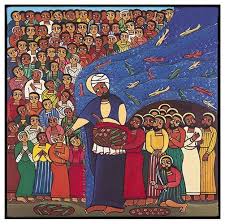
How much is enough?  I heard someone say once that enough is just a little more than what I have. Which is apparently why people who have a perfectly comfortable lifestyle continue to buy lottery tickets, dreaming about what they would do with a whole lot more than what they have. Ask a guitar play how many guitars are enough. Usually it’s one more than they have. How big a boat is enough — just a little bigger than the one you have.

Enough is a tricky thing to think about in a culture that is more about scarcity than enough. Conversations in Washington always give us the impression that we have to cut something in because there isn’t enough money for some this or that. Over the years I’ve talked to many people who have comfortable retirement savings who live their lives in fear that their money will run out before the end of their lives. And of course, I have also known many people who really did not have enough to live on. We are conditioned to think of enough as a zero sum game that is more about scarcity of resources than abundance of resources. If we want to do A, then we can’t do B or C because there isn’t enough to go around. Or if we want to do B, then A will have to be cut and C can’t be done at all.

The narrative of scarcity flies in the face of what we hear in our readings this morning. In the first reading, the prophet Elisha encounters a hungry crowd in the midst of a famine. Someone has some loaves of barley bread, but clearly it’s not enough for everyone. Elisha tells him to distribute the bread anyway, and miraculously, there’s enough to go around. Elisha trusts God; God provides enough and even more to satisfy the need.

In the gospel lesson, the crowds are following Jesus. He has been healing their sick and teaching them. People have discovered that this itinerant rabbi has much to offer. So, Jesus goes up the side of a mountain and sits down with his disciples. But they aren’t alone for very long. The crowds follow him, and Jesus takes the responsibility to make sure the crowds have something to eat. Jesus asks Philip a test question. “Hey, Phil. Help me out here. The crowds are hungry. Where can we get them some lunch?” The first thing Philip does is the calculations. A lot of people. Six months paychecks would not be enough to even get everyone a sandwich and chips. Andrew also recognizes the magnitude of the situation; he doesn’t so much do the calculations as look around to see what’s available. A poor boy has his traveling lunch: a few small loaves of bread and some dried fish. The equivalent of a granola bar and a piece of beef jerky. What’s available is almost a joke in the face of so much need. Andrew asks, “What good is the boy’s picnic lunch in the face of so much need?” I hardly think that Andrew’s question is a serious one. He’s not asking it in the hope that it will do any good, but rather as an indication of how little they have. Of how scarce the resources are.

You know the rest of the story. In the hands of Jesus, scarcity becomes abundance. The poor boy’s lunch becomes provision for thousands.

May I remind you that this is but one story in a large collection of biblical stories that remind us of how things work in God’s kingdom. In the very first story in the bible, creation was filled with abundant provision for people and for all the creatures. When God delivered the Israelites from slavery in Egypt, God provided  manna — bread — for their journey, and everyone had enough. When Isaiah proclaimed what the coming kingdom would be like, he wrote that the Lord would make a feast for all people, a feast of rich food and aged wines, so much wine that the wine would be dripping from the sides of the mountains.

These stories challenge us. They offer a different reality, one that is often hidden behind the narratives of scarcity and zero sum accounting.  What shall we do with this story of a miraculous feeding? What shall we do with this story in a day when church membership is declining and the cost of keeping the church doors open just keeps going up and up and up? What shall we do with this story in a congregation where our offerings are not keeping up with our expenses and we are looking at roof and siding repairs that will cost hundreds of thousands of dollars? What shall we do with this story, dear church, in a community where we know that children go to bed hungry, where families don’t have adequate housing, where too many are living on the edge?

One temptation would be just to shrug our shoulders and say, “Well that’s just the way it is.” And then go merrily on our way, certain that there is never enough to go around.

But this story addresses precisely that temptation. When we say the need is overwhelming and our resources are too meager, Jesus says, “Tell the people to sit down.” Because he’s about to act.

Jesus acts. Jesus acts, not just in the miracle, but in his entire ministry, life, death, and resurrection. Jesus acts and address the hunger that is at the very heart of human life. The gospel writer John here wants to tell us something more important than the miraculous provision for a crowd. His purpose is not to suggest that we believers will be provided for miraculously by a wondrous king. Rather, the point is that Jesus himself is all we need for life.

Did you notice the little chronological clue that John gives us? There’s this little throwaway sentence that almost seems not to have anything to do with anything else in the story. Verse 4:  “Now, the Passover, the feast of the Jews, was at hand.” The Passover is the feast which celebrates the great deliverance. It was the yearly commemoration of the exodus from Egypt, the beginning of the journey from slavery to freedom. God made it possible to share a new life together with God in their midst. By setting the event near the Passover, when the messiah was expected to appear, John uses the story to proclaim that Jesus is the One. He is the One who has come to bring us from slavey to sin and death to freedom and life with God. He has given himself in death so that we might have life.

Because of that, there is enough. There is enough for all. Our cries of “never enough” are never the final answer. Scarcity is a mindset that refuses to acknowledge how God works. In God’s economy, we are simply called to take what we have and offer it to God, and to the world; and to offer not only what we have, but who we are, our very lives. In the hands of Jesus, what we have and who we are will be multiplied and there will be more than enough for everyone. When we feel inadequate, we recall that it is not up to us to solve the world’s problems; God has already given us what we need. Our task is to open our eyes to see what we have been given and then to open our hearts to share with those in need. The answer to the narrative of scarcity is to consider God’s abundant providence. Remember Andrew’s question? “What good is what we have for so many?” It’s the wrong question. The question is, “What have we already been given?” “What do we have?” And then offer it to God believing that God will bless it. Ministry is not just about scrambling to stretch our meager resources, but to offer what we have so that in God’s hands what we have becomes a revelation of God’s amazing grace.

In 1946, a young woman named Agnes Gonxha Bojaxhiu came face to face with the masses of suffering and dying people in Calcutta. Ever heard of her? You probably know her better as Mother Teresa. She experienced a call to serve those suffering the most.  Her knowledge, her wealth, her wisdom were meager in the face of such human need. Armed only with a call, she began the Missionaries of Charity, a small order of 13 members. In the decades to come, the order would grow to thousands of members giving care in scores of orphanages and charity centers in places of dire human need. Love multiplies meager resources and makes a way forward.

And now, very shortly, the One who fed thousands will feed us with his body and blood. He offers himself again for our life. And there is enough for all.
On Being a Prophetic Church

This sermon was preached at Shepherd of the Bay Lutheran Church in Ellison Bay, Wisconsin on Sunday, July 22. It was based on the lessons for the day, Jeremiah 23:1-6; Psalm 23; Ephesians 2:11-22; Mark 6:30-34, 53-56

Last week, I preached about two faithful prophets who spoke a word of truth to power and, as a result placed their lives in danger. I talked about how its hard to be that kind of Christian. Apparently, that sermon sparked quite a bit of conversation. So, I decided to use the theme and a few quotes from that sermon as the basis for our Theology on Tap conversation on Wednesday evening. I opened the conversation with this question, “What does it mean to be a prophetic church and what does that look like? When we had our time for questions at the end, someone asked, “Pastor, what is a prophetic church?” In that moment, I realized that I had mad an unfair assumption. I had been using insider language and needed to be very clear and simple. So, after talking about what it means to be a prophetic church, someone said, “Pastor, I think you have the topic for your next sermon. You need to tell us us what it means to be a prophetic church.”

This morning, our lessons gives us exactly the chance to consider that very question. What does it mean to be a prophetic church?

Jeremiah proclaims a word of judgment to the leaders of the ancient nation of Israel. Throughout Jeremiah’s lifetime, much of the ancient Middle East was in a constant state of warfare. The tiny nations of Israel and Judah often got caught in the machinations of the larger world superpowers. But they were not entirely victims. Jeremiah proclaimed that the nasty plight of Israel and Judah was God’s punishment for their unfaithfulness. In today’s reading, Jeremiah likens the rulers to shepherds who were supposed to care for ALL people as a good shepherd cares for ALL his sheep — to nourish them and to protect them. Here the judgment is placed on rulers who have misused their power and failed shepherd their people. Because the shepherds have failed to visit their flock with vigilance and care, thus ensuring their welfare, God will now visit these shepherds in judgment.

This is one piece of what it means to be a prophetic church. A prophetic church speaks the truth about what it sees going on in the world. A prophetic church stands up for and commits itself to the enactment of God’s vision for the world. God intends a world where all God’s creatures flourish, a world characterized by peace and justice and righteousness.

To speak the truth and stand up for what’s right is not where the prophetic church begins, however. The great Old Testament theologian Walter Brueggemann suggests that the first task of the prophetic church is to lament. That is, to grieve over the shattered vision of what God intends for the world. To lament the structures that were created good but have been coopted for evil. To get a stomach ache over the fact that so many people are not allowed to flourish and to live as God intends. In the gospel lesson, Mark tells us that Jesus had compassion on the crowds because they were stumbling through life as though they were sheep without a shepherd. The Greek word there, the one we translate “had compassion for,” literally means to have a stomach ache over. Jesus had a stomach ache over the plight of the people.

I spent two days this past week at a statewide conference on affordable housing. What I learned is that the challenges we face in Door County in providing decent affordable housing for our working people are not unique to our community. It’s nationwide crisis. I learned how many of the poor are spending over 50% of their income on housing that is often in horrible condition. Matthew Desmond’s powerful book, Evicted, tells the story of what it’s like to be poor and try to find a decent place to live. A prophetic church is heartbroken when it sees economic and social structures that chain the poor in cycles of need that they have little chance of escaping.

A prophetic church is realistic. Jeremiah rightly understood that the king was never going to be able to be that leader that the people so desperately needed. So, he placed his hope in a king that God would provide, a new David, one who would come without the flaws of the first David, one who would fully and perfectly care for his people and protect them from evil. Jeremiah’s hope is a reminder that our salvation and the salvation the world needs will never be realized by any earthly ruler. A prophetic church is starkly realistic about what we can expect from any ruler or any government or institution. We don’t look for more than is possible; we are realists; we understand that salvation is from God. The prophetic church looks to God and to the leader whom God would raise up. That leader is Christ, the One who came as the Good Shepherd. He’s the One Jeremiah was pointing to. He is the One who knows his sheep, the one who looked at the people who were like sheep without a shepherd, and in order to care for them and protect them, gave his life for them. See, if Jesus is Messiah — and we believe that he is — then God’s care, God’s shepherding does not come as we might expect.  It does not come through pursuing war and violence and force — even if the war and violence and force are waged by the good guys. God’s provision and God’s purposes will not be realized as armies and powerful nations defeat their worldly enemies in battle. It comes through God’s offering God’s self in vulnerability and weakness. The great 20th century rabbi and philosopher Abraham Joshua Heschel wrote, “To the prophet. . .God does not reveal himself in abstract absoluteness, but in a personal, intimate relation to the world. He does not simply command and expect obedience; he is also moved and affected by what happens in the world. God is concerned about the world and shares its fate. Indeed, this is the essence of God’s moral nature: his willingness to be involved in the history of humanity.” We have seen this very miracle of divine love, that God is so wiling to be involved in the history of humanity that God has sent God’s son, “born of the virgin Mary, suffered under Pontius Pilate, was crucified, died, and was buried.” The miracle of divine love comes to us and to the world through the Messiah’s crucifixion and resurrection. As the followers of the crucified one die to themselves and rise to new life, they in turn share that self-giving love with the world.

Here’s where we come to the final piece of what it means to be a prophetic church. A prophetic church is involved in the world, becomes the agents of God’s intentions and purposes for the world. The church, individual children of God who have died to themselves in their baptism, and have risen to new life in Christ, collectively become the agents for what God intends in the world. Paul writes in his letter to the Ephesians that in Christ Jesus, we who were once far off from God have been brought near by the blood of Christ. So, we become agents of reconciliation, repairers of the breach, bringing all things into their fullness in Christ Jesus. We become the ones who spread the compassion of Jesus in the dark corners of the world. Compassion is different than pity. When we pity people, we can keep them at arm’s length, never getting our hands dirty and our hearts broken. That’s not what Jesus did. They laid their sick at his feet and his touch healed them. Jesus’ compassion is not distant and it is not condescending; Jesus compassion identifies with the hurting, the burdened, the broken and gets down in the midst of them.  Now he calls us to come out of our places of comfort and distance and identify with, and show solidarity with, the hurting, the burdened, and the broken.

Mark offers two descriptions of those who gathered around Jesus, each as true today as it was  then. In all the comings and goings of our lives, our community and our nation, we are like sheep without a shepherd. Yet in all of it, our Shepherd is present and the crowds around us recognize God in Christ in us, with us, and among us. So, don’t be surprised, dear church, when they rush about and start to bring the sick and the needy to touch Jesus. And we, dear prophetic church, will be there as Christ touches them and heals them through us.

This Is Hard Stuff

This sermon was preached at Shepherd of the Bay Lutheran Church in Ellison Bay, Wisconsin on Sunday, July 15, 2018. It is based on the Revised Common Lectionary lessons for the 8th Sunday after Pentecost, Amos 7:7-15, Ephesians 1:3-14, and Mark 6:14-29.

beheadingofjohn

I know what you’re thinking. How is he going to wrestle a sermon out of the beheading of John the Baptist?  I agree. This is hard stuff, these lessons. Give me a good text full of promises, the kind that brings peace and comfort. Give me a story about the way God loves us, a story full of that unconditional grace.  Give me something that I can walk away from feeling good.

Instead we get a prophet who is sent to speak harsh words of judgment to those in power and another that gets beheaded for answering the same call. This is hard stuff, these lessons.

The beloved John the Baptist is executed by beheading. King Herod, the powerful ruler of Judea, gets stuck in a complicated relationship with John, with his wife, and with his stepdaughter. Herod is at odds with his wife over John the Baptist and at odds with John the Baptist over his wife. When he throws a party, has a few too many, and loves the dancing of his stepdaughter a little too much, he makes a boast to the crowd.  “As payment for her fine dancing, I will give Herodias anything in my kingdom.” His boast brings more than he bargained for. Goaded on by her mother who was, of course, Herod’s wife, the fancy-dancing child, Herodias, asks for John’s head.

Or consider Amos, the farmer, the keeper of the fig trees, not a prophet by vocation, but called to speak to the halls of power. His word of judgment threatens the religious and political establishment of Israel. Amaziah, the priest at Bethel, reports to King Jereboam that Amos has conspired against him and prophesied his death. For being true to his calling to follow the Lord, Amos is branded a threat to homeland security.

What binds John and Amos together is their mutual commitment to doing what God asked of them without qualification, without reservation, without question. Even when it meant going against the cultural grain, against popular opinion, and even when it had to potential to bring them great harm.

This is hard stuff, these lessons. It’s hard to be that kind of Christian, to be that kind of church. It’s easier and safer just to accept the status quo, to look around and say, well, that’s just the way it is, and to excuse ourselves — the problems are too big, the power too great, and like they say, you can’t fight city hall.

Will Willimon is a contemporary theologian who has written a ton about the church in these days. He used to be the Dean of the Chapel at Duke University and then went on to serve as a bishop in the Methodist Church. As bishop he used to get around to visit a lot of congregations. He’d often ask folks what they thought the work of the church is and what they thought the work of the pastor is. Invariably, people would answer that the purpose of the church is directed at their own needs — to bring them comfort, to help them in their struggles, to let them know they’re loved and valuable.

That’s what we want. And knowing what some of you are going through, it seems perfectly logical to proclaim a word of comfort and leave it at that. It’s a whole lot easier than speaking out and taking action against all that rails against God’s justice and God’s righteousness, against God’s intentions. This is hard stuff, these lessons.

They’re hard, in part, because they challenge us against our own self-absorption and complacency.

Self-absorption is a cruel and sinful disease. The relative prosperity and prestige with which many of us are surrounded can be crippling to our relationship with God. In this beautiful room, we can begin to think that our ministry begins and ends here. In our lovely homes with their beautiful Door County address, we can begin to believe that it is we who have provided for ourselves. In the vast variety and abundance of this world, we can begin to believe that somehow it all belongs to us. And we can so easily forget that we are called to be a part of God’s people for the sake of God’s intentions and purposes.

Complacency is the disease of sleep-walking through life, of believing that nothing I could do would ever matter in the big picture. Complacency is to sing “Jesus love me, this I know” without ever getting to the part which asks, so where would he have me go.

That’s why we need a savior. Not a cheerleader or a pep-talk, but a savior. One who can free us from our bondage to self-absorption and complacency. John’s execution is a foreshadowing of the death that Jesus would face at the hands of the misguided powers of empire and church. His body would be nailed to a tree and placed into a tomb. In his body, he would carry our own self-absorption and bury it. His death and resurrection bring our own dying to self and rising to new life in God. God has come among us in Jesus; God has delivered us from the tyranny of the self and freed us to live for God and for others. What God has made us to be is described in poetic paeans of praise in the lesson from Ephesians. Listen:  God has blessed us with every spiritual blessing; God has made us holy and blameless; God has adopted us as God’s daughters and sons and provided us redemption, the forgiveness of our sins according to the richness of his grace.

In this grace, we have been predestined for works, so that our lives and our work are part of the purposes of the One who has called us. It’s his power, not ours, that enlivens our work as church. We are not just do-gooders; we are the body of Christ through whom God intends to work. Viewed apart from the eyes of faith, we have nothing to offer when speaking to power or facing the big problems of our community and our world. But wrapped in the death and resurrection of Christ, we offer ourselves for God’s use. We are called to be a threat to the worldly powers that perpetuate the status quo of injustices and oppression. Like Amos, we are amateur prophets, injecting tension into the status quo because we know the way thing are is not the way things should be. 

The great rabbi and philosopher, Abraham Joshua Heschel wrote that the office of the prophet in Israel was to remind the king that his sovereignty was limited, that over any pronouncements that the king might make, the pronouncements of the Lord and the justice of the Lord have the final say. When our sole focus is on our own need and our own place in the world, we lose sight of where are are placed in the greater creation and who has places us here. We already know we are cherished and will be cared for; from that vantage point, we keep our eyes peeled for the surprising ways God may be at work in the world.

Ordinary people like us do God’s work and enact God’s vision of the kingdom. In 1976, Millard and Linda Fuller worked with Clarence Jordan and began a project to build 42 homes for low income families outside Americus, Georgia. Since then Habitat for Humanity has built over one million homes, touching the lives of five million people. Lutheran Social Services of Wisconsin and Upper Michigan Illinois was begun in 1882 when Pr. E.J. Homme opened an orphanage in Wittenberg, Wisconsin with a vision to take care of orphaned children. Today, LSS touches the lives of over 100,00 people through 263 programs at 188 sites in 115 communities throughout Wisconsin and Upper Michigan. A weeks ago, 30,000 ELCA youth and adults descended on Houston, a city ravaged last summer by Hurricane Harvey. High school students — teens — touched a city with the love of Christ.

This is hard stuff, these lessons. They are a reminder and an encouragement that our lives are not our own. When I bless children at the communion table, I tell them, “You belong to Jesus.” Christ has made a claim on you for the sake of the world. We gather in this room to be sent out — as prophets, as the hands and feet of Jesus. No one is exempt. All are called. As the Lord said to Amos, so the Lord says to you, “Go.”