Monthly Archives: October 2015

When the Newtown, Connecticut Police Chief Stepped to the Podium. . .

donotstandidlyby. . .the tears began running down my face. It wasn’t so much what he said. It was seeing in flesh and blood a man who had seen far more of the consequences of senseless violence than anyone should ever have to see; it was seeing in the lines on his face the toll that such a tragedy had taken. And it was the deep sadness that the senseless loss of life from gun violence goes on because we have not decided yet that enough is enough.

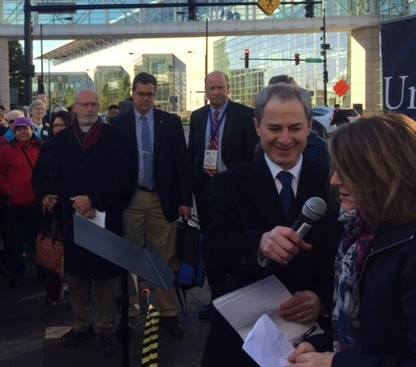
On Monday, I was at McCormick Place, the huge convention center complex in downtown Chicago, for a rally and press conference sponsored by Metro IAF, the midwest/east coast version of the community organizing affiliate that our congregation works with. For a couple of years now, Metro IAF has been working on a broad strategy directed at gun safety, Do Not Stand Idly By.

The rally was timed to coincide with the 2015 conference and exhibition of the International Association of Chiefs of Police. About 200 citizens mostly from Chicago and surrounding suburbs stood at the edge of the street stood across the street from the hall where the conference was being held. Inside the exhibition hall, major firearm manufacturers were displaying their wares, competing against one another for more sales to the government entities around the world that purchase these essential tools for law enforcement.

The IAF’s strategy is to leverage the buying power of government agencies at every level to force gun manufacturers to begin manufacturing their guns with smart technology that would allow only the owner of the gun to fire the gun. The technology is already available. One approach uses fingerprint recognition technology, similar to the security apparatus on the current generation of iPhones. Another approach requires a bracelet to be worn on the shooting hand before the gun will fire. (In addition to the website linked above, you can read more about the strategy in this Washington Post article.)

We heard personal stories that illustrate why the need for action is so urgent. DiAne Boese of Oak Park told of how as 4 year old child, she was a gunshot victim. She was playing in her yard with the child from next door who had found a gun at home and thought it was a toy. He pointed it at her head and pulled the trigger. The gun was loaded and went off, sending a bullet through her head. She spent most of her childhood enduring a series of surgeries and treatments attempting to repair that damage from that tragic accident.

A pastor from Bridgeport, Connecticut told of a promising 15 year old member of his congregation who got caught in the cross-fire of a gang-related shooting. “I have buried too many young people who have died before they had a chance to live,” he said.

Every day 150 Americans are shot and 83 (including eight children) are killed by firearms. Every year an average of 30,000 Americans die from firearms. A 2009 study at the Yale School of Medicine showed that over 7,000 children are hospitalized or killed due to gun violence every year. An additional 3,000 children die from gun injuries before making it to the hospital, bringing the total number of injured or killed adolescents to 10,000 each year. Why are we ready to accept such carnage? Why do we think it’s acceptable?

Attending the rally were police chiefs from Palatine, Illinois, Bridgeport, Connecticut, and Newtown, a few of the dozens of chiefs of police around the country who are endorsing this effort. When Chief Kehoe from Newtown spoke, his heartfelt plea was to take action. He is supporting this approach that provides a way forward that ought to find support across the political spectrum. It is neither pro- nor anti-gun. It’s a reasonable approach to gun safety and reducing the number of tragic shooting deaths. “With people like you involved and working, we can do this,” Kehoe said.

Decades ago, as a society we decided that too many people were dying in automobile accidents; we forced auto manufacturers to install seatbelts. Then we made laws that made it a ticketable offense not to wear a seatbelt. When that wasn’t enough, we forced auto manufacturers to install lifesaving air bags. Auto deaths have been reduced dramatically.  When we decided too many children were dying accidentally in baby cribs (a tiny fraction of the number of children killed by guns), we forced the manufacturers of baby furniture to change their design to reduce the chance that a baby would get stuck and die in the crib. The list goes on and on and on of instances in which the federal government has forced manufacturers of a wide spectrum of consumer goods to make changes that make those products safer.

I’m not so naive as to draw a straight line of causation between easy access to guns and the epidemic of gun violence in this country. That epidemic has a tangled and complicated web of causation. Still, it’s reasonable to hold that easy access to guns is part of the equation and something that we can easily do something about, if only we muster the communal will to do so. And it’s about time.

Perfectionism and the Topsy-Turvy Gospel

perfect familyLet me introduce you to Glen and Glenda from Glen Ellyn:  They are good people. No, I mean it. Glen supervises the regional marketing team for that company that everyone knows and has steadily and consistently been promoted. Glenda is a CPA and works for a small accounting firm doing small business taxes. Their kids are wonderful! Gary plays soccer and baseball, and is now taking trumpet lessons. Gertie has just started field hockey and loves her ballet lessons. They are both in scouts and the children’s choir at church. Glen helps coach soccer and baseball, and is the chair of the Worship Team at church. Glen and Glenda think it’s important to help the less fortunate, so they volunteer at PADS once a month and they have decided this year to help organize the fifth grade classes to do a food drive for the Glen Ellyn Food Pantry.

You would love their house. Glenda has decorated the living room spectacularly; it looks like the cover of a magazine. And not to be outdone by the neighbors, Glen has manicured his lawn to Wrigley Field specifications. It looks perfect. Every Friday afternoon he even cuts the front yard twice so that it has that crosshatched look to it. Not a weed is to be found in that lawn.

These are good people. They are model citizens. They are the kind of people, we might say, that if there were more of them, the world would be a better place.

These good people are tired. They are stressed. They complain about having no time, of being pulled in a thousand directions; they feel consumed and overwhelmed by the pressures around them. They are living, but it’s not much of a life. How can they be doing so much and feel so empty?

We are socially conditioned to be good people. In fact, I think we are socially conditioned to be perfect people.  This perfectionist strain means we have to do everything right — house, marriage, parenting, work, community involvement, church. Now, of course, no one can do that, and in our minds, we know it’s impossible, yet in our guts, we somehow try. So we refuse to make choices, thinking that if I say no to something, there is something I might miss. Because so much is possible, so much must be necessary. Trying to do everything and trying to do everything perfectly is sucking the life out of us.

Imagine Glen and Glenda taking that trip to Italy that they’ve always wanted to take. Two days in Rome, and they get on one of those touring buses and they see everything. The next morning it’s off to Tuscany where they take a quick tour of Assisi in the morning and a vineyard in the afternoon. The next morning it’s off to Florence, where they rush through the art museum in the morning and the cathedral and the shopping district in the afternoon. The next morning it’s off to Venice, where they go see the glassblowers in the morning and a gondolier ride in the afternoon and a romantic dinner along the canals in the evening. Another day split between the leaning tower of Pisa and Cinque Terre, then a day in the lakes region, a day hiking in the Italian Alps and then a day taking the train back to Rome where they fly out the next morning. When they get back to Glen Ellyn, they’re so tired, they need a vacation. They have a photograph of everything, but they have seen nothing.

Does it sometimes seem like that’s how we live?

It recalls for me a story about a rich man who came to Jesus. “Good Teacher, what must I do to be saved?”  The man was a good man. He really was. He had kept the commandments since his youth. He had worked hard. He was a exemplary citizen and a model member of his local synagogue. Infected, perhaps, with that perfectionist virus? How could he do so much and still feel so empty?

“Go. Sell what you have an give it to the poor,” Jesus said. Jesus confronted him with the impossibility his perfectionism. Called his bluff. Forced a choice: the endless and elusive striving to be a good person. Or something different. A life that’s not an achievement, but a gift.

We are not called to be good people. The gospel of Jesus calls us into the circle of God’s love, a love that flows to us in Jesus’ death and resurrection. In Christ we are made new, now, and again each morning. God makes us good people. Goodness is not an achievement. Perfection is neither a requirement nor a goal. In this new kingdom, our lives are not defined by what we achieve. We are loved, and because we are loved, we serve.

This topsy-turvy Gospel and this upside down kingdom of God call us to live differently. Receive the gift. Make some choices. Pare it down to what’s essential. Do your part. Not everything. Your part.

Wouldn’t that be life-giving? Wouldn’t that feel like freedom?

On Living in Fear. Or Not.

lockdowndrill.jpgLast week, I made the last of my confirmation visits to our seventh grade students, the ones entering our two-year confirmation process. Most of the visit is about just getting to know the students, what they are interested in, what school is like for them, what they did over the summer. When I asked about school and about how the year had started for him, the student I was visiting stopped me and suddenly became much more animated. He began to recount what had happened that very day. He told about a drill they had to go through to help prepare them for what might happen if a shooter came into their school.

They were told over the intercom that the school was on lockdown and that they should initiate the protocol for an emergency involving an armed intruder to the school. During the first week of school, they had been told what to do; they knew the drill, literally. So, the entire class of students huddled in a corner of the room away from the door and windows and the teacher locked the classroom door.

They didn’t know whether or not it was a drill. They didn’t know that it wasn’t, and the student said they thought it probably was, but they weren’t told whether it was or not. He talked about the wave of fear that overcame the huddled group of students when someone came to their classroom door, unlocked it and stepped in. It was someone the student hadn’t seen before, and his first thought was that this was real and someone had just entered their classroom to harm them.

As it turned out, it was a new custodian who apparently hadn’t gotten the word about the drill and was just going about his work of emptying trash cans. ‘

This all happened last Thursday, ironically, the same day that the mass shooting happened at Umpqua Community College in Roseburg, Oregon. Of course, the students didn’t know any of that, and I suppose it doesn’t matter. Only one of those strange, haunting coincidences.

As I sat there listening to this seventh grade student — a bright, well-adjusted, very gifted and articulate student who is growing up in a stable family with two parents who love him and provide for him — my heart sank.

I get the idea of safety drills. No one ever knows what is going to happen and practicing what to do if the bad stuff happens makes some sense. I grew up on the plains of western Nebraska, an area where tornadoes were not uncommon; we went through tornado drills and fire drills. We always knew when they were drills and when they weren’t. We’d do our thing of getting out of the school for a fire drill, or getting down under our desks for the tornado drill, and then it would be over and we’d get back to our business.

But I never worried about someone coming into my school intent on shooting us. Now, our children worry about that. And in the case of the drill fail at a local middle school last Thursday, we had a group of students who for a split second thought that their nightmares were coming true.

I think it’s bad enough that so many lives are ending too quickly and too violently because of gun violence in this country. I think it’s horrifying that we witness so many mass shootings.

But think about this. Aside from the massive, senseless loss of life, we are raising a generation of children who are learning to be afraid. We are teaching them to be afraid of someone coming into their school to shoot them, that we have to worry about terrorism every time we get on an airplane, and that people who look different are to be distrusted because they could be terrorists. The pervasive culture of fear, especially for our children, is among  the most tragic consequences of all.

For now, let me state the obvious, and something which requires a choice for each of us: we don’t have to live in fear.  Parents, we don’t have to live in fear. Let your kids know we don’t have to live in fear. There is a big, beautiful, awe-inspiring world out there, full of wonder and mystery, full of abundance and beauty. The bogeyman under the bed wins if we let him. We can choose to embrace what is good and beautiful about life, about community, about the people around us, the ones we know and the ones we don’t. We can live with curiosity and gratitude. Joy is possible. We can live hopefully, knowing that together we can curb the impulses to fear and the violence and hatred that engenders it. Choosing to see the good and dwell on it is the antidote to living in fear.

I get my 35 middle school students for 90 minutes a week, and I’m determined that this is going to be a drumbeat with them. While there are scary things out there — there always have been — we don’t have to live in fear. I’m not about to let the madness draw my attention away from that.

On Leaders Who Disappoint and How Real Change Happens

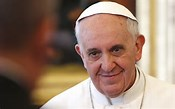
francis.jpgIn his speech before Congress Pope Francis managed to rise above the fray.  With no histrionics, he spoke directly and simply, yet profoundly. The speech surprised me; he managed to address the divisive issues that have become occasions for the two parties to shout across the aisle at each other. He spoke in such a way that all of us in this divided house could listen.

Not forty-eight hours later came the report that Pope Francis met with Kim Davis, the Rowan County, Kentucky county clerk who has refused to issue marriage licenses to anyone as a way to make a stand for her opposition to gay marriage. Since the news came out, there have been as many interpretations of that visit as there are positions to take. And regardless of the Pope’s awareness and degree of complicity, that meeting has enormous symbolism. I’m not ready to make a personal judgment; however, for the symbolic impact of that visit, I am disappointed.

It’s disappointing to me because Kim Davis is the icon for a brand of Christianity that is disdainful to me. It’s a brand of Christianity that makes our faith more about the rules than about relationship, and especially rules about sex. I wish we could just get off of that. Every time I turn around, someone else is reinforcing the ridiculous notion that the Christianity is mostly about rules, and we’re concerned about the sex rules more than any others. It’s maddening.

While I’m disappointed that the meeting happened, I’m not losing much sleep over it. While I was impressed with the pope’s speech before Congress, I never went over the moon about it. He represents a change of tone from the Vatican, but perhaps not much else. A friend, who is a good Roman Catholic and an astute observer of all things Catholic, often reminds me that nothing of substance has changed.

Leaders inspire us. Leaders disappoint us. Sometimes leaders just downright make us mad. Just ask the members of my congregation.

The whole back and forth saga of the pope’s visit to America — and I have to imagine that it feels the same for both conservatives and progressives — is a reminder that while leaders have influence, real change is not going to happen from the top down. Bernie Sanders (another leader who inspires me and who I’m sure will disappoint me and enrage me) reminded students at the University of Chicago this week that real change, deep change never happens from the top down. It always happens from the bottom up, beginning at the margins and moving towards the center.

Earlier this week, I facilitated a bible study with a group of about 20 women. Part of our study was about the gospel lesson for this coming Sunday (Mark 10:2-16, if you want to read it), a difficult text where Jesus pits scripture against scripture. On the one hand he holds up the inviolability of the marriage covenant; on the other, he cites the Mosaic law which allows for divorce in certain occasions, a legal move which was only available to the man.

The study led us into conversation about marriage, about the difficulty and hard work of relationships, especially relationships like marriage. And it led us into the tall grass of a conversation about same sex marriage.

I fully celebrate that our gay and lesbian brothers and sisters can now be legally married. The sealing of their covenantal love is just as holy and just as wonderful a relationship and covenant as heterosexual marriage. I also know that not everyone in the congregation I serve shares that opinion.

The conversation we had yesterday would not have happened a dozen years ago in this place. Partially, it’s a sign of the rapid change that has happened in the larger society.

But I’d like to think that the priority we’ve placed on having deep and meaningful conversation in our congregation has contributed to the change. Over the past dozen years, we have created space for lots of conversations about lots of things. Forty or fifty people meet every week for bible study. We host conversations about the intersection of faith and life. We talk a lot these days about the rapid changes in our society and their impact on the church. Every council and team meeting includes time for conversation and prayer. At any given moment in time several groups, including our staff, are reading and discussing a book together. We have hosted authors to lead us in conversation about things that matter. When space is created for people to listen to one another, space is also created for the Spirit to soften our hearts.

It’s not the kind of change that happens rapidly; it’s not always even visible. But it’s the kind of work that forms and shapes us as the body of Christ, forming us as individuals, and more importantly, forming us as a corporate body, so that our thoughts, words, and deeds are in greater alignment with the work God is doing in the world, so that we are participating with God in bringing about the kingdom.