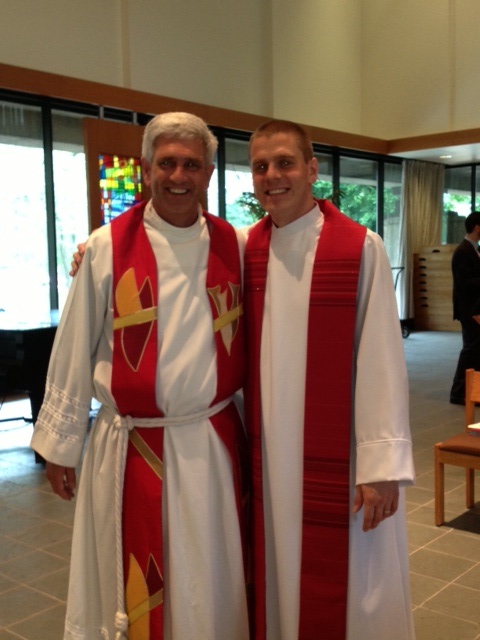
Below is the written copy of a sermon I preached at the ordination service for Nate Sutton on Saturday, June 29 at Augustana Chapel on the campus of Lutheran School of Theology at Chicago. Nate was the 2011-2012 intern at Faith. He has been called to serve as Associate Pastor at Sharon Lutheran Church in Grand Forks, North Dakota. Receiving such gifted young leaders into the church’s ministry is a sign of God’s rich and gracious provision for the church and her mission. It was an honor to be a part of the celebration. The sermon is based on the gospel lesson for the Feast of Saints Peter and Paul, John 21:15-19
Today is the day of the ordination of Nate Sutton and the Feast Day of Saints Peter and Paul. They share this feast day because tradition holds they were both martyred in Rome on this day c. 64 c.e., although the time and place of their deaths and burials is an unsettled question. In many ways, Peter and Paul could not have been more different. However, one similarity is that at their call, they are both given a new name. Peter is the name given to Simon, and Paul was formerly Saul. So, in keeping with tradition, I’d like to propose that on this day, Nate, we change your name to Mary, thus giving us the rare opportunity to celebrate the Feast of Peter, Paul, and Mary.
Seriously, there is so much I want to tell you today, Nate. I want to tell you what it will be like, what to do, what not to do, what to look for and what to look out for. As your internship supervisor I had a whole year to do that and yet it wasnt enough! However, you have not asked me for advice; you have asked me to preach. So, a sermon on this gospel lesson will have to suffice.
You heard the story of one of the several post-resurrection appearances in John’s gospel. We got just a snippet, the tail end of a longer story where Jesus meets his disciples as they are back at work. He leads them to a miraculous, overwhelming catch of fish, and then fixes a campfire breakfast for them on the beach. After breakfast Jesus addresses Peter directly and individually, though not necessarily privately. Three times he asks him two versions of the same question , “Simon, son of John, do you love me more than these?” and then, simply, “Simon, son of John, do you love me?”
Each time, Peter answers, “Yes, Lord, you know that I love you,” the last time becoming impatient, even indignant, “Yes, yes, you know that I do, what do you want me to say?”
Of course, you students of Greek, will know that actually Jesus doesn’t ask exactly the same question. The first two times, he asks, “Do you love me, agapeo, unconditionally, purely, with the same love that the Father loves me and with the love that I love you?” Peter’s answer doesn’t exactly match: “Yes, Lord, I love you, phileo, a brotherly love, a mutual affection, deep, close friendship.” Only the last time do their verbs match when Jesus asks, Peter, not do you agapeo me, but do you phileo me.
“Do you love me, Nate?” “Do you love me Betty and Carl and Michelle and Robert and Amy?” No matter how we answer that, we know that our love for God is always conditioned by our condition — our brokenness, our fallenness, our ego, our need for attention, in short, our sin. Even what we do in Jesus’ name, for the sake of ministry, in answer of the call is tinged by the same fallenness. Sometimes I wonder why I do this work of being a pastor. Is it because of what I get out of it or because of the call of God? Why do I stand in the pulpit and preach, because I like being the center of attention or because there’s a fire burning in my bones?
Our love for God is always colored by our sin and brokenness. Peter’s love for Jesus was obviously imperfect, imperfect to the point of denial. Perhaps Peter was unwilling to go beyond committing to a brotherly love, knowing better than anyone what had transpired in the past several days.
Yet the call comes. The gracious call of our baptism, and now for you, Nate, the church’s gracious call setting you aside for ordained ministry. Jesus’ call through the church does not demand a perfect love on your part. It does not demand that you have fully purified your motives. It does not demand that you have attained a certain measure of love that sets you apart. It comes. By grace. It comes from God who has loved you, agapeo, unconditionally, decidedly, persistently, eternally. And in that love, you will do the work of ministry.
Speaking of the work of ministry. In each question and answer exchange, Jesus gives a charge. That charge comes in three different forms: feed my lambs, tend my sheep, and feed my sheep.
Ministry is feeding. It is sharing the Word; it is teaching and forming faith; it is administering the life-giving sacraments; it is visiting the sick and the imprisoned; it is comforting the bereaved and troubled.
Ministry is tending. Tending evokes some of the more tension-filled parts of ministry that may not be as pleasant, but are nevertheless necessary. Speaking to the context of the congregation of God’s people to whom you have been called of how brokenness and self-centeredness plays out. Saying that hard word about complicity in oppression about keeping the poor at arms’ length. Pointing out how we have turned our backs on the Crucified One for the sake of the gods of the economy.
Ministry is relating. You know this, Nate. You have learned and practiced and committed yourself to this way of doing ministry. Ministry is not just knowing the names of the sheep, but knowing their story. Sitting down with them and asking the pointed questions, knowing what they are concerned about and what they are energized about so that the work of ministry is done by a true community and not by a collection of individuals. And it is relational ministry with those who may not even be acknowledged members of the flock, but are, nonetheless, sheep whom the shepherd loves.
After this exchange between Jesus and Peter, the text takes a decidedly negative turn. Jesus predicts a life of suffering and a difficult death. Jesus does not candy-coat his call to Peter.
I’ve wondered what to think about that and what to say about that on this occasion of your ordination. Of course, it was an option just to ignore it. After all, we rarely preach on every section of every text in every sermon. Yet, there is something important here.
In calling Peter, Jesus established the expectation that there would be suffering. According to church tradition, Peter met a cruel and violent death by crucifixion. Though it’s unlikely that your ministry will follow that precise pattern, I can virtually guarantee that there will be times of pain and discouragement, times when you feel abandoned by God and by the church. You have been nurtured in Mother Church, and today the whole church is shining its lovely and encouraging face on you; but it will not always be like that. Mother Church can be nurturing and loving, and she can also be harsh and cruel.
Strangely enough I say, embrace those times. Contrary to what the world says, embrace those times of suffering and discouragement and failure and pain. The world says that we should avoid suffering at all cost. But suffering is an inevitable part of life. In suffering and pain and discouragement, we learn the most valuable lessons. As you know, Nate, there are parts of my ministry that have been very painful. I would not wish those things on you or anyone. Yet as I reflect on my own journey, those have been times of deep growth — in faith, in my vocation as pastor, and in my connection to community. Why should I be surprised? It’s biblical. It’s the pattern that has been set. We follow a crucified savior. Not only in the lesson we read today that comes from the end of Paul’s life, but permeating his entire epistolary corpus is this theme that God’s grace worked through Paul’s own suffering. In suffering, our wisdom is refined, our skills are honed, and most importantly, we come to realize that the sufficiency for ministry is from God and not from us. We do, after all, have this treasure in jars of clay.
Nate, you are an extraordinarily gifted young man. Bishop, you will discover what a gem your synod has received, Dave and Ardis and all of your fellow members from Sharon Church in Grand Forks, you will quickly discover what a blessing this young pastor will be to you and your community. I have every expectation that you will become an exceptional leader in the church. But the ministry that you do will not be rooted in your gifts. It will be rooted in the love of the savior that calls you in spite of your imperfect love and imperfect motives. It will be rooted in the promises of God for the people you serve and for all of creation. It will be rooted in the death and resurrection of Jesus the Christ and of God’s intention for the Spirit to be moving in the church and in the world. It will be rooted in the foolish proclamation of the Word and of God’s foolish intention to work God’s grace through water and wine and bread. Your gifts will merely — and I use that word very intentionally — merely the vessels through which God’s work gets done. In short, your call and ministry flow from grace.
After this, Jesus said to him, “Follow me.”

 James K. Honig